The fratarakas were local Persian rulers of Persis, the Persian homeland around Persepolis in today’s Fars province, in the centuries after Alexander. They governed under Seleucid and later Parthian overlords, struck their own silver coins with Aramaic legends, and dressed in the style of Achaemenid satraps. Their successors, the kings of Persis, ruled until the 3rd century CE, when one of them, Ardashir, founded the Sasanian Empire.
| Region | Persis (Pârs, modern Fars), around Persepolis and Istakhr |
|---|---|
| Dates | 3rd to 2nd century BCE (exact dates debated); kings of Persis until c. 224 CE |
| Known rulers | Baydad, Ardakhshir I, Vahbarz (Oborzos), Vadfradad I and II, then Darev I as “king” |
| Title on coins | Aramaic prtrk’ zy ‘lhy’, often translated “frataraka of the gods” |
| Main evidence | Coins; a few lines in Greek writers |
Persis after Alexander
Persis was the land of Cyrus and Darius, with Pasargadae, Persepolis and the royal tombs. Alexander burned the Persepolis palaces and appointed governors there; the Macedonian Peucestas, who learned Persian, was popular with the Persians, and when Antigonus removed him in 316 BCE a leading Persian who protested was executed (see Alexander’s death and the wars of the successors). Under the Seleucids, Persis was a province with Greek settlements, among them a city called Antioch in Persis. But the Persian nobility was still there, and so were the fire cults and the memory of the old kings.
Almost nothing about the fratarakas is told in written history. Their story has been rebuilt from their coins, which form a long series from the 3rd or 2nd century BCE onward.
What “frataraka” means
The word is Old Iranian and means something like “the one in front”, a leader or governor. In Achaemenid Aramaic documents from Egypt it is used for an official below the satrap. On the coins of Persis it appears in the phrase prtrk’ zy ‘lhy’, usually translated “frataraka of the gods”. Scholars disagree about what that implied: a governor ruling on behalf of the gods, a ruler with a religious role, or simply a local lord avoiding the title “king” while a foreign king held power. The later coins replace it with mlk, “king”.
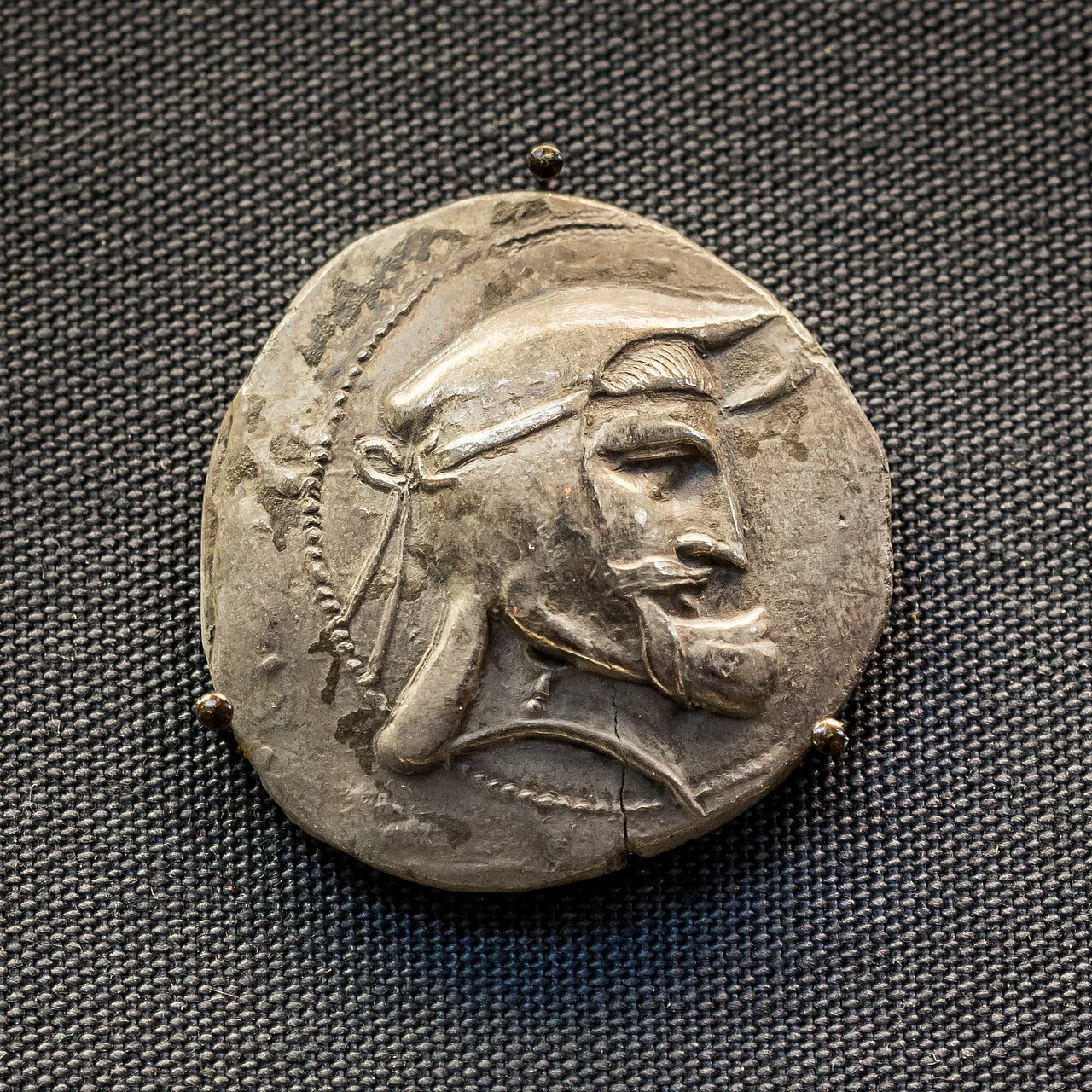

The coins: a Persian image of kingship
The fratarakas’ coins are silver tetradrachms and smaller pieces on the Seleucid weight standard, but their images look back to the Achaemenids. The ruler wears a soft tiara with flaps, the headdress of Persian satraps, sometimes with a Hellenistic diadem tied over it. On the reverse he often stands in front of a building, usually read as a fire temple or tower, with a fire altar and a standard; from about the time of Vahbarz or Vadfradad I a winged figure, perhaps Ahura Mazda or the royal glory (khvarenah), hovers above. Some types show the ruler seated on a throne, like the Achaemenid kings on the Persepolis reliefs a few kilometres away.
The legends are in Aramaic script, the old administrative script of the Persian Empire, not in Greek. That choice alone is striking in a Hellenistic kingdom. The coins announce a Persian ruler, devoted to Persian gods, in a Persian landscape.
When did they rule
The date of the fratarakas is one of the most debated problems in Hellenistic Iranian history.
- An early date. Some numismatists place the first fratarakas soon after 300 BCE, under Seleucus I or Antiochus I, from coin hoards and from coins struck over older Seleucid ones.
- A later date. Michael Alram and Josef Wiesehöfer argued for a date in the 2nd century BCE, after Antiochus III’s defeat by Rome, when Seleucid power in Iran was weakening.
Recent work leans toward a long series that started in the 3rd century, with the rulers at first acting as Seleucid governors and becoming more independent later. Either way, Antiochus III still had a Greek city in Persis around 205 BCE, and a Greek inscription at Bisotun shows a Seleucid governor of the upper satrapies as late as 148 BCE.
Vahbarz and the 3,000 settlers
One of the few stories about a frataraka comes from Polyaenus, a 2nd-century CE writer who collected military tricks. He tells of a Persian ruler he calls Oborzos, usually identified with Vahbarz of the coins, who learned that about 3,000 Macedonian military settlers were plotting against him. He had them billeted one by one in Persian households and killed in a single night. If the story is reliable, it shows a Persian ruler acting independently against the Seleucid colonists, and a real hostility between some Persians and the settlers.
Kings of Persis under the Parthians
When the Parthian king Mithridates I took over western Iran in the 140s BCE, he left the Persian dynasts in office as vassal kings. From Darev I onward the coins call the ruler “king” (mlk). The Greek geographer Strabo, writing around the turn of the era, notes that the Persians had their own kings, who were subject to other kings: once to the Macedonians, now to the Parthians. Their coins carry names that recall the old empire, such as Darev (Darius), Ardakhshir (Artaxerxes) and later Manuchihr, a name from the Iranian epic tradition.
From Persis to the Sasanians
In the early 3rd century CE a local family based at Istakhr, near Persepolis, took over Persis. Its leader Papak and his son Ardashir overthrew the last kings of Persis, and in 224 Ardashir defeated the Parthian king Artabanus IV and founded the Sasanian Empire (see the fall of the Parthian Empire and Ardashir I).
The fratarakas are the link that explains how that happened. For five centuries after Alexander, Persis kept a line of Persian rulers who presented themselves as heirs of the Achaemenids, worshipped at fire temples and wrote in an Iranian tradition. When Ardashir carved his reliefs at Naqsh-e Rostam beside the Achaemenid royal tombs, he was building on a local Persian identity that the fratarakas had kept alive.
Persian words from this page
| پارس | Pârs | Persis |
| فارس | Fârs | Fars province |
| استخر | Estakhr | Istakhr |
| آتشکده | âtashkade | fire temple |
| اردشیر | Ardeshir | Ardashir (Artaxerxes) |
| منوچهر | Manuchehr | Manuchihr |
Sources and further reading
- Josef Wiesehöfer, Die “dunklen Jahrhunderte” der Persis (Beck, 1994).
- Josef Wiesehöfer, Ancient Persia from 550 BC to 650 AD (I. B. Tauris, 1996).
- Encyclopaedia Iranica, “Fratarakā” and “Persis”.
- Vesta Sarkhosh Curtis, “The Frataraka Coins of Persis: Bridging the Gap between Achaemenid and Sasanian Persia”, in J. Curtis and St J. Simpson (eds), The World of Achaemenid Persia (I. B. Tauris, 2010).
- Polyaenus, Stratagems 7.40; Strabo, Geography 15.3.24.
Want to learn Persian? Get the free Starter Pack
Get the 14-page printable Starter Pack (all 32 letters, a 7-day reading plan, 100 core words and 20 survival phrases) and a short 5-email course. Free.
More in Alexander and the Seleucid Empire (330–141 BCE)
- Alexander the Great in Iran
- Spitamenes and the Revolt of Bactria and Sogdiana
- Roxana and the Mass Weddings at Susa
- Alexander’s Death and the Wars of the Successors in Iran
- The Battles of Paraitakene and Gabiene
- Seleucus I Nicator and the Seleucid Empire
- Iran under the Seleucids
- The Greco-Bactrian Kingdom
- Antiochus III’s Eastern Anabasis
- The Fratarakas: Local Rulers of Persis
- Greek Culture in Iran
- How the Seleucids Lost Iran