Between Alexander’s conquest in 330 BCE and the rise of the Parthians, Greek language, cities and art spread across Iran and Central Asia. The best evidence is the city of Ai-Khanoum on the Amu Darya, Greek inscriptions from Iran such as the Heracles at Bisotun, and coins. What came out was not a simple copy of Greece but a mixed culture, in which Greek forms met Iranian gods, Persian building traditions and local languages.
| Period | Late 4th to 2nd century BCE, with Greek influence continuing under the Parthians |
|---|---|
| Key sites | Ai-Khanoum (Afghanistan); Bisotun, Nahavand and Susa (Iran); Takht-i Sangin (Tajikistan) |
| Languages | Greek alongside Aramaic, Bactrian, Persian and other Iranian languages |
| Typical mix | Greek architecture and inscriptions with Iranian temples and gods |
Who brought Greek culture east
The carriers of Hellenism in Iran were not philosophers but soldiers and settlers. Alexander left garrisons and new towns across the plateau and in Bactria, and the Seleucids planted many more (see Iran under the Seleucids). Settlers came from Macedonia, mainland Greece and the Greek cities of Asia Minor. They brought what Greeks took with them everywhere: a council and magistrates, a gymnasium where young men trained and studied, a theatre, Greek gods, and the Greek language for laws, contracts and dedications. Plutarch, writing much later and in praise of Alexander, claimed that Persian and Susian children learned to recite Sophocles and Euripides. That is rhetoric, but Greek drama did reach Iran: Plutarch also describes a performance of Euripides’ Bacchae at the Armenian court in 53 BCE, in front of the Parthian king.
Ai-Khanoum: a Greek city on the Oxus
The clearest picture comes from Ai-Khanoum, at the meeting of the Amu Darya (Oxus) and Kokcha rivers in northern Afghanistan. The site was noticed in 1961, when the king of Afghanistan was shown a Corinthian capital found there, and French archaeologists under Paul Bernard excavated it from 1964 until 1978. The city was probably founded around 300 BCE, perhaps on an earlier settlement, and destroyed around 145 BCE (see the Greco-Bactrian kingdom).
Ai-Khanoum had a theatre for several thousand people, one of the largest gymnasiums known in the Greek world, Greek columns, roof tiles and statues, and Greek writing: an inscribed list of the moral sayings of Delphi, set up in the tomb shrine of the city’s founder, Kineas, by a man named Clearchus who said he had copied them at Delphi itself. Fragments of a philosophical dialogue on papyrus and administrative notes in Greek on pottery jars were also found.
But much of the city was not Greek at all. The great palace, with its courtyards and long corridors, followed an Achaemenid and Near Eastern plan. The main temple had stepped niches in the Mesopotamian style and housed a cult statue of which only a foot in a Greek sandal survives. A silver plate shows Cybele riding in a chariot under a sun god, in a style that mixes Greek and eastern forms. The treasury held goods from India. Ai-Khanoum was a Greek city built by people who had lived in Central Asia for generations.

Greek inscriptions in Iran
Inside modern Iran, the Greek evidence is thinner but telling.
Heracles at Bisotun
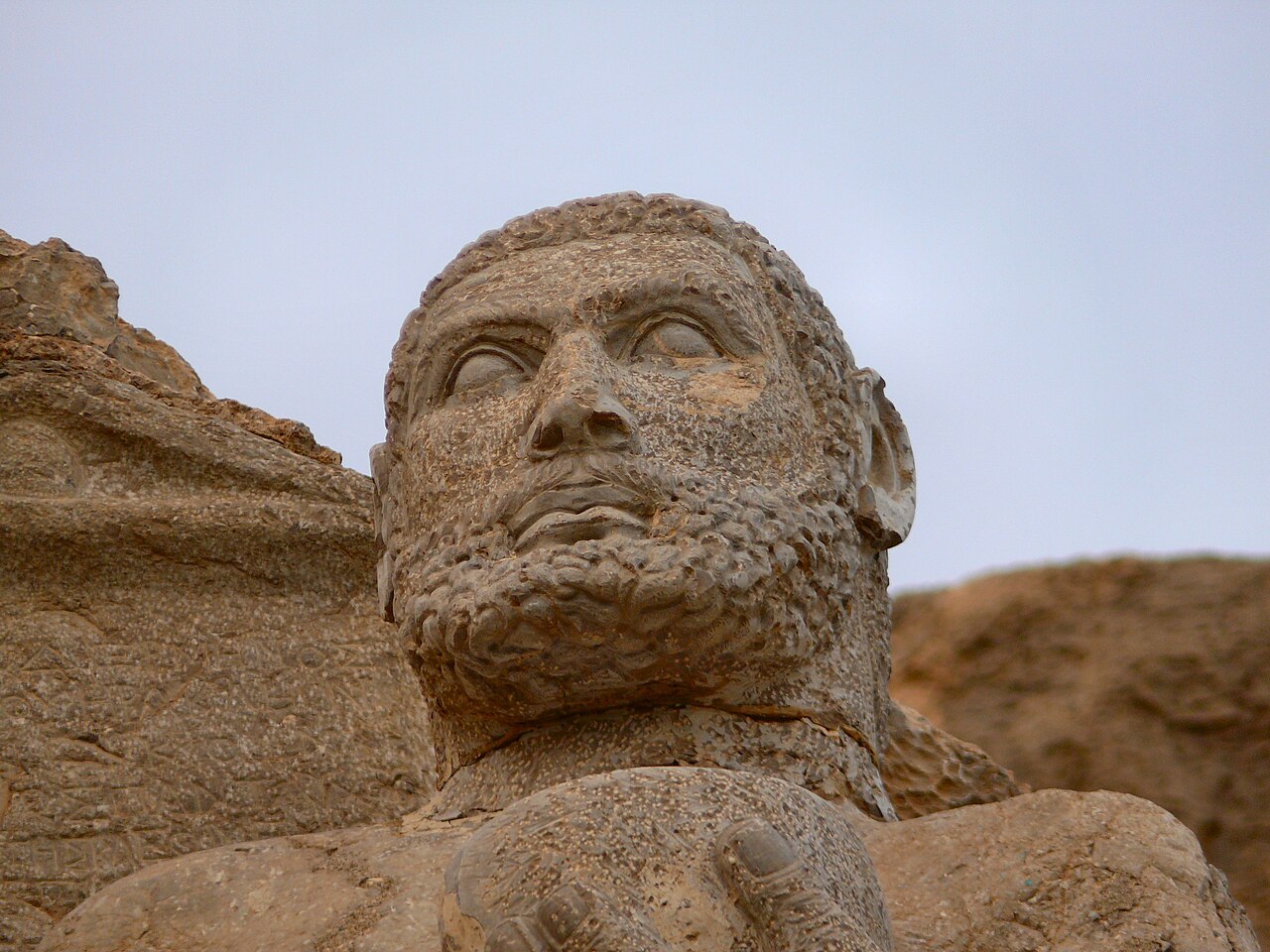
At Bisotun near Kermanshah, a short walk from Darius the Great’s famous inscription, a statue of Heracles reclines on a lion skin, holding a cup. It was found in 1958 during road building. A Greek inscription beside it says that in the year 164 of the Seleucid era, June 148 BCE, a man named Hyakinthos son of Pantauchos dedicated it to “Heracles the glorious victor” for the safety of Kleomenes, governor of the upper satrapies. Within a few years the Parthians took Media, so this is one of the last monuments of Seleucid rule in western Iran. Visitors can see it today: see Behistun (Bisotun).
Laodicea, Susa and other finds
At Nahavand, the Seleucid city of Laodicea, a stone was found with a royal order of Antiochus III, dated 193 BCE, setting up a cult for his queen Laodice. At Susa, renamed Seleucia on the Eulaios, Greek inscriptions continued into the Parthian period, including verse dedications and a letter of the Parthian king Artabanus II written in Greek in 21 CE. Greek remained the language of the Parthian coinage, and several Parthian kings called themselves philhellen, “friend of the Greeks”, on their coins.
Greek gods with Iranian names
The most lasting result was not Greek culture replacing Iranian culture, but the two being read in terms of each other. Greek settlers worshipped local gods under Greek names, and Iranians adopted Greek images for their own gods.
- Heracles and Verethragna. The Iranian god of victory, Verethragna (later Bahram), was often shown as Heracles. In the 1st century BCE, King Antiochus I of Commagene in eastern Anatolia, who claimed both Persian and Macedonian ancestors, named his gods in Greek inscriptions as Zeus-Oromasdes (Ahura Mazda), Apollo-Mithras and Artagnes-Heracles.
- The Oxus god. At the temple of Takht-i Sangin in Tajikistan, a small altar carries a Greek dedication by a man with an Iranian name, Atrosokes, to the river god Oxus, with a figure of the satyr Marsyas playing pipes.
- Anahita and Artemis. Greek writers identified the Iranian water goddess Anahita with Artemis, and Greek-style images of her spread under the Parthians.
The limits of Hellenism
For a long time, European historians saw the Hellenistic East as Greek civilisation planted among Asians. More recent work, using the evidence from Ai-Khanoum, Babylon and Iran, stresses how limited and how mixed it was. Greek culture was strongest in the cities and among the settlers and the court. In the countryside of Persis, Media and Bactria, Iranian languages, religion and ways of life carried on. In Persis, local rulers struck coins with Aramaic legends and fire temples rather than Greek gods (see the fratarakas of Persis).
The Parthians kept many Greek forms, but over time Iranian traditions came forward again: Parthian and later Middle Persian replaced Greek on coins and inscriptions, and the frontal, richly dressed figures of Parthian art (see Parthian art and architecture) owe as much to Iran as to Greece. Persian kept a few Greek words, mostly through Aramaic, Middle Persian or Arabic. Two everyday examples are درهم (derham, from the Greek drachma) and قلم (qalam, pen, from Greek kalamos, a reed). For the wider relationship, see Iran and Greece: perceptions and exchanges.
Persian words from this page
| بیستون | Bisotun | Bisotun (Behistun) |
| هرکول | Herkul | Heracles (Hercules) |
| بهرام | Bahrâm | Bahram, the Iranian god of victory |
| درهم | derham | dirham, from Greek drachma |
| قلم | qalam | pen |
| کرمانشاه | Kermânshâh | Kermanshah |
Sources and further reading
- Rachel Mairs, The Hellenistic Far East: Archaeology, Language, and Identity in Greek Central Asia (University of California Press, 2014).
- Paul Bernard, “Ai Khanum on the Oxus: A Hellenistic City in Central Asia”, Proceedings of the British Academy 53 (1967).
- Getzel M. Cohen, The Hellenistic Settlements in the East (University of California Press, 2013).
- Encyclopaedia Iranica, “Hellenism” and “Bisotun”.
- Plutarch, On the Fortune of Alexander 1.5 and Life of Crassus 33.
Want to learn Persian? Get the free Starter Pack
Get the 14-page printable Starter Pack (all 32 letters, a 7-day reading plan, 100 core words and 20 survival phrases) and a short 5-email course. Free.
More in Alexander and the Seleucid Empire (330–141 BCE)
- Alexander the Great in Iran
- Spitamenes and the Revolt of Bactria and Sogdiana
- Roxana and the Mass Weddings at Susa
- Alexander’s Death and the Wars of the Successors in Iran
- The Battles of Paraitakene and Gabiene
- Seleucus I Nicator and the Seleucid Empire
- Iran under the Seleucids
- The Greco-Bactrian Kingdom
- Antiochus III’s Eastern Anabasis
- The Fratarakas: Local Rulers of Persis
- Greek Culture in Iran
- How the Seleucids Lost Iran