Alexander the Great spent roughly seven of his last eight years inside the lands of the old Persian Empire, and most of that time on the Iranian plateau and in Central Asia. Between his victory at Gaugamela in 331 BCE and his death in Babylon in 323 BCE he took the Persian capitals, hunted down the last Achaemenid claimants, and tried to rule as a Persian-style king. Greek writers remembered a hero; Zoroastrian priests remembered him as gizistag, “the accursed”.
| Period | Late 331 to 323 BCE |
|---|---|
| Main stages | Susa, Persian Gates, Persepolis, Ecbatana, pursuit of Darius III, Bactria and Sogdiana, return through Gedrosia |
| Iranian opponents | Ariobarzanes, Bessus (Artaxerxes V), Satibarzanes, Spitamenes |
| Persian name | اسکندر Eskandar |
| Main sources | Arrian, Quintus Curtius Rufus, Plutarch, Diodorus; Middle Persian Zoroastrian texts; Ferdowsi’s Shahnameh |
After Gaugamela: Babylon and Susa open their gates
The great battle of 1 October 331 BCE is told on its own page, the Battle of Gaugamela, together with the earlier defeats at the Granicus and Issus. What followed was less a war than a hand-over. Darius III fled east into Media, and the western capitals were left to make their own terms.
Babylon surrendered without a fight. Its commander, the Persian noble Mazaeus, who had led Darius’s right wing at Gaugamela, came out to meet Alexander and was rewarded with the satrapy of Babylonia. He was the first Persian to keep a governorship under the new king, and the choice set a pattern: Iranian nobles in the top civil posts, Macedonian officers commanding the troops and the treasuries. At Susa, in December 331, the satrap Abulites handed over the city and its treasure, reported by the Greek historians at around 40,000 to 50,000 talents of silver.
Into Persis: the Uxians and the Persian Gates
From Susa the road to Persepolis climbed into the Zagros. Alexander first had to deal with the Uxian hillmen, who were used to charging even the Persian king a toll for passage. Then, in midwinter 331 to 330, he met real resistance. Ariobarzanes, satrap of Persis, blocked the narrow pass the Greeks called the Persian Gates with a wall and a few thousand men, and threw back the first Macedonian assault. Alexander only broke through after a local guide led part of his army along a mountain track to the defenders’ rear. The stand is the subject of Ariobarzanes and the Battle of the Persian Gate.

Persepolis, Pasargadae and the fire
Alexander entered Persepolis in early 330 BCE. The ancient writers say the treasury there held about 120,000 talents, far more than Susa, and that thousands of pack animals were needed to move it. His troops were allowed to plunder the city outside the palace terrace. He stayed about four months, visited Pasargadae and the tomb of Cyrus, and before he left, the great palaces on the terrace burned. Whether the fire was planned revenge for Xerxes’ burning of Athens or a drunken act, as Plutarch and Diodorus tell it, is discussed on the page on the burning of Persepolis. For Persians it was the moment the dynasty’s heart was destroyed. He appointed a Persian, Phrasaortes, as satrap of Persis.
The chase after Darius
In late spring 330 Alexander marched north to Ecbatana (modern Hamadan), where Darius had hoped to raise a new army. Darius had already gone. At Ecbatana Alexander sent home his Greek allied troops, a sign that the “war of revenge” against Persia was officially over and a war for the Persian throne had begun. He left his senior general Parmenion there with the treasure and set off after Darius with his fastest units.
The pursuit ran east past Rhagae (near modern Rey, see the historic city of Rey) and through the Caspian Gates. Arrian describes forced marches through the night and men and horses dropping on the road. In July 330, somewhere near Hecatompylos in Parthia, Alexander’s advance guard found the king dying in a wagon. His own nobles, led by Bessus, satrap of Bactria, with Nabarzanes and Barsaentes, had arrested him and then stabbed him rather than let him fall into Macedonian hands. Alexander sent the body to Persepolis for a royal burial. The details are on the death of Darius III and Bessus.
Bessus, Areia and the east
Bessus withdrew to Bactria, put on the upright tiara and called himself King Artaxerxes, so for a time there was a Persian rival claiming the throne. Alexander now presented himself as Darius’s avenger. On the way east he passed through Hyrcania, on the Caspian shore, and Areia, around modern Herat, where the satrap Satibarzanes submitted, then revolted and killed his Macedonian escort. In Drangiana (Sistan) Alexander uncovered or claimed to uncover a plot, executed Parmenion’s son Philotas, and had Parmenion himself killed at Ecbatana.
In spring 329 the army crossed the Hindu Kush. Bessus’s support melted away, and two of his own men, the Sogdian lord Spitamenes and Dataphernes, handed him over. Arrian says his nose and ears were cut off, the Persian punishment for a rebel against the king, and that he was sent to Ecbatana to be executed before an assembly of Medes and Persians. Alexander was punishing him as a Persian king would. The hardest fighting of the whole campaign followed, against Spitamenes and the peoples of Bactria and Sogdiana: see Spitamenes and the revolt of Bactria and Sogdiana.
Alexander’s Persian policy
From 330 onward Alexander began to look and act like a Persian ruler, and his Macedonians resented it. The main steps, as the Greek sources report them:
- Dress and court. He adopted the diadem and parts of Persian royal dress. Plutarch says he chose a mixed style and avoided the trousers and the tall tiara. He used Persian court officials and ushers.
- Prostration. In 327 at Bactra he tried to introduce proskynesis, the bow or prostration Persians made before their king. For Persians it was court etiquette; for Greeks it was worship. The historian Callisthenes refused, and the idea was dropped for Macedonians.
- Iranian governors. Besides Mazaeus and Phrasaortes, Iranian nobles governed Media, Parthia and other provinces. One of them, Atropates in Media, kept his province after Alexander’s death, and its later name, Atropatene, is the root of the name Azerbaijan.
- Marriage. He married the Bactrian noblewoman Roxana in 327 and, at Susa in 324, two Achaemenid princesses, while around eighty of his officers took Iranian brides. See Roxana and the mass weddings at Susa.
- Iranian soldiers. He had 30,000 Iranian youths trained in Macedonian fighting. They arrived at Susa in 324, and the Macedonian veterans took it as a sign they were being replaced, one cause of the mutiny at Opis that year.
Modern historians disagree about what this meant. An older view, made famous by W. W. Tarn, saw a dream of the “unity of mankind”. Most scholars now see something more practical: a small Macedonian army could not hold a vast empire without the Iranian aristocracy, and Alexander took over the Achaemenid system as a going concern. Pierre Briant called him, in this sense, “the last of the Achaemenids”.
The return: Gedrosia and the purge of 324
After India, Alexander led part of his army back through the Gedrosian desert (Baluchistan) in 325, with heavy losses. When he reached Carmania and Persis again he found that many governors, Iranian and Macedonian alike, had not expected him back. At Pasargadae the tomb of Cyrus had been robbed, and he ordered Aristobulus to restore it. Orxines, who had made himself ruler of Persis, was hanged, and Abulites of Susa was executed. The new satrap of Persis was the Macedonian Peucestas, who, Arrian says, learned Persian and wore Persian dress, and was popular with the Persians for it. Alexander died at Babylon in June 323. What happened next is told in Alexander’s death and the wars of the successors.
How Iran remembered Alexander
“The accursed” in Zoroastrian tradition
Persian historical memory of Alexander was kept mainly by the Zoroastrian priesthood, and its verdict was harsh. In Middle Persian texts of the Sasanian and early Islamic period he is Aleksandar ī gizistag, “Alexander the accursed” (often written gujastak; modern Persian گجسته gojaste). The Ardā Wirāz Nāmag says the Evil Spirit sent him to Iran, that he killed the king and many priests, and that he took the Avesta, which had been written on prepared ox-hides in gold and kept in the “fortress of archives” at Istakhr near Persepolis, and burned it. Other texts, such as the Bundahishn and the Letter of Tansar, repeat the charge.
Historians treat this as a later tradition rather than an eyewitness record. The Avesta was mostly passed down orally until Sasanian times, so the story of a single written copy destroyed by Alexander is doubtful. But the burning of Persepolis and the killing of Persians were real, and the story explained to later priests why so much of their sacred tradition had been lost. For more, see Zoroastrianism through the ages.
Eskandar the Iranian prince
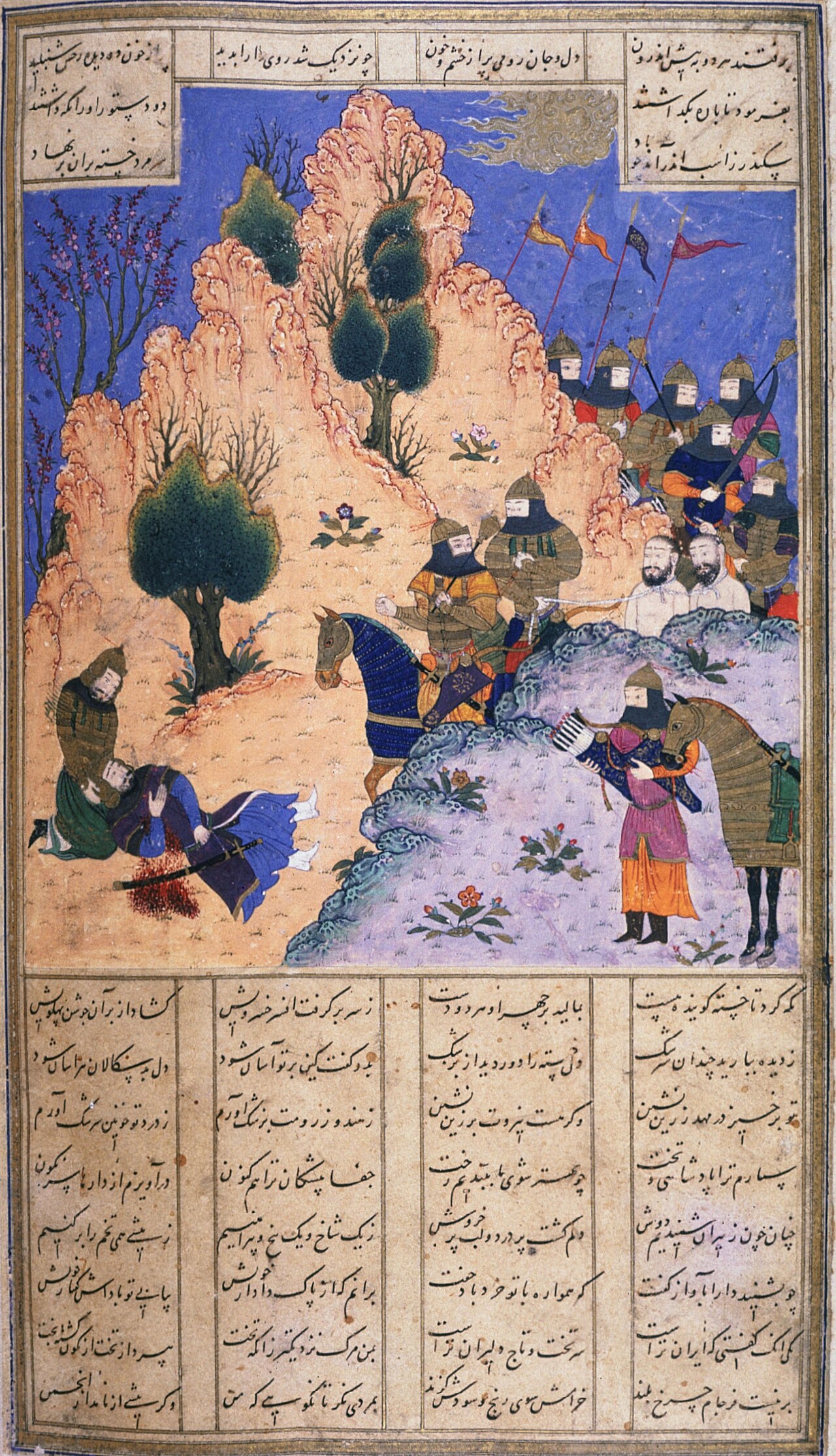
A very different Alexander reached Iran through the Greek Alexander Romance, translated into Middle Persian and then Arabic. In Ferdowsi’s Shahnameh, Eskandar is the son of the Persian king Darab and a daughter of Philip of Macedon, which makes him the half-brother of Dara (Darius) and a legitimate Iranian king. He holds the dying Dara in his arms, promises to avenge him and marries his daughter Roshanak (Roxana). Later, Nezami of Ganja’s Eskandarnameh made him a philosopher and seeker of wisdom, and in Islamic tradition he was often identified with Dhu’l-Qarnayn of the Quran. So the same man appears in Persian literature as both a destroyer and a hero.
Persian words from this page
| اسکندر | Eskandar | Alexander |
| دارا | Dârâ | Darius (in the Shahnameh) |
| گجسته | gojaste | accursed |
| تخت جمشید | Takht-e Jamshid | Persepolis |
| اصطخر | Estakhr | Istakhr, city near Persepolis |
| روشنک | Roshanak | Roxana |
Sources and further reading
- Arrian, Anabasis of Alexander, Books 3 to 7.
- Quintus Curtius Rufus, History of Alexander; Plutarch, Life of Alexander.
- Pierre Briant, Darius in the Shadow of Alexander (Harvard University Press, 2015).
- Encyclopaedia Iranica, “Alexander the Great ii. In Zoroastrian Tradition”, iranicaonline.org.
- A. B. Bosworth, Conquest and Empire: The Reign of Alexander the Great (Cambridge University Press, 1988).
- Ferdowsi, Shahnameh, the reigns of Dara and Eskandar.
Want to learn Persian? Get the free Starter Pack
Get the 14-page printable Starter Pack (all 32 letters, a 7-day reading plan, 100 core words and 20 survival phrases) and a short 5-email course. Free.
More in Alexander and the Seleucid Empire (330–141 BCE)
- Alexander the Great in Iran
- Spitamenes and the Revolt of Bactria and Sogdiana
- Roxana and the Mass Weddings at Susa
- Alexander’s Death and the Wars of the Successors in Iran
- The Battles of Paraitakene and Gabiene
- Seleucus I Nicator and the Seleucid Empire
- Iran under the Seleucids
- The Greco-Bactrian Kingdom
- Antiochus III’s Eastern Anabasis
- The Fratarakas: Local Rulers of Persis
- Greek Culture in Iran
- How the Seleucids Lost Iran