Astyages was the last king of the Medes, ruling from about 585 to 550 BCE, when his army deserted to Cyrus of Anshan and Media passed under Persian rule. He was the son of Cyaxares and, according to Herodotus, the grandfather of Cyrus. Babylonian texts confirm his name and his defeat, while almost everything else known about him comes from Greek stories that portray him as a suspicious and cruel ruler.
| Names | Greek Astyages; Babylonian Ishtumegu; Ctesias Astyigas; modern Persian Âstiyâg |
|---|---|
| Reign | c. 585–550 BCE (35 years in Herodotus) |
| Father | Cyaxares |
| Wife | Aryenis, daughter of Alyattes of Lydia (Herodotus) |
| Daughter | Mandane, mother of Cyrus (Herodotus, Xenophon); Amytis (Ctesias) |
| Capital | Ecbatana (Hamadan) |
| End | Captured by Cyrus c. 550 BCE; later fate uncertain |

Heir to an empire built by war
Astyages inherited the kingdom his father had made great by destroying Assyria and fighting Lydia. His marriage was itself part of that legacy: the peace that ended the Battle of the Eclipse was sealed when Alyattes of Lydia gave his daughter Aryenis to Astyages. This made Astyages the brother-in-law of Croesus, the next Lydian king, a family link that mattered later. Herodotus says one reason Croesus went to war against Cyrus was to avenge Astyages.
His name appears in the Babylonian Nabonidus Chronicle as Ishtumegu. The Iranian original is usually reconstructed as Rishtivaiga, a name connected with brandishing the spear. The Greek form, Astyages, was probably shaped to sound like a Greek word.
A long and quiet reign
For a reign of some 35 years remarkably little is recorded. No Median inscription survives, and the Babylonian chronicles of these decades are broken or silent about Media. Herodotus describes no wars of Astyages before the Persian revolt. The kingdom seems to have been at peace with Lydia and, for most of the period, with Babylon.
One Babylonian text shows that relations with Babylon cooled. Nabonidus, king of Babylon from 556 BCE, wanted to restore the temple of the moon god Sin at Harran, in northern Mesopotamia. In an inscription from Sippar he says that the Medes, whom he calls the Umman-manda, were in control of Harran and its surroundings, and that the god Marduk told him in a dream not to fear them, because Cyrus would scatter them. Harran had been taken by the Medes and Babylonians together in 610 BCE; two generations later Babylon saw the Median presence there as an obstacle.
The Median court in Herodotus
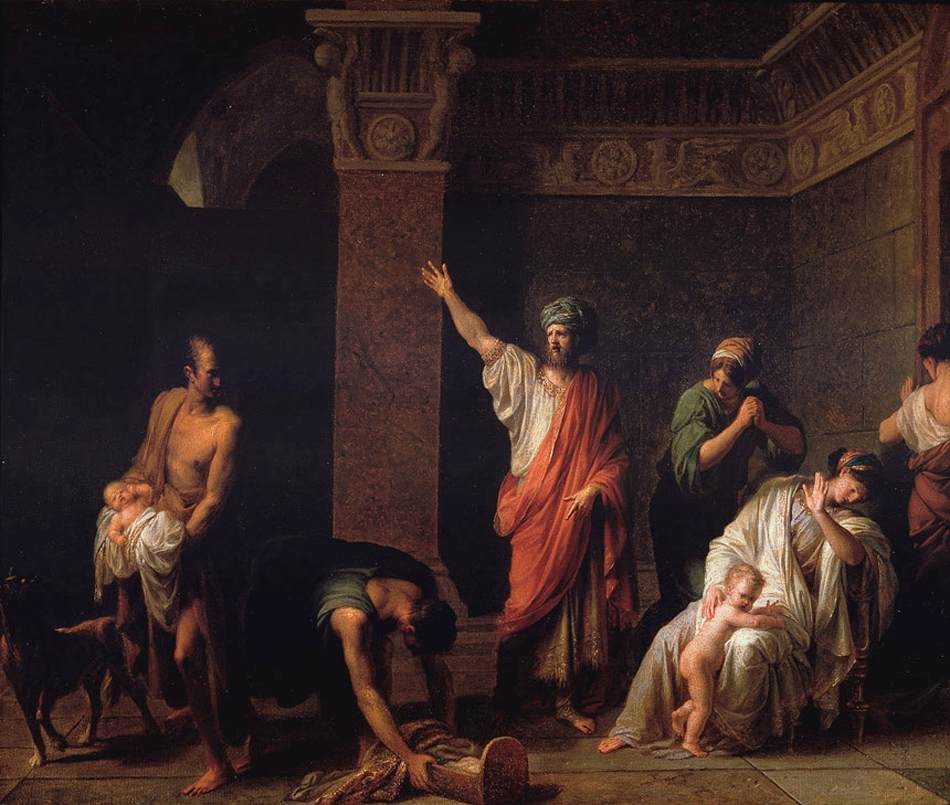
Herodotus’s picture of Astyages’s court at Ecbatana, with its distant king, its messengers and its nobles, belongs to his tale of Cyrus’s birth (Histories 1.107–130). Astyages dreams twice that his daughter Mandane’s child will rule all Asia. He marries her to Cambyses, a Persian of good family but, he thinks, no threat. When the child is born he orders his kinsman and trusted noble Harpagus to kill it. Harpagus passes the baby to a royal herdsman, who raises it as his own. The full legend of the boy who survived, and the other versions of Cyrus’s childhood, are told on Cyrus the Great: birth, legends and rise to power.
The banquet of Harpagus
From the Median side the most important part of the story is what happens to Harpagus. When the ten-year-old Cyrus is recognised, Astyages pretends to be pleased that the boy is alive and invites Harpagus to a feast to celebrate. He tells Harpagus to send his own son, about thirteen years old, to the palace. Astyages has the boy killed and his flesh cooked, and serves it to Harpagus at dinner. At the end of the meal he shows the father the head, hands and feet in a basket. Harpagus keeps his self-control, says that whatever the king does is pleasing, and takes the remains home to bury.
The magi, who had interpreted the dreams, then advise Astyages that the danger is over, since the boy has already been “king” in a children’s game. Astyages sends Cyrus to his parents in Persia.
What the story is for
The tale has the pattern of Greek tragedy: a king who tries to cheat fate, a crime that demands revenge, and a nobleman who waits years for his moment. In Herodotus it explains why Harpagus later helped Cyrus and why the Median army abandoned its king. Herodotus also says that Astyages was harsh to the Medes in general, and that this was why so many turned against him. It is plausible that a real Median noble led a faction that went over to the Persians, and later in his work Herodotus has the same Harpagus commanding Cyrus’s armies in Asia Minor after 546 BCE. The banquet itself cannot be checked and is best read as a story.
The end of the reign
The Nabonidus Chronicle gives the most sober account. In 550/549 BCE Ishtumegu gathered his army and marched against Cyrus, king of Anshan. His army rebelled, seized him and handed him over to Cyrus. Cyrus then took Ecbatana and carried its treasure to Anshan. The campaign and the reasons the Median army changed sides are covered on the fall of Media and the Persian revolt.
Three versions of his fate
Herodotus says Cyrus did Astyages no harm and kept him at his court until he died (1.130). Justin, a later Roman writer who summarised older histories, says Cyrus made him governor of Hyrcania, near the Caspian Sea.
Ctesias, a Greek doctor at the Persian court around 400 BCE, gives a very different story, preserved in a summary by the Byzantine scholar Photius. In his version Astyages was not Cyrus’s grandfather at all. After his defeat he hid in the palace at Ecbatana with his daughter Amytis and her husband Spitamas. Cyrus had Spitamas killed, married Amytis himself and treated Astyages with honour, sending him to govern the Barcanians. Years later a royal eunuch sent to bring the old king to court abandoned him in the desert, where he died of hunger and thirst. His body, the story says, was found untouched by wild animals and given a splendid burial.
None of these accounts can be confirmed. They show that within a century of his death Astyages had become a figure of legend, used by Persian and Greek storytellers to explain how power passed from the Medes to the Persians.
Persian words from this page
| آستیاگ | Âstiyâg | Astyages |
| هارپاگ | Hârpâg | Harpagus |
| ماندانا | Mândânâ | Mandane |
| کوروش | Kurosh | Cyrus |
| خواب | khâb | dream, sleep |
| مهمانی | mehmâni | feast, party |
Sources and further reading
- Herodotus, Histories, Book 1, chapters 73–74 and 107–130.
- The Nabonidus Chronicle (ABC 7), in A. K. Grayson, Assyrian and Babylonian Chronicles (1975).
- Ctesias, Persica, in the summary of Photius; translated in L. Llewellyn-Jones and J. Robson, Ctesias’ History of Persia (2010).
- Encyclopaedia Iranica, “Astyages“.
- Amélie Kuhrt, The Persian Empire: A Corpus of Sources from the Achaemenid Period (2007).
Want to learn Persian? Get the free Starter Pack
Get the 14-page printable Starter Pack (all 32 letters, a 7-day reading plan, 100 core words and 20 survival phrases) and a short 5-email course. Free.
More in The Median Empire (c. 728–550 BCE)
- The Rise of the Medes and Deioces
- Ecbatana (Hamadan): Capital of the Medes
- Phraortes, the Scythian Interregnum and Median Expansion
- Scythians and Cimmerians in Iran
- Cyaxares the Great and the Fall of Nineveh
- The Battle of the Eclipse: Medes against Lydia
- Astyages, the Last Median King
- The Fall of Media and the Persian Revolt
- Median Society, Magi and Religion
- Herodotus and the Medes: Myth or History?