Ecbatana, Old Persian Hagmatāna, was the capital of the Median kingdom and later a summer residence of the Achaemenid and Parthian kings. Its ruins lie under the modern city of Hamadan in western Iran, where the mound of Tepe Hegmataneh has been excavated since 1983. Greek writers described a city of painted walls and silver-roofed palaces, but archaeologists have still not found a building that can be securely dated to the Median period.
| Ancient names | Hagmatāna (Old Persian), Agbatana / Ekbatana (Greek), Achmetha (Bible, Ezra 6:2) |
|---|---|
| Modern site | Tepe Hegmataneh, central Hamadan |
| Elevation | About 1,800 m, at the foot of Mount Alvand |
| Capital of | Median kingdom (7th century to c. 550 BCE); later a royal summer seat |
| Main excavations | Charles Fossey 1913; Mohammad Rahim Sarraf, 11 seasons 1983–2000 |

Why here
Ecbatana stands on a fertile plain at the northern foot of Mount Alvand, where snowmelt streams water the fields. It also sits on the main road from Mesopotamia to the Iranian plateau, which climbs through the Zagros by way of Kermanshah and Behistun and continues east towards Rey and Khorasan. Whoever held the plain controlled that road. The Old Persian name Hagmatāna is usually explained as “place of gathering”, which suits a meeting point of routes and peoples.
The seven walls of Herodotus
Herodotus (Histories 1.98) says that the first Median king, Deioces, ordered the Medes to build a single great city. Ecbatana, he writes, was laid out on a hill as seven concentric walls, each rising above the one outside it, so that the king’s palace and treasury stood at the centre. The battlements of the walls were painted in seven colours: white, black, purple, blue and orange for the outer five, then silver and gold for the two innermost. He adds that the outer circuit was about the size of the walls of Athens.
No trace of such a city has been found, and few historians take the description literally. The seven colours resemble the colours associated with the seven planets in Babylonian tradition, and Herodotus may have combined a report of a strong citadel with a symbolic picture of royal power, the king hidden behind ring after ring of walls. His story of Deioces and the Median court is told on the rise of the Medes.
Ecbatana in the Median and Persian records
Contemporary Near Eastern texts confirm the city’s importance at the end of the Median kingdom. The Babylonian Nabonidus Chronicle says that after Astyages’s army deserted him, Cyrus marched to Ecbatana, the royal city, and carried off its silver, gold and goods to Anshan. The story of that war, seen from the Median side, is on the fall of Media.
Under the Achaemenids, Ecbatana kept its rank. The Behistun inscription of Darius I describes how a Median rebel, Fravartish, claimed the throne of Media in 522 BCE; after his defeat Darius had him mutilated and impaled at Ecbatana. The Book of Ezra says a copy of Cyrus’s decree on the Jerusalem temple was found in the fortress at Achmetha, in the province of Media. Greek writers describe the Persian kings spending the summer here, when Susa and Babylon were unbearably hot.
Silver tiles and cedar beams
The fullest physical description comes from the Greek historian Polybius (Histories 10.27), writing in the 2nd century BCE. He says the city had no walls by his time but a strong citadel beside the palace. The palace beams and columns were of cedar and cypress, plated with silver and gold, and the roof tiles were silver. Most of this metal, he says, had been stripped by Alexander’s army and by the Macedonian rulers who followed. Alexander left the captured Persian treasure at Ecbatana in 330 BCE, and his friend Hephaestion died there in 324 BCE.
Digging under a living city
Excavating Ecbatana is difficult because Hamadan has been occupied without a break, and the medieval and modern city covers much of the ancient one. The French archaeologist Charles Fossey dug trial pits in 1913, but the First World War ended his work. The mound of Hegmataneh was registered as a national monument in 1931, and aerial photographs taken in the 1930s by Erich Schmidt showed buried walls under the fields.
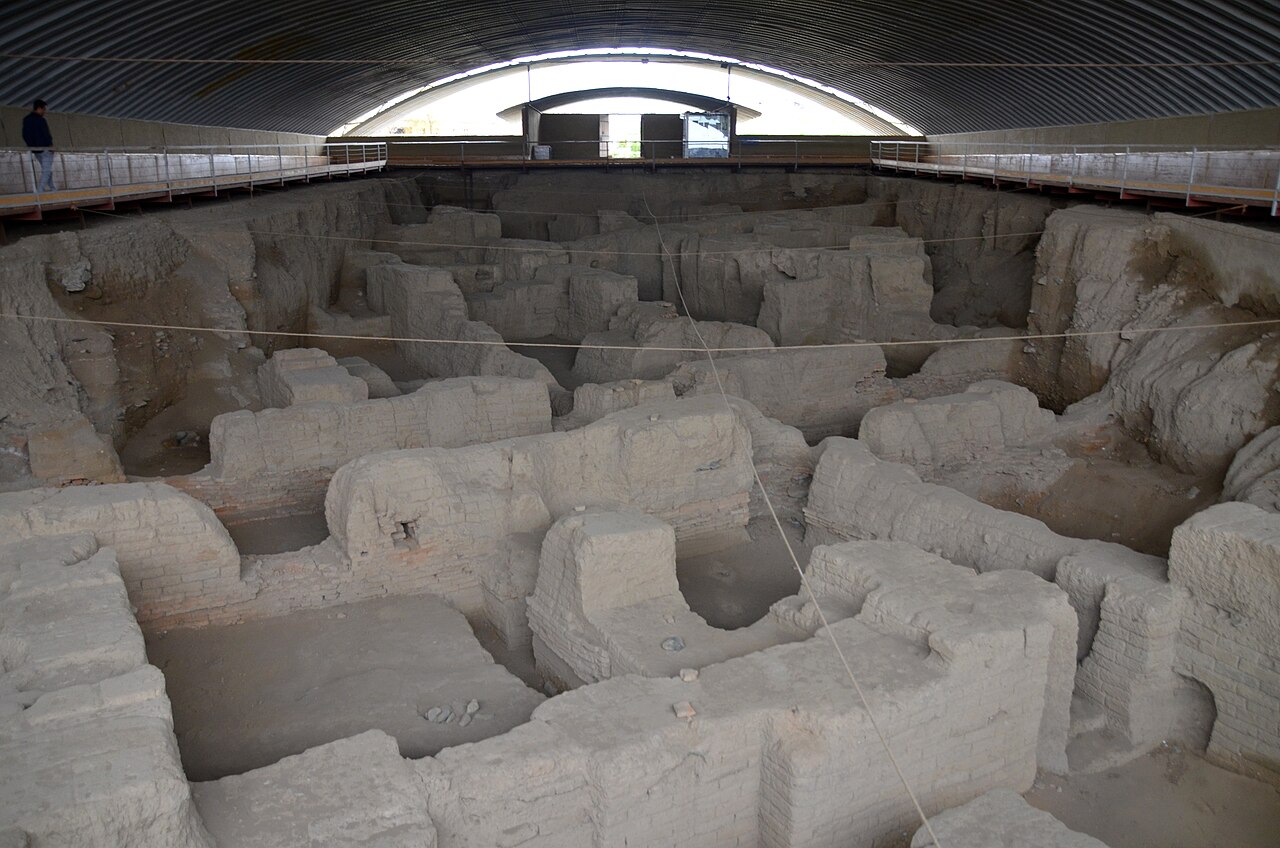
Systematic excavation began in 1983 under the Iranian archaeologist Mohammad Rahim Sarraf, who directed eleven seasons up to 2000. His teams exposed a remarkable town plan: blocks of mudbrick buildings about 17.5 metres square, separated by straight streets about 3.5 metres wide and narrower alleys, all set on a regular grid. Massive mudbrick fortifications, some walls around 9 metres thick, survive on the edges of the mound.
Dating the grid
The date of the grid is the central question. Sarraf considered it Median or Achaemenid, which would make it one of the oldest planned cities in Iran. Other archaeologists point out that the dated finds from the excavated levels, including coins and pottery, are mostly Seleucid and Parthian, and argue that the grid belongs to those later periods. The question is still open, and no Median palace, temple or wall has yet been identified with certainty.
Other objects said to come from Hamadan add to the puzzle. Column bases inscribed by Artaxerxes II show that the Achaemenids built here. Two gold tablets bearing Old Persian texts in the names of Ariaramnes and Arsames, the great-grandfather and grandfather of Darius, were reported from Hamadan in the 20th century; most specialists think they were made later than the reigns they claim, and the origin of many objects sold as “from Hamadan” on the antiquities market is uncertain.
Visiting the site today
Tepe Hegmataneh is an open archaeological site with a small museum, in the middle of Hamadan. Visitors can walk among the excavated mudbrick blocks and see finds from the mound. For opening times and tickets, check current local information. The modern city, Avicenna’s mausoleum and the nearby Achaemenid inscriptions are covered on our Hamadan city page and on the Ganjnameh inscriptions.
Persian words from this page
| هگمتانه | Hegmatâneh | Ecbatana |
| همدان | Hamedân | Hamadan |
| تپه | tappeh | mound, hill |
| پایتخت | pâytakht | capital city |
| دیوار | divâr | wall |
| الوند | Alvand | Mount Alvand |
Sources and further reading
- Herodotus, Histories, Book 1, chapter 98.
- Polybius, Histories, Book 10, chapter 27.
- The Behistun inscription of Darius I, column II.
- Encyclopaedia Iranica, “Ecbatana“.
- David Stronach, “Independent Media: archaeological notes from the homeland”, and Mohammad Rahim Sarraf on the Hamadan excavations, both in Continuity of Empire (?): Assyria, Media, Persia, ed. Lanfranchi, Roaf and Rollinger (2003).
Want to learn Persian? Get the free Starter Pack
Get the 14-page printable Starter Pack (all 32 letters, a 7-day reading plan, 100 core words and 20 survival phrases) and a short 5-email course. Free.
More in The Median Empire (c. 728–550 BCE)
- The Rise of the Medes and Deioces
- Ecbatana (Hamadan): Capital of the Medes
- Phraortes, the Scythian Interregnum and Median Expansion
- Scythians and Cimmerians in Iran
- Cyaxares the Great and the Fall of Nineveh
- The Battle of the Eclipse: Medes against Lydia
- Astyages, the Last Median King
- The Fall of Media and the Persian Revolt
- Median Society, Magi and Religion
- Herodotus and the Medes: Myth or History?