The Median kingdom fell between about 553 and 550 BCE, when the Persians of Anshan under Cyrus rebelled against their overlord Astyages and, after several battles, won over the Median army. Babylonian texts record that the Median troops mutinied, handed their king to Cyrus and opened the way to Ecbatana. For the Medes this was less a conquest than a change of dynasty: they kept a privileged place in the new Persian empire.
| Date | c. 553–550 BCE (start: “third year” of Nabonidus; end: his sixth year, 550/549 BCE) |
|---|---|
| Sides | Medes under Astyages; Persians under Cyrus II of Anshan |
| Battles | Hyrba and several battles in Persis, the last near the later site of Pasargadae (Nicolaus of Damascus, Strabo) |
| Turning point | Median army deserts Astyages; Harpagus changes sides (Herodotus) |
| Result | Ecbatana taken and its treasure carried to Anshan; Media becomes part of the Persian empire |

Two Babylonian witnesses
The dates come from Babylon. An inscription of King Nabonidus from Sippar says that in his third year (553 BCE) the god Marduk raised up Cyrus, king of Anshan, who with his small army scattered the extensive Median forces and captured Astyages. Because the text was written some years after the events, it compresses them. The Nabonidus Chronicle, a year-by-year record, is more precise: under the sixth year (550/549 BCE) it reports that Astyages mustered his army and marched against Cyrus, that the army rebelled and handed him over, and that Cyrus took the royal city of Ecbatana and carried off its silver, gold and goods.
Taken together the texts suggest a war of about three years, beginning with a Persian revolt and ending with a Median offensive that collapsed from within. How those texts sit beside the Greek versions of Cyrus’s early life is discussed on Cyrus the Great: birth, legends and rise to power. This page follows the war from the Median side.
A divided Median nobility
Herodotus explains the defeat through one man, Harpagus. In his story Astyages had tricked the noble into eating the flesh of his own son as punishment for disobedience years before (see Astyages, the last Median king). Harpagus waited for revenge. He went to the leading Medes one by one, and, since Astyages was harsh towards them, persuaded them to accept Cyrus as king in his place. Only then did he urge Cyrus to revolt.
Modern historians do not accept the details, but the main idea, a split among the Median nobility, fits the Babylonian evidence that Astyages’s own soldiers seized him. The Median kingdom had been built by alliances between powerful families, and a long reign may have left many of them estranged. Cyrus’s link to the Median royal house, if Herodotus is right that his mother was Astyages’s daughter, would have made him an acceptable alternative.
The fighting
Herodotus: an army that would not fight
When Astyages heard of the Persian revolt, Herodotus says (1.127), he armed all the Medes and, as if blinded by the gods, appointed Harpagus as their commander. When the armies met, a few Medes who were not in the plot fought; others went over openly to the Persians; most deliberately fought badly and fled.
Astyages’s reaction shows a king who had lost control. He had the magi impaled, the dream interpreters who had told him years earlier that Cyrus was no danger. He then armed the Medes left in the city, young and old, led them out himself, and was defeated and taken prisoner.
Ctesias and Nicolaus: a harder war
A fuller and more violent version comes from Ctesias, preserved in fragments of the historian Nicolaus of Damascus (1st century BCE). In it Cyrus escaped from the Median court, where he had risen to be a royal servant, and his first clash with Median horsemen came at a place called Hyrba. Astyages then invaded Persis with a large army. Over several days of fighting the Persians were pushed back towards the mountain where their families had taken refuge.
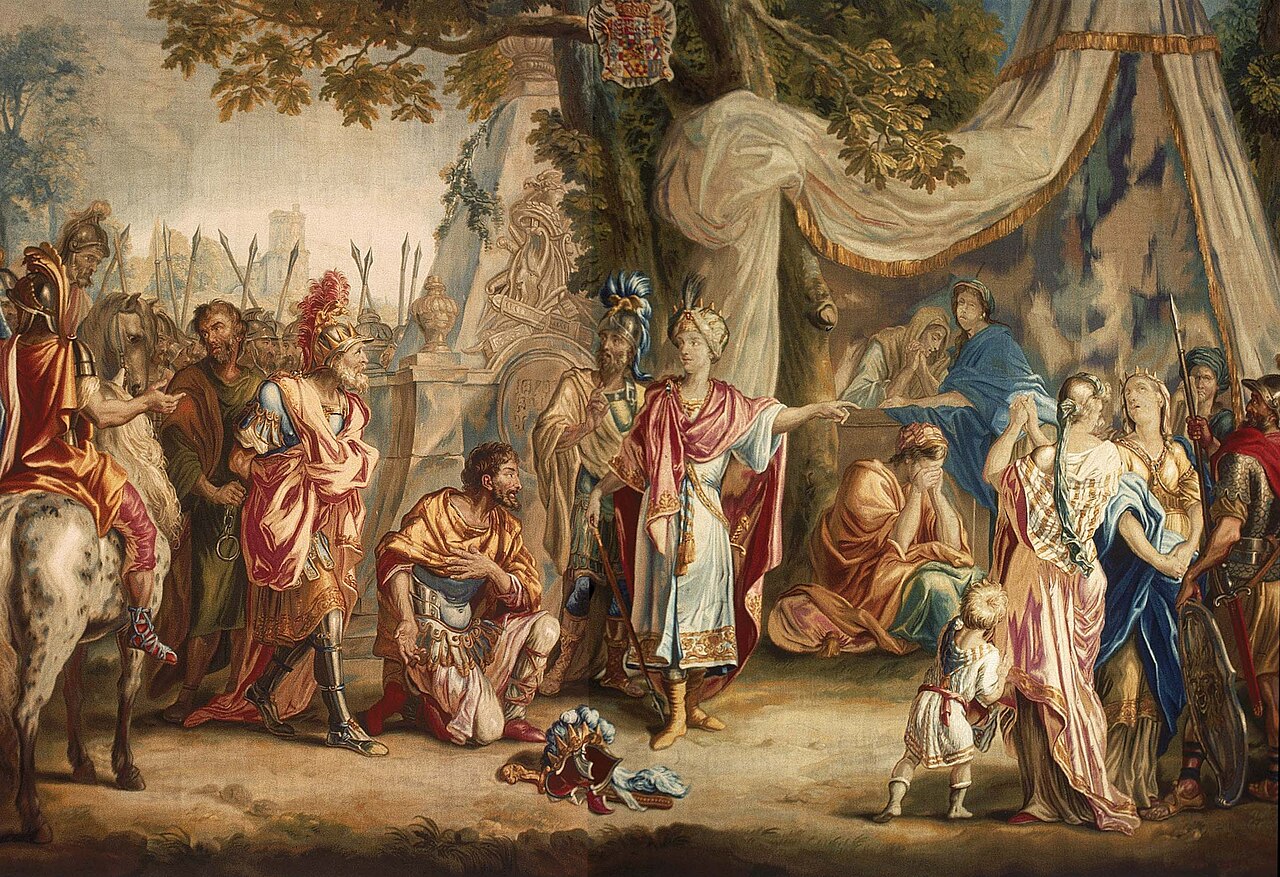
There, the story goes, the Persian women came out to meet their fleeing men and shamed them into turning back. The Roman writer Justin and Plutarch tell the same episode. The Persians returned to the fight and broke the Median army. The geographer Strabo adds that Cyrus founded his capital, Pasargadae, at the place where he defeated Astyages; the city is described on Pasargadae: Cyrus’s capital and tomb.
Harpagus and Astyages after the battle
Herodotus gives the defeated king a last scene (1.129). Harpagus came to gloat over the captured Astyages and asked how he liked slavery in place of kingship. Astyages asked whether Harpagus claimed the victory as his own work. When Harpagus said he did, since he had written to Cyrus, Astyages called him the most foolish and most unjust of men: foolish because he had given the throne to another when he could have taken it himself, and unjust because, to avenge a private wrong, he had made the Medes slaves and the Persians their masters.
The speech is Herodotus’s own, but it states clearly how a Greek of the 5th century understood what had happened: the Medes had handed power to the Persians, who had been their subjects.
The Medes under Persian rule
Ecbatana was not destroyed. Cyrus took its treasury, but the city became one of the royal residences of the new empire (see Ecbatana, capital of the Medes). Media appears in every list of lands in the royal inscriptions, the Median delegation leads the procession of tribute bearers on the Apadana reliefs at Persepolis, and Medes stand beside Persians among the royal guards. Median generals such as Harpagus and Mazares led Cyrus’s armies in Asia Minor. Greeks continued to call the Persians “the Medes” and the Persian Wars “the Median affairs”.
The Medes did not forget their independence. In 522 BCE a Mede called Fravartish claimed to be a descendant of Cyaxares and raised much of Media in revolt against Darius I; he was captured and executed at Ecbatana. Xenophon records another Median revolt in 409 BCE, against Darius II. Neither restored the old kingdom. The ways the Median state shaped the Persian empire that replaced it are described on Median society, Magi and religion.
- 559 BCE Cyrus becomes king of Anshan, a vassal of the Medes
- 553 BCE Persian revolt begins (Nabonidus’s “third year”)
- c. 552 BCE First clashes, including Hyrba in Nicolaus’s account
- 550/549 BCE Astyages’s army mutinies; Cyrus takes Ecbatana
- 522 BCE Median revolt of Fravartish against Darius I
Persian words from this page
| پارس | Pârs | Persis, Fars |
| پاسارگاد | Pâsârgâd | Pasargadae |
| هارپاگ | Hârpâg | Harpagus |
| شورش | shuresh | revolt, rebellion |
| شکست | shekast | defeat |
| گنج | ganj | treasure |
Sources and further reading
- The Nabonidus Chronicle (ABC 7) and the Sippar Cylinder of Nabonidus, translated in Amélie Kuhrt, The Persian Empire: A Corpus of Sources from the Achaemenid Period (2007).
- Herodotus, Histories, Book 1, chapters 123–130.
- Nicolaus of Damascus, fragments on Cyrus (FGrHist 90 F 66), drawing on Ctesias.
- Strabo, Geography, Book 15, chapter 3.8; Justin, Epitome, Book 1, chapter 6.
- Pierre Briant, From Cyrus to Alexander: A History of the Persian Empire (2002).
Want to learn Persian? Get the free Starter Pack
Get the 14-page printable Starter Pack (all 32 letters, a 7-day reading plan, 100 core words and 20 survival phrases) and a short 5-email course. Free.
More in The Median Empire (c. 728–550 BCE)
- The Rise of the Medes and Deioces
- Ecbatana (Hamadan): Capital of the Medes
- Phraortes, the Scythian Interregnum and Median Expansion
- Scythians and Cimmerians in Iran
- Cyaxares the Great and the Fall of Nineveh
- The Battle of the Eclipse: Medes against Lydia
- Astyages, the Last Median King
- The Fall of Media and the Persian Revolt
- Median Society, Magi and Religion
- Herodotus and the Medes: Myth or History?