The Cimmerians and the Scythians were horse-riding nomads from the steppes north of the Caucasus who appeared in north-western Iran in the late 8th and 7th centuries BCE. For about a century they fought for and against Assyria, Urartu, the Mannaeans and the Medes, and their mounted archers changed the way war was fought in the region. Both peoples are known mostly from Assyrian letters and oracle texts and from Herodotus.
| Cimmerians | Akkadian Gimirri; first recorded c. 714 BCE near Urartu |
|---|---|
| Scythians | Akkadian Ishkuza / Ashguzai; Hebrew Ashkenaz; recorded from the 670s BCE |
| Known kings | Teushpa (Cimmerian), Dugdamme / Lygdamis (Cimmerian), Ishpakai, Partatua (Scythian) |
| Language | Scythian was an Iranian language; Cimmerian is unknown but often thought Iranian too |
| Main area in Iran | Around Lake Urmia and the Mannaean lands of today’s Iranian Azerbaijan and Kurdistan |
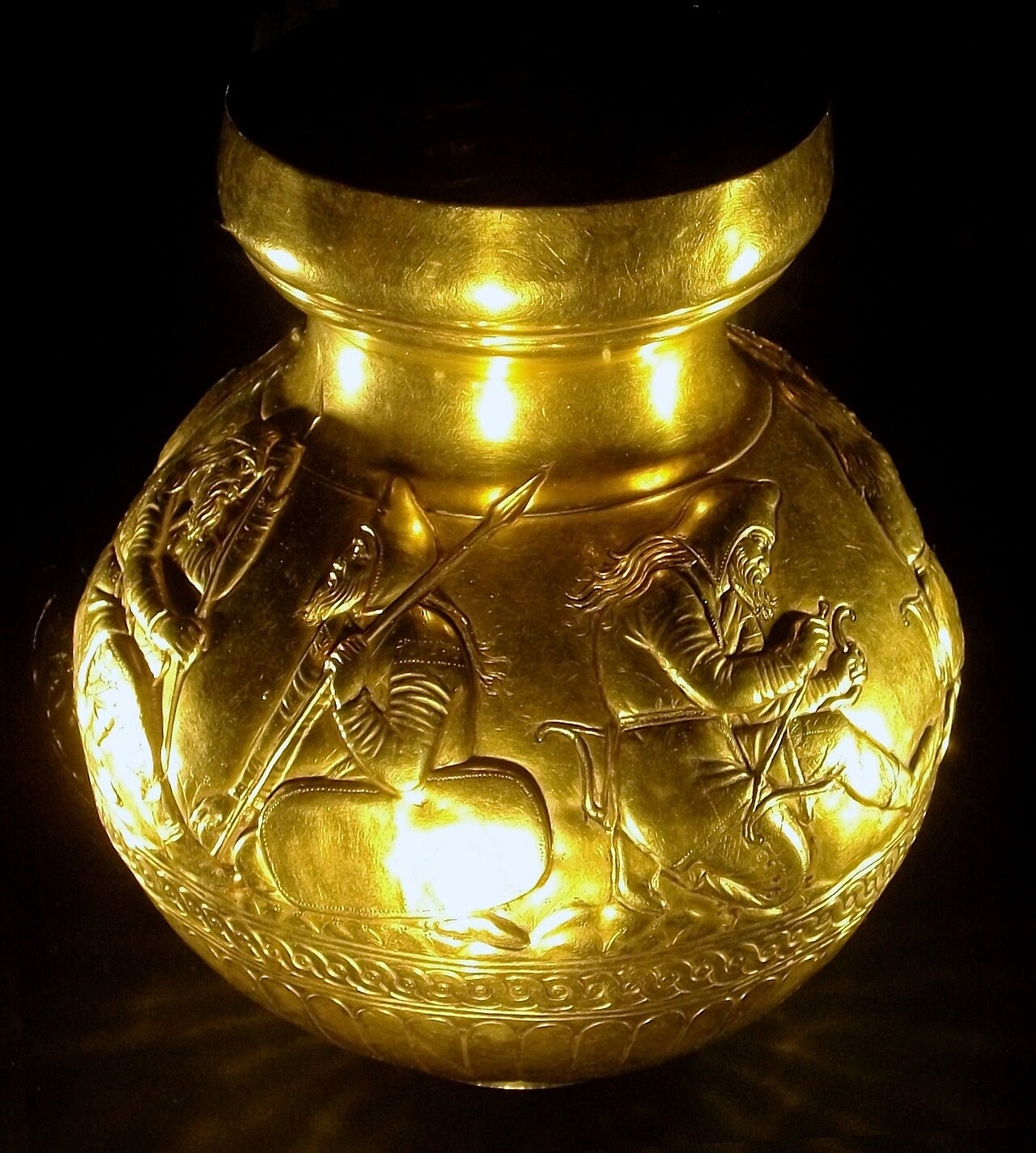

Riders from beyond the Caucasus
Herodotus says the Cimmerians once lived on the north shore of the Black Sea and were driven out by the Scythians, who chased them south into Asia. The Cimmerians, he says, went along the coast, and the Scythians lost the trail and came instead through the Caucasus into Media (Histories 1.103–104 and 4.11–12). Modern historians doubt that the movements were this neat, but the general direction of the story matches the Near Eastern records: both peoples arrived from the north, and both first appear near Urartu and Lake Urmia.
They brought a style of warfare that suited open country. Steppe archers rode without stirrups, shot short composite bows from horseback and carried a new type of bronze arrowhead, small and three-bladed, with a socket for the shaft. Arrowheads of this type turn up in 7th-century destruction layers across the Near East and are often called “Scythian”, although armies of every kind soon adopted them.
The Cimmerians: from Urartu to Lydia
The Cimmerians enter history in letters sent to the Assyrian king Sargon II by his intelligence officers around 714 BCE. They report that the king of Urartu had marched into the land of Gamir, the Cimmerian country, and had been badly defeated, with several of his governors killed. Sargon attacked the weakened Urartians in the same year.
Over the next decades groups of Cimmerians fought as raiders, mercenaries and allies of whoever paid. Around 679 BCE the Assyrian king Esarhaddon defeated a Cimmerian leader called Teushpa in the land of Hubushna. Some Cimmerians stayed in the Zagros: in about 672 BCE they appear as allies of the Median chief Kashtaritu in his revolt against Assyria (see Phraortes and the Scythian interregnum).
The main Cimmerian force moved west into Anatolia. There they ruined the kingdom of Phrygia and in the 640s BCE killed King Gyges of Lydia and sacked his capital, Sardis, except for the citadel. Their king Dugdamme, whom the Greeks called Lygdamis, threatened Assyria itself until he died around 640 BCE. After that the Cimmerians fade from the record.
The Scythians: allies of Assyria
The Scythians appear slightly later and closer to Iran. Around 676 BCE Esarhaddon fought a Scythian king, Ishpakai, who had joined the Mannaeans against Assyria, and Ishpakai was killed. His successor Partatua took a different course. An oracle question asks the sun god whether Partatua, king of the Ishkuza, would keep his word if Esarhaddon gave him a royal daughter in marriage. Whether the marriage happened is unknown, but the Scythians seem to have become Assyria’s partners for a time. Herodotus’s Protothyes, father of the Scythian king Madyes, is very probably the same Partatua.
A Scythian kingdom seems to have existed in the Mannaean lands south of Lake Urmia. The prophet Jeremiah, calling on the nations to rise against Babylon, names the kingdoms of Ararat, Minni and Ashkenaz together (Jeremiah 51:27), that is, Urartu, the Mannaeans and the Scythians, which shows how firmly the Scythians were linked with this corner of Iran.
The Ziwiye treasure
The most famous objects that may come from this Scythian presence belong to the Ziwiye treasure, found near Saqqez in Kurdistan province in 1947. Several pieces, such as a gold pectoral and gold plaques, combine Assyrian and Urartian motifs with crouching stags and other beasts in the “animal style” of the steppes. The treasure was dispersed through the antiquities trade, and its find-spot and unity are disputed. It is described on the Mannaeans, Urartu and north-west Iran.
Scythians and Medes
Herodotus makes the Scythians masters of Asia for 28 years after they defeated the Medes, until Cyaxares killed their leaders at a banquet. No contemporary text describes such an empire, and historians are divided over how long and how wide Scythian control really was. What is clear is that Scythian warriors were a major force in the region in the 7th century, and that the Medes learned from them. Herodotus says Cyaxares later employed a band of Scythians and sent Median boys to them to learn their language and archery; a quarrel with these Scythians started the Median war with Lydia (see the Battle of the Eclipse). Many historians link the reorganised Median army of Cyaxares, with its separate units of archers and cavalry, to this contact.
Scythian groups seem to have joined the Babylonians and Medes in the wars that destroyed Assyria at the end of the century, and then many returned north. Later Persians knew the steppe peoples of Central Asia as Saka; Darius I fought them, and his campaign against the European Scythians is told on Darius’s Scythian campaign.
- c. 714 BCE Cimmerians defeat the king of Urartu
- c. 679 BCE Esarhaddon defeats the Cimmerian Teushpa
- c. 676 BCE The Scythian king Ishpakai is killed fighting Assyria
- c. 672 BCE Cimmerians join Kashtaritu’s Median revolt; Partatua seeks an Assyrian bride
- 640s BCE Cimmerians kill Gyges of Lydia and sack Sardis
- c. 640 BCE Death of the Cimmerian king Dugdamme
Persian words from this page
| سکاها | Sakâ-hâ | Scythians, Saka |
| کمان | kamân | bow |
| تیر | tir | arrow |
| سوارکار | savârkâr | horseman |
| دریاچه ارومیه | Daryâcheh-ye Orumiyeh | Lake Urmia |
| سقز | Saqqez | Saqqez (town near Ziwiye) |
Sources and further reading
- Herodotus, Histories, Book 1, chapters 103–106, and Book 4, chapters 11–12.
- Ivan Starr, Queries to the Sungod: Divination and Politics in Sargonid Assyria, State Archives of Assyria IV (1990).
- Encyclopaedia Iranica, “Cimmerians“.
- A. Ivantchik, Les Cimmériens au Proche-Orient (1993).
- I. M. Diakonoff, “Media”, in The Cambridge History of Iran, vol. 2 (1985).
Want to learn Persian? Get the free Starter Pack
Get the 14-page printable Starter Pack (all 32 letters, a 7-day reading plan, 100 core words and 20 survival phrases) and a short 5-email course. Free.
More in The Median Empire (c. 728–550 BCE)
- The Rise of the Medes and Deioces
- Ecbatana (Hamadan): Capital of the Medes
- Phraortes, the Scythian Interregnum and Median Expansion
- Scythians and Cimmerians in Iran
- Cyaxares the Great and the Fall of Nineveh
- The Battle of the Eclipse: Medes against Lydia
- Astyages, the Last Median King
- The Fall of Media and the Persian Revolt
- Median Society, Magi and Religion
- Herodotus and the Medes: Myth or History?