Almost everything usually written about the Median kings, from Deioces to Astyages, comes from a few chapters of Herodotus’s Histories, written in the 5th century BCE, more than a century after the Median kingdom fell. Since the 1980s historians have asked how much of his account is history and how much is Greek storytelling, and some have doubted that there ever was a Median “empire” at all. The debate has changed how the period between Assyria and Persia is understood.
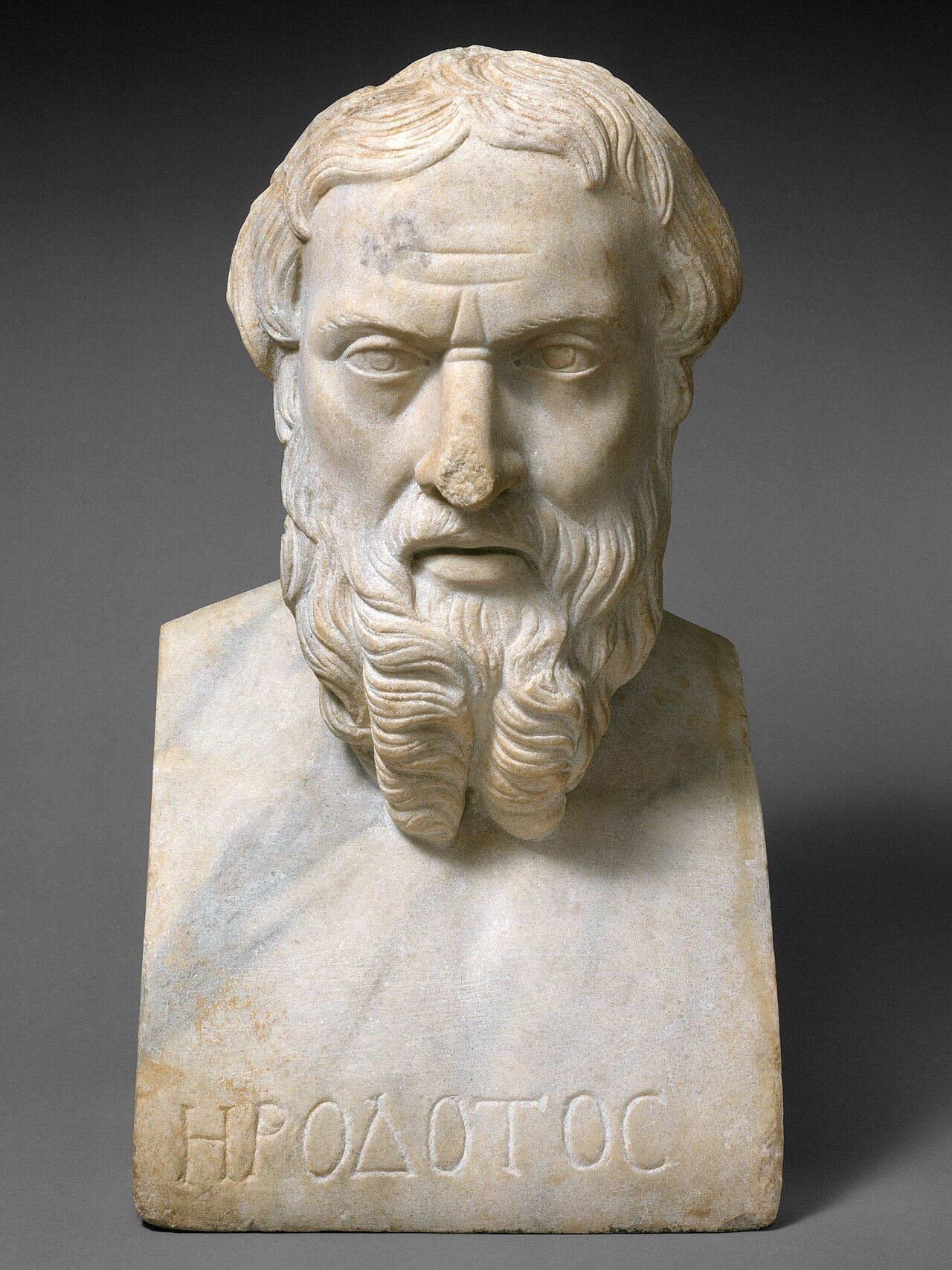

The Median story in the Histories
Herodotus’s account of the Medes forms part of his first book (Histories 1.95–130), inside his story of how Cyrus came to power. He presents a tidy sequence of four kings, each the son of the one before:
| Deioces | 53 years: chosen king as a judge, builds Ecbatana, creates the court |
|---|---|
| Phraortes | 22 years: conquers the Persians, dies attacking Assyria |
| Cyaxares | 40 years: army reform, Scythian period, takes Nineveh, war with Lydia |
| Astyages | 35 years: dreams, Harpagus, overthrown by Cyrus |
The reigns add up to 150 years. Herodotus also says (1.130) that the Medes ruled Asia beyond the Halys for 128 years, apart from the period of Scythian domination. The figures do not fit together neatly, and modern scholars have proposed several ways of reconciling them. Working back from the fall of Astyages in 550 BCE, his scheme puts Deioces around 700 BCE, which is why reference books often give c. 728 or c. 700 BCE for the start of the Median kingdom.
Where Herodotus got his information
Herodotus says he knew four versions of Cyrus’s birth and chose the most believable, following “some of the Persians”. His Median material probably came from Persian and Median informants in Asia Minor, where Persian governors and Median families lived among Greeks. Some scholars have suggested that the family of Harpagus, which seems to have kept power in Lycia, was a source for the stories in which Harpagus plays a central part. None of this can be proved.
Several of the Median stories follow patterns found elsewhere in his work and in Greek literature: the judge who becomes a tyrant, the dream warning a king, the child exposed and saved, the cannibal feast and its revenge. These patterns do not make the stories false, but they show how strongly Herodotus shaped his material.
Checking Herodotus against contemporary texts
Where Assyrian and Babylonian records survive, they sometimes confirm and sometimes contradict him.
- Confirmed: the Medes, with Babylon, destroyed Assyria; a Median king named Ishtumegu (Astyages) was betrayed by his army and captured by Cyrus, who took Ecbatana; the names Cyaxares (Umakishtar) and, probably, Deioces (Daiukku) were real.
- Not confirmed: the Assyrian texts of the 8th and early 7th centuries show many Median chiefs and no Median king, which sits badly with a powerful Deioces reigning 53 years. No contemporary text describes a Scythian empire over Media for 28 years.
- Doubtful: the conquest of the Persians by Phraortes, and the reach of Median power as far as the Halys River in Anatolia.
The individual reigns are discussed on the rise of the Medes, Phraortes and Cyaxares.
Ctesias: a rival history
Herodotus’s account was not the only one in antiquity. Ctesias, a Greek physician at the Persian court around 400 BCE, wrote a Persica that survives through later summaries, especially Diodorus of Sicily (Book 2) and the Byzantine scholar Photius. Ctesias gives a much longer list of nine Median kings, starting with Arbaces, who in his version overthrew the last Assyrian king, Sardanapalus, and founded Median rule long before Herodotus’s Deioces. His Astyages is not even Cyrus’s grandfather.
Ctesias claimed to use Persian royal records, but ancient critics already called him unreliable, and his king list cannot be matched with Near Eastern sources. The existence of two incompatible Greek versions shows how little firm tradition about the Medes had reached the Greeks.
The “Median empire” debate
In 1988 the Dutch historian Heleen Sancisi-Weerdenburg published an essay with this title. She argued that the evidence for a centralised Median state, with a capital, a bureaucracy and provinces, was extremely thin: no Median inscriptions, no Median archives, and a capital whose Median levels had not been found. Herodotus, she suggested, had imagined the Median kingdom as an earlier version of the Persian empire he knew.
Later work developed the argument. In Continuity of Empire (?): Assyria, Media, Persia (2003), Mario Liverani described the Medes as a confederation of tribal chiefs that came together for war and fell apart again, rather than a state. Michael Roaf pointed out that the main excavated Median sites, Godin Tepe, Nush-i Jan and Baba Jan, were abandoned or reduced to squatter settlements in the late 7th or 6th century BCE, just when Herodotus’s empire should have been at its height; he called the period a “Median dark age”. Robert Rollinger questioned the Median conquests in the west.
The case for a real kingdom
Other historians, including Igor Diakonoff before them and Inna Medvedskaya and David Stronach in the same debate, defend a stronger Median state. They note that the Medes did destroy the greatest empire of the age, that Babylonian texts treat Astyages as a king with a royal city and a treasury, that Nabonidus feared Median power at Harran, and that Median rebels of 522 BCE still claimed descent from Cyaxares. Some state, they argue, must lie behind these facts, even if it was organised in ways that left few written records.
Most current views fall between the two positions: a powerful Median kingdom existed under Cyaxares and Astyages, controlling the central Zagros and dominating its neighbours, but it was looser and shorter-lived than the “empire” of Herodotus and was not a model for every Persian institution. The question of what the Persians did inherit from Media is taken up on Median society, Magi and religion.
Why the Median “empire” mattered to later writers
Herodotus also gave later historians a pattern. He made the Medes the link in a chain of empires: Assyria, then Media, then Persia. The Book of Daniel uses a similar sequence, and Greek and Roman writers extended it to Macedon and Rome. The idea of power passing from one world empire to the next shaped European history writing for centuries, and the Medes held their place in it largely because Herodotus put them there.
In Iran itself the Medes were forgotten for a long time. The national history told in Ferdowsi’s Shahnameh knows nothing of Deioces or Cyaxares. They returned to Iranian history books in the late 19th and early 20th centuries, when Iranian scholars such as Hasan Pirnia read the Greek and Babylonian sources, and the Medes now appear in Iranian school textbooks as the first Iranian state. Herodotus’s wider portrait of the Persians is discussed on Herodotus and the Persians.
Persian words from this page
| هرودوت | Herodot | Herodotus |
| مادها | Mâd-hâ | the Medes |
| تاریخ | târikh | history |
| افسانه | afsâneh | legend, myth |
| شاهنامه | Shâhnâmeh | the Shahnameh |
| امپراتوری | emperâturi | empire |
Sources and further reading
- Herodotus, Histories, Book 1, chapters 95–130.
- Diodorus of Sicily, Library of History, Book 2, chapters 24–34 (following Ctesias).
- H. Sancisi-Weerdenburg, “Was there ever a Median empire?”, in Achaemenid History III: Method and Theory, ed. A. Kuhrt and H. Sancisi-Weerdenburg (1988).
- G. B. Lanfranchi, M. Roaf and R. Rollinger (eds.), Continuity of Empire (?): Assyria, Media, Persia (2003), especially the chapters by Liverani, Roaf and Stronach.
- Encyclopaedia Iranica, “Media” (M. A. Dandamayev and I. N. Medvedskaya).
Want to learn Persian? Get the free Starter Pack
Get the 14-page printable Starter Pack (all 32 letters, a 7-day reading plan, 100 core words and 20 survival phrases) and a short 5-email course. Free.
More in The Median Empire (c. 728–550 BCE)
- The Rise of the Medes and Deioces
- Ecbatana (Hamadan): Capital of the Medes
- Phraortes, the Scythian Interregnum and Median Expansion
- Scythians and Cimmerians in Iran
- Cyaxares the Great and the Fall of Nineveh
- The Battle of the Eclipse: Medes against Lydia
- Astyages, the Last Median King
- The Fall of Media and the Persian Revolt
- Median Society, Magi and Religion
- Herodotus and the Medes: Myth or History?