The Medes left no texts of their own, so their society has to be pieced together from Assyrian records, Greek writers and a handful of excavated sites in the Zagros. The picture that emerges is of a horse-breeding, tribal people ruled by local lords from fortified manors, with a priestly group, the Magi, who later served the Persian kings. Median dress, court customs and administrative words passed into the Achaemenid empire, which is why Greeks long spoke of “the Medes” when they meant the Persians.

Tribes and city lords
Herodotus names six Median tribes: the Busae, Paretaceni, Struchates, Arizanti, Budii and Magi (Histories 1.101). He gives no details about how they were organised, and no Near Eastern text mentions them. Historians have suggested that some were regional groups, some kin groups and at least one, the Magi, a hereditary priestly class.
Assyrian records of the 8th and 7th centuries BCE show a different, more local layer of power. They name dozens of Median “city lords”, each holding a fortified settlement and its villages. Some swore loyalty to Assyria, some rebelled, and in the 670s some joined the coalition of Kashtaritu (see Phraortes and the Scythian interregnum). The Median kingdom of the late 7th century seems to have been built on top of this world of chiefs rather than replacing it, and the loyalty of the great families decided its fate in 550 BCE.
Horses and herds
Wealth in Media was counted in animals. Assyrian kings took thousands of Median horses, mules, cattle and sheep as tribute and booty. The Nisaean plain in Media bred the large horses that Herodotus describes pulling the sacred chariot in Xerxes’s army (7.40). Pastoralism and horse breeding remained the base of the Median economy, alongside farming in well-watered valleys such as the plains of Hamadan and Kermanshah.
Manors, forts and columned halls
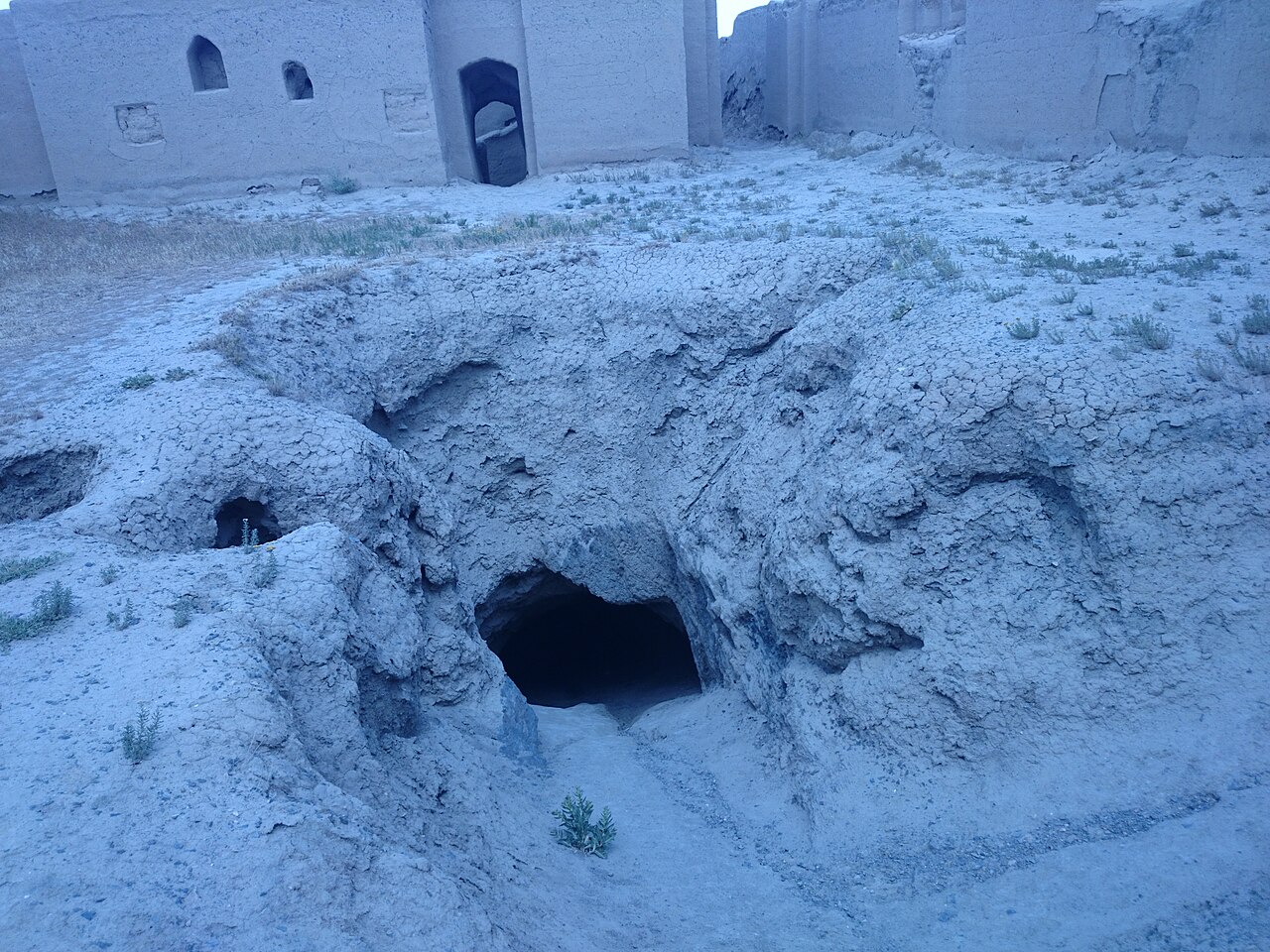
Three excavated sites show how the Median elite lived.
Godin Tepe, near Kangavar, was dug by a Canadian team under T. Cuyler Young between 1965 and 1973. In its Period II, of the 8th and 7th centuries BCE, the top of the mound held a walled manor with towers, storerooms and a large hall whose roof rested on rows of wooden columns.
Nush-i Jan, near Malayer, was excavated by David Stronach for the British Institute of Persian Studies from 1967 to 1977. On a rock outcrop stood a fort, a columned hall and two temples. The central temple, a tall building with a lozenge-shaped plan, held a stepped mudbrick fire altar. At some point, probably in the late 7th or early 6th century BCE, the temple was carefully filled with stones and shale up to its roof, as if to preserve or “bury” it, before the site was abandoned. A hoard of silver objects and spiral ornaments was found in the fort.
Baba Jan, in Lorestan, excavated by Clare Goff, had a fortified manor with a painted chamber.
The columned halls at these sites interest historians of architecture because they come before the great columned audience halls of the Achaemenid kings at Pasargadae and Persepolis. Many scholars see the Median halls as one of their ancestors.
The Magi
For Herodotus the Magi were both a Median tribe and the specialists in religion and dreams. They interpret Astyages’s dreams about his grandson, and after his defeat Astyages has them impaled for their bad advice (see the fall of Media). In his account of Persian customs he says no Persian sacrifice could take place without a magus present to chant a song of the gods’ origins (1.132).
The Magi kept this role under the Persians. The administrative tablets from Persepolis record men called makuš receiving rations for religious duties. The Behistun inscription calls the usurper who seized the throne in 522 BCE “Gaumata the magus”, and Herodotus says the Persians celebrated his overthrow with a “killing of the magi” (see Bardiya and Gaumata). Through Greek magos the word gave English “magic”, and the Magi who visit the infant Jesus in the Gospel of Matthew are “wise men from the East” of this tradition. In later Iran, the chief Zoroastrian priest was the mobad, a title that goes back to Middle Persian magupat, “chief of the magi”.
Fire and worship
The fire altar of Nush-i Jan is the strongest evidence that fire was at the centre of Median worship, as it was later for Zoroastrians. Whether the Medes followed the teaching of Zoroaster is unknown. The Magi appear as Zoroastrian priests in later centuries, but Herodotus never mentions Zoroaster, and some scholars think the Magi practised an older Iranian religion before adopting Zoroastrianism. The debates over Zoroaster’s date and teaching are on Zoroaster and the Avesta, and the faith of the Persian kings on religion in the Achaemenid empire.
What Persia took from Media
The Persians conquered the Medes, but in many ways they continued their state.
- Dress. On the Persepolis reliefs two styles of costume appear side by side: the long pleated Persian robe and the “Median” outfit of a rounded felt cap, a belted knee-length tunic, trousers and a short sword worn on the right hip. Herodotus says the Persians adopted Median dress because they thought it more handsome (1.135).
- Words of government. The language of the Medes is known only from names and from words borrowed into Old Persian. Linguists think several terms of royal administration came through Median; the Greek word “satrap”, for a provincial governor, is usually traced to a Median form rather than to the Old Persian xšaçapāvan.
- The court. Herodotus’s description of Deioces’s ceremonial, with the king hidden from sight and approached through officials, resembles the Persian court he knew, and Greek writers believed the Persians had inherited it from the Medes.
- People. Medes served as generals and guards. The Median delegation heads the procession of subject peoples on the Apadana reliefs at Persepolis (see the Apadana reliefs).
To the Greeks, Medes and Persians were so closely joined that siding with Persia was called “medising”, and the Book of Daniel speaks of “the law of the Medes and Persians, which cannot be changed”.
Persian words from this page
| مغ | mogh | magus, priest |
| موبد | mobad | Zoroastrian priest |
| آتشکده | âtashkadeh | fire temple |
| آتش | âtash | fire |
| نوشیجان | Nushijân | Nush-i Jan |
| ملایر | Malâyer | Malayer |
Sources and further reading
- Herodotus, Histories, Book 1, chapters 101, 107–108, 128, 131–135.
- David Stronach, “Independent Media: archaeological notes from the homeland”, in Continuity of Empire (?): Assyria, Media, Persia (2003).
- R. Schmitt, “Die Sprache der Meder: eine grosse Unbekannte”, in the same volume.
- Encyclopaedia Iranica, “Magi”.
- Encyclopaedia Iranica, “Godin Tepe”.
Want to learn Persian? Get the free Starter Pack
Get the 14-page printable Starter Pack (all 32 letters, a 7-day reading plan, 100 core words and 20 survival phrases) and a short 5-email course. Free.
More in The Median Empire (c. 728–550 BCE)
- The Rise of the Medes and Deioces
- Ecbatana (Hamadan): Capital of the Medes
- Phraortes, the Scythian Interregnum and Median Expansion
- Scythians and Cimmerians in Iran
- Cyaxares the Great and the Fall of Nineveh
- The Battle of the Eclipse: Medes against Lydia
- Astyages, the Last Median King
- The Fall of Media and the Persian Revolt
- Median Society, Magi and Religion
- Herodotus and the Medes: Myth or History?