Cyrus II, later called the Great, was born around 600 to 590 BCE into the royal family of Anshan in south-western Iran, became its king in 559 BCE and around 550 BCE defeated his Median overlord Astyages. That victory was the first step towards the Persian Empire. His childhood, by contrast, survives mainly as legend: Herodotus said he knew four different versions and chose the one he found most believable.
| Born | c. 600–590 BCE (year unknown) |
|---|---|
| Father | Cambyses I, king of Anshan |
| Mother | Mandane, daughter of Astyages, according to Herodotus and Xenophon |
| King of Anshan | from 559 BCE |
| Victory over Astyages | c. 550 BCE (Nabonidus Chronicle, year 6 of Nabonidus) |
| Persian name | کوروش Kurosh (Old Persian Kuruš) |

The firmest evidence: two Babylonian texts
The best information about Cyrus’s rise does not come from Greek storytellers but from Babylon, where scribes were watching events in Iran with interest. Two texts written within a generation of the war are the closest we have to contemporary reports.
The Nabonidus Chronicle, a year-by-year record kept in Babylon, says that in the sixth year of King Nabonidus (550/549 BCE) Astyages gathered his army and marched against “Cyrus, king of Anshan”. His own troops rebelled, seized him and handed him over to Cyrus. Cyrus then marched to Ecbatana, the Median capital, and carried its silver, gold and other treasures back to Anshan.
The second text is an inscription of Nabonidus from Sippar. In it the Babylonian king describes a dream in which the god Marduk promised that the Medes would be scattered. In the third year, the text says, Marduk raised up Cyrus, king of Anshan, “his young servant”, who with his small army defeated the Medes and took Astyages prisoner. Read together, the two texts suggest a conflict that began around 553 BCE and ended with the betrayal of Astyages around 550 BCE. Neither says anything about Cyrus’s birth or family ties to the Medes.
Herodotus: the child who should have died
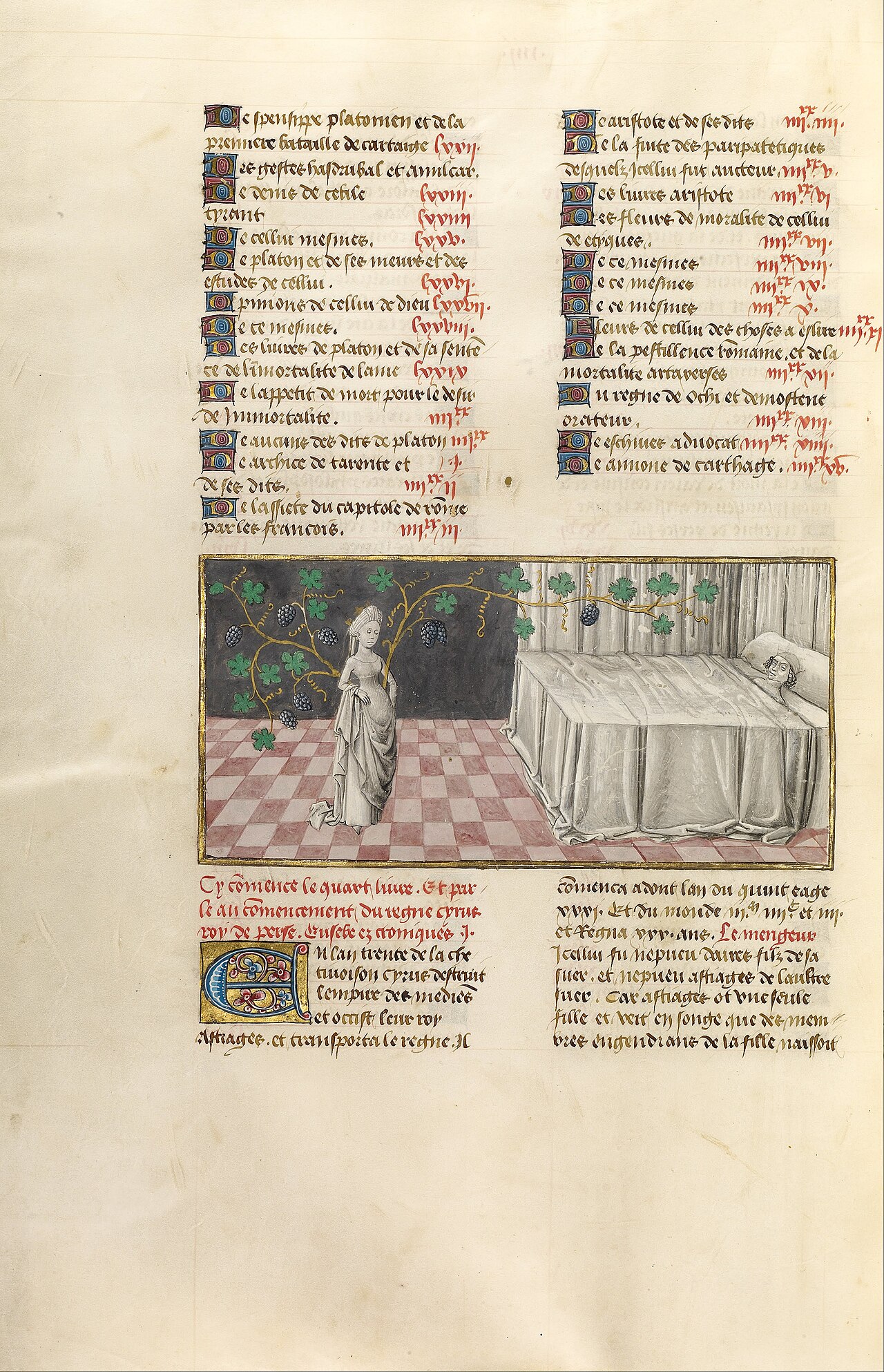
The most famous version is in Herodotus (1.107–130). He says Astyages dreamed twice about his daughter Mandane: once that she flooded all Asia, and once that a vine grew from her womb and covered it. Frightened, he married her to a Persian named Cambyses, a man of good family but quiet temper, and when she bore a son he ordered his kinsman Harpagus to kill the baby.
Harpagus passed the task to a royal herdsman, Mitradates, whose wife had just given birth to a stillborn child. The couple kept the prince and exposed their own dead son instead. At about ten years old the boy, playing “king” with village children, had a nobleman’s son whipped for disobeying him. The complaint reached Astyages, who recognised his grandson. The Magi advised that the dream had been fulfilled by the game, so the king sent Cyrus back to his parents in Persia, and took a terrible revenge on Harpagus by serving him his own son at a banquet. The Median side of this story, and what it says about Astyages, is told on Astyages, the Last Median King.
Herodotus adds a detail that matters for language learners. The herdsman’s wife, he says, was called Spako, the Median word for a female dog, and Cyrus’s parents later spread the story that a dog had suckled him to make his survival seem divine. Modern Persian سگ sag, “dog”, belongs to the same Iranian word family.
The other versions
Ctesias: the son of a Mardian bandit
Ctesias, a Greek doctor at the Persian court around 400 BCE, told a quite different story, preserved in summaries by Nicolaus of Damascus. In his account Cyrus was not related to Astyages at all. His father Atradates was a poor man of the Mardian tribe who lived by banditry, and his mother Argoste herded goats. Cyrus entered the Median palace as a servant, rose through the household to high office and then turned the Persians against their masters. Ctesias says that after his victory Cyrus married Astyages’s daughter Amytis.
Xenophon: the model prince
Xenophon’s Cyropaedia (Education of Cyrus), written in the fourth century BCE, makes Cyrus the son of a Persian king Cambyses and of Mandane, raised in strict Persian discipline and admired as a boy at his grandfather’s court. There is no exposure and no revolt: in Xenophon he inherits Media peacefully. The book is a political novel about ideal leadership, and historians do not use it as a record of events.
Justin and the dog
The later Roman summary by Justin turns Herodotus’s explanation into a straightforward miracle: the abandoned baby was found being suckled by a dog.
Why the stories look alike
The child who is condemned by a jealous king, rescued by humble people and recognised by his royal nature is a story pattern found across the ancient Near East and the Mediterranean. Sargon of Akkad, Moses, and Romulus and Remus all have versions of it. Most historians therefore treat the exposure tale as legend, not biography.
The legends still carry useful information. Herodotus’s version makes Cyrus half Median, which helped present Persian rule over Media as a rightful inheritance. Ctesias’s version reflects a different tradition in which Cyrus won power by merit and force. Both show what later Persians and Greeks thought a founder’s story needed. For more on how far Herodotus can be trusted on the Medes, see Herodotus and the Medes: Myth or History?
King of Anshan, 559 BCE
The date of Cyrus’s accession is worked out backwards. Herodotus says he reigned 29 years, and Babylonian documents show that he died in 530 BCE, which gives 559 BCE. He succeeded his father Cambyses I as king of Anshan, a small highland kingdom in Fars whose background is explained on Achaemenes, Teispes and the Early Persian Kings of Anshan.
Greek writers describe the Persians of this time as subjects of the Medes. How tight that control was is debated: many historians now doubt that the Medes ran a centralised empire, and see instead a powerful confederation whose leader collected tribute and loyalty from neighbours such as Anshan.
The revolt against Astyages
Herodotus says the revolt began when Harpagus, still nursing his grievance, sent Cyrus a secret letter sewn inside a hare. Cyrus then gathered the Persian tribes, made them spend one day clearing a field of thorns and the next day feasting, and asked which life they preferred. Whatever the truth of the story, Herodotus names the tribes who followed him, led by the Pasargadae, the Maraphii and the Maspii.
The fighting probably lasted several seasons. Later writers place a final battle near the site where Cyrus would build his capital, and Strabo says Pasargadae was founded at the place of his victory. The decisive moment agrees in both Herodotus and the Nabonidus Chronicle: much of the Median army deserted or turned on Astyages. Herodotus adds that Cyrus spared the old king and kept him at court. The campaign itself is covered in detail on The Fall of Media and the Persian Revolt.
What the victory gave Cyrus
Taking Ecbatana gave Cyrus a treasury, a trained army and the loyalty, or at least the service, of a large Median nobility. Medes such as Harpagus and Mazares became his generals in the west. Median court customs and titles passed into the new Persian state, and for generations Greeks spoke of “the Mede” when they meant the Persians.
It also put Cyrus face to face with the other great powers that had divided the old Assyrian world: Lydia in Anatolia and Babylon in Mesopotamia. His next campaign is told on Cyrus Conquers Lydia. For an overview of his whole life and reign, read the site’s guide to Cyrus the Great.
Persian words from this page
| کوروش | Kurosh | Cyrus |
| آستیاگ | Âstiyâg | Astyages |
| ماندانا | Mândânâ | Mandane |
| هارپاگ | Hârpâg | Harpagus |
| ماد | Mâd | Media, the land of the Medes |
| هگمتانه | Hegmatâne | Ecbatana (modern Hamadan) |
| سگ | sag | dog |
Sources and further reading
- Herodotus, Histories 1.95 and 1.107–130.
- The Nabonidus Chronicle (ABC 7), in A. K. Grayson, Assyrian and Babylonian Chronicles (1975); the Sippar cylinder of Nabonidus, translated in A. Kuhrt, The Persian Empire: A Corpus of Sources (2007).
- Ctesias, Persica, in L. Llewellyn-Jones and J. Robson, Ctesias’ History of Persia: Tales of the Orient (Routledge, 2010).
- Xenophon, Cyropaedia, books 1 and 8.
- Encyclopaedia Iranica, “Cyrus iii. Cyrus II the Great”.
- Pierre Briant, From Cyrus to Alexander: A History of the Persian Empire (Eisenbrauns, 2002), chapter 1.
Want to learn Persian? Get the free Starter Pack
Get the 14-page printable Starter Pack (all 32 letters, a 7-day reading plan, 100 core words and 20 survival phrases) and a short 5-email course. Free.
More in The Achaemenid Empire (550–330 BCE)
- Achaemenes, Teispes and the Early Persian Kings of Anshan
- Cyrus the Great: Birth, Legends and Rise to Power
- Cyrus Conquers Lydia: Croesus and the Battle of Thymbra
- The Persian Conquest of Ionia and Asia Minor
- Cyrus Takes Babylon (539 BCE)
- The Cyrus Cylinder
- Cyrus and the Return of the Jews
- The Death of Cyrus and the Massagetae
- Pasargadae: Cyrus’s Capital and Tomb
- The Tomb of Cyrus through History
- Cambyses II
- Cambyses Conquers Egypt: The Battle of Pelusium
- Bardiya and Gaumata: The Usurper Question
- Darius the Great Takes the Throne
- The Great Revolts of 522–521 BCE
- The Behistun Inscription
- The Persian Conquest of the Indus Valley
- Darius’s Scythian Campaign
- Darius’s Canal from the Nile to the Red Sea
- Darius’s Reforms: Satrapies, Taxes and Law
- The Royal Road and the Persian Postal System
- The Daric: Achaemenid Coinage and Economy
- The Ionian Revolt (499–493 BCE)
- The Greco-Persian Wars: An Overview
- Mardonius and the First Persian Expedition to Greece (492 BCE)
- The Battle of Marathon (490 BCE)
- The Death of Darius I and the Succession of Xerxes
- The Royal Tombs of Naqsh-e Rostam
- Xerxes I: King of Kings (486–465 BCE)
- Xerxes’ Invasion of Greece (480–479 BCE)
- The Battle of Thermopylae (480 BCE)
- The Battle of Artemisium (480 BCE)
- The Persian Capture of Athens (480–479 BCE)
- The Battle of Salamis (480 BCE)
- The Battle of Plataea and the End of the Invasion (479 BCE)
- The Palace of Darius at Susa
- Building Persepolis: How Darius and Xerxes Built Parsa
- The Persepolis Fortification and Treasury Tablets
- Herodotus and the Persians
- The Apadana Reliefs: Nations Bringing Gifts
- The Achaemenid Paradise Gardens
- The Persian Immortals and the Achaemenid Army
- The Achaemenid Navy
- Religion of the Achaemenid Kings
- Women of the Achaemenid Court
- Old Persian Language and Cuneiform
- Egypt under Persian Rule
- Babylon under Persian Rule
- Artaxerxes I
- The Peace of Callias
- Darius II and the Peloponnesian War
- Famous Satraps of the Persian Empire
- Artaxerxes II Mnemon
- Cyrus the Younger and the Battle of Cunaxa
- The King’s Peace (387 BCE)
- The Great Satraps’ Revolt
- Artaxerxes III and the Reconquest of Egypt
- Darius III, the Last Achaemenid King
- The Battle of the Granicus (334 BCE)
- The Battle of Issus (333 BCE)
- Alexander Takes Tyre, Gaza and Egypt (332 BCE)
- The Battle of Gaugamela (331 BCE)
- Ariobarzanes and the Battle of the Persian Gate
- The Burning of Persepolis (330 BCE)
- The Death of Darius III and Bessus
- The Legacy of the Achaemenid Empire