The Battle of the Eclipse was fought between the Medes under Cyaxares and the Lydians under Alyattes in central Anatolia, after a war of five years. Herodotus says day suddenly turned to night in the middle of the fighting, and both armies stopped and made peace, with the Halys River (today’s Kızılırmak in Turkey) as their border. The eclipse is usually identified with the total solar eclipse of 28 May 585 BCE, which makes this one of the earliest battles that can be dated to a single day.
| Date | Probably 28 May 585 BCE (other dates proposed: 610 and 603 BCE) |
|---|---|
| Place | Central Anatolia, probably near the Halys River; exact site unknown |
| Medes | King Cyaxares |
| Lydians | King Alyattes |
| Result | Fighting stopped; peace treaty; Halys River fixed as the border |
| Main source | Herodotus, Histories 1.73–74 |

Two expanding kingdoms
After the destruction of Assyria in 612–609 BCE the Medes extended their power north-west, over the former kingdom of Urartu in the Armenian highlands and into eastern Anatolia (see Cyaxares and the fall of Nineveh). At the same time Lydia, ruled from Sardis in western Asia Minor, was growing under the Mermnad kings. Alyattes had recovered from the Cimmerian raids that killed his grandfather Gyges and was pushing east across the Anatolian plateau. Sooner or later the two powers were bound to meet.
Herodotus’s cause of the war
Herodotus (1.73) gives a grim story as the cause. A band of Scythian nomads had come to Media as refugees, and Cyaxares welcomed them. He trusted them so much that he gave them Median boys to teach their language and the use of the bow. The Scythians went out hunting every day and brought back game. One day they came back with nothing, and Cyaxares, who was quick to anger, treated them harshly.
The Scythians took revenge. They killed one of the boys in their care, prepared his flesh like game and served it to Cyaxares, then fled to Alyattes at Sardis. When Cyaxares demanded them back, Alyattes refused, and war followed.
The story belongs to a familiar Greek type, the cannibal feast that brings ruin, which Herodotus uses again in the tale of Harpagus and Astyages (see Astyages, the last Median king). Historians accept that there was a war but treat the cause as legend. The real reason was competition for the lands between the two kingdoms.
Day turns into night
The war lasted five years, Herodotus says, with victories on both sides, and once there was a battle at night. In the sixth year the armies met again. As they were fighting, “day was suddenly turned into night”. Both sides were alarmed, stopped fighting and became eager to make peace.
Herodotus adds that Thales of Miletus, the Greek philosopher, had foretold to the Ionians that this eclipse would happen, naming the year in which it took place.
Dating the eclipse
Astronomers can calculate which total solar eclipses crossed Anatolia in this period. The strongest candidate is the eclipse of 28 May 585 BCE (in the Julian calendar), whose path of totality crossed Asia Minor in the late afternoon. The Roman writer Pliny the Elder dates Thales’s eclipse to the fourth year of the 48th Olympiad, which corresponds to 585/584 BCE, matching it well. In the 19th century some scholars argued for earlier eclipses in 610 or 603 BCE, but the calculation of the eclipse paths and the fit with Pliny make 585 BCE the date accepted by most historians.
Thales and the prediction
Whether Thales really predicted the eclipse is much doubted. Babylonian astronomers kept long records and knew cycles that could warn that an eclipse was possible, but in the 6th century BCE nobody could reliably say where on Earth a solar eclipse would be total. Thales may have heard of Babylonian methods and made a lucky forecast, or the story may have grown up later around a famous wise man.
The peace treaty
Two rulers acted as mediators: Syennesis of Cilicia and Labynetus of Babylon. “Labynetus” is Herodotus’s name for a Babylonian king; here it most likely refers to Nebuchadnezzar II, Cyaxares’s ally, or to a high official of his who later became king as Nabonidus. The treaty was sealed by a marriage: Alyattes’s daughter Aryenis became the wife of Astyages, the son of Cyaxares.
Herodotus also describes the oath ceremony. The Medes and Lydians swore oaths in the same way as the Greeks, he says, but added a custom of their own: each party cut the skin of the arm and licked the other’s blood.
The Halys frontier
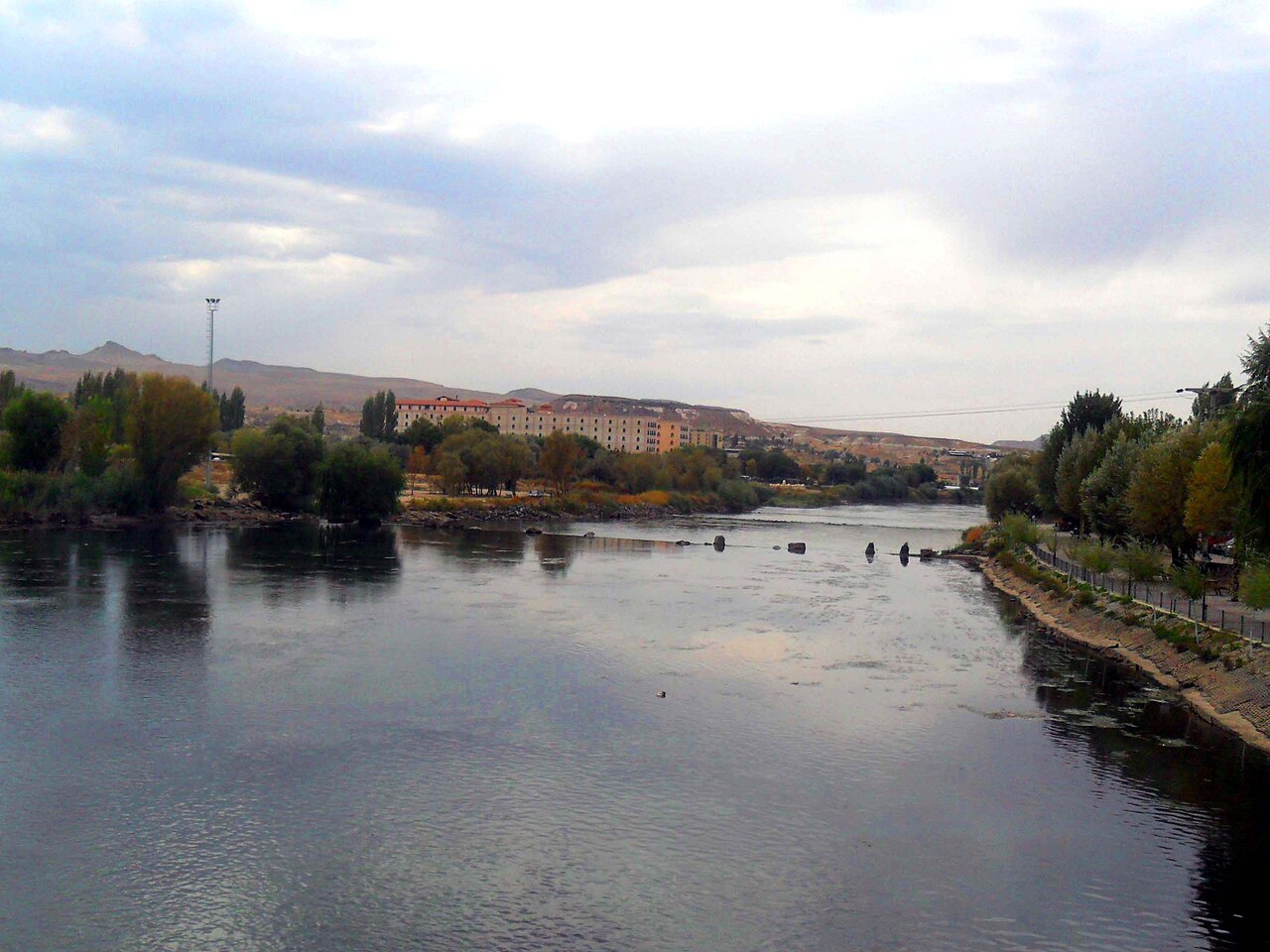
The treaty left the Halys River as the boundary between Lydia to the west and the Medes to the east (Herodotus 1.72 and 1.74). The Halys, today the Kızılırmak or “red river”, is the longest river in Turkey, curving through central Anatolia to the Black Sea. The frontier held for about 35 years, until the Median kingdom fell to Cyrus. In 547 BCE Croesus, the son of Alyattes, crossed the Halys to attack the Persians, and the war that followed ended with the fall of Sardis (see Cyrus conquers Lydia).
The reach of Median power
Some historians, such as Robert Rollinger, doubt that the Medes ever controlled central Anatolia and argue that Herodotus’s Halys border reflects the later Persian frontier. Others point to Kerkenes Dağ, a huge fortified city on a mountain east of the Halys, which the archaeologist Geoffrey Summers once suggested was a Median foundation; later work has led many to see it as Phrygian instead. The debate on the size of Median rule is part of a wider question, discussed on Herodotus and the Medes: myth or history?
Persian words from this page
| خورشیدگرفتگی | khorshid-gereftegi | solar eclipse |
| لیدی | Lidi | Lydia |
| جنگ | jang | war, battle |
| صلح | solh | peace |
| مرز | marz | border |
| رود | rud | river |
Sources and further reading
- Herodotus, Histories, Book 1, chapters 72–74.
- Pliny the Elder, Natural History, Book 2, chapter 53.
- R. Rollinger, “The western expansion of the Median ’empire’: a re-examination”, in Continuity of Empire (?): Assyria, Media, Persia (2003).
- Encyclopaedia Iranica, “Cyaxares“.
- F. R. Stephenson, Historical Eclipses and Earth’s Rotation (1997).
Want to learn Persian? Get the free Starter Pack
Get the 14-page printable Starter Pack (all 32 letters, a 7-day reading plan, 100 core words and 20 survival phrases) and a short 5-email course. Free.
More in The Median Empire (c. 728–550 BCE)
- The Rise of the Medes and Deioces
- Ecbatana (Hamadan): Capital of the Medes
- Phraortes, the Scythian Interregnum and Median Expansion
- Scythians and Cimmerians in Iran
- Cyaxares the Great and the Fall of Nineveh
- The Battle of the Eclipse: Medes against Lydia
- Astyages, the Last Median King
- The Fall of Media and the Persian Revolt
- Median Society, Magi and Religion
- Herodotus and the Medes: Myth or History?