Around 547 BCE, though the exact year is disputed, Cyrus the Great defeated Croesus, the famously rich king of Lydia, captured his capital Sardis after a siege of about two weeks and took control of western Anatolia. The conquest gave Persia the wealth of Lydia and made it a direct neighbour of the Greek world. The “Battle of Thymbra” that many books name comes from Xenophon’s idealised Cyropaedia; our main source, Herodotus, describes instead a battle on the plain outside Sardis.
| Date | c. 547 BCE (traditional); some historians argue for a date in the early 540s |
|---|---|
| Opponents | Cyrus II of Persia against Croesus of Lydia (r. c. 560–547 BCE) |
| Main engagements | Pteria in Cappadocia (indecisive); the plain before Sardis (Persian victory); siege of Sardis |
| Siege length | 14 days, according to Herodotus |
| Result | Lydia became a Persian province with its seat at Sardis (Old Persian Sparda) |

Why Croesus went to war
Lydia and Media had fought each other in the 580s BCE until a solar eclipse halted a battle and a peace fixed their border on the river Halys (the modern Kızılırmak), a story told on The Battle of the Eclipse. The peace was sealed by a marriage: Croesus’s sister Aryenis became the wife of Astyages. When Cyrus overthrew Astyages around 550 BCE, Croesus lost a brother-in-law and gained an ambitious new neighbour.
Herodotus (1.46–56) says Croesus first tested the Greek oracles and then asked Delphi whether to attack Persia. The answer became proverbial: if he crossed the Halys, he would destroy a great empire. He also made alliances with Amasis of Egypt, Nabonidus of Babylon and the Spartans. Whatever his motives, revenge for Astyages, fear of Cyrus or simple expansion, he struck first.
The first campaign: Pteria
Croesus crossed the Halys into Cappadocia, captured the city of Pteria and enslaved its people. Cyrus marched west, gathering troops on the way, and the two armies fought near Pteria. Herodotus says the battle was hard and ended at nightfall with neither side winning.
Croesus then made the decision that cost him his kingdom. Since his army was smaller, he withdrew to Sardis, dismissed his foreign troops for the winter and sent to his allies to gather in the spring, five months later. He did not expect Cyrus to follow him so late in the campaigning season.
Camels on the plain of Sardis
Cyrus did follow, quickly enough that he arrived before news of his coming. Croesus led out the Lydian cavalry, then among the best in Asia, onto the plain in front of the city.
Herodotus (1.80) credits the Median general Harpagus with a stratagem. The baggage camels were unloaded, mounted with riders and sent in front of the army. Horses cannot bear the sight and smell of camels, Herodotus explains, and the Lydian horses turned and bolted. The Lydian riders jumped down and fought on foot, bravely by his account, but they were driven back inside the walls.
The fall of Sardis
The siege lasted fourteen days. Herodotus (1.84) tells how it ended: a Mardian soldier named Hyroeades saw a Lydian climb down a sheer, unguarded stretch of the citadel to pick up a fallen helmet, and climbed up the same way. Others followed, and the city fell. Herodotus explains that this part was left unguarded because it was thought too steep to need defending.
Excavations at Sardis give the event a grim physical reality. Archaeologists working on the city’s western fortification found a thick burnt layer from the mid-sixth century BCE, mudbrick fused by fire, 136 bronze and iron arrowheads near a gate, an iron and bronze helmet, and the unburied skeletons of two young soldiers with weapon wounds. A small silver coin of Croesus’s type lay beside one skull. Crawford Greenewalt and Nicholas Cahill of the Sardis Expedition link this destruction to the Persian capture.
The “Battle of Thymbra”
Xenophon’s Cyropaedia (book 7) describes a large set-piece battle at a place called Thymbrara, with Egyptian infantry fighting for Croesus, Persian scythed chariots and moving siege towers. Modern military histories sometimes repeat it as “the Battle of Thymbra, 546 BCE”.
Most historians are cautious. The Cyropaedia is a work of political fiction about ideal kingship, written about 150 years later, and its battle has anachronisms such as scythed chariots, which are not attested so early. Its place name cannot be securely located. If there was one decisive battle, Herodotus’s account of the fight outside Sardis is the closer source, although he too wrote a century after the event.
What happened to Croesus
The fate of Croesus became one of the most retold stories of antiquity, and the versions contradict each other.
- Herodotus (1.86–90): Cyrus placed Croesus in chains on a pyre with fourteen Lydian boys. Croesus called out the name of Solon, the Athenian who had warned him that no one should be called happy before his death. Moved, Cyrus ordered the fire put out, but it had taken hold until Apollo sent a sudden rainstorm. Croesus then became Cyrus’s adviser, and Herodotus later shows him advising both Cyrus and Cambyses.
- Bacchylides (Ode 3, 468 BCE): Croesus climbed the pyre willingly with his family to avoid slavery. Zeus quenched the flames and Apollo carried the old king away to the land of the Hyperboreans.
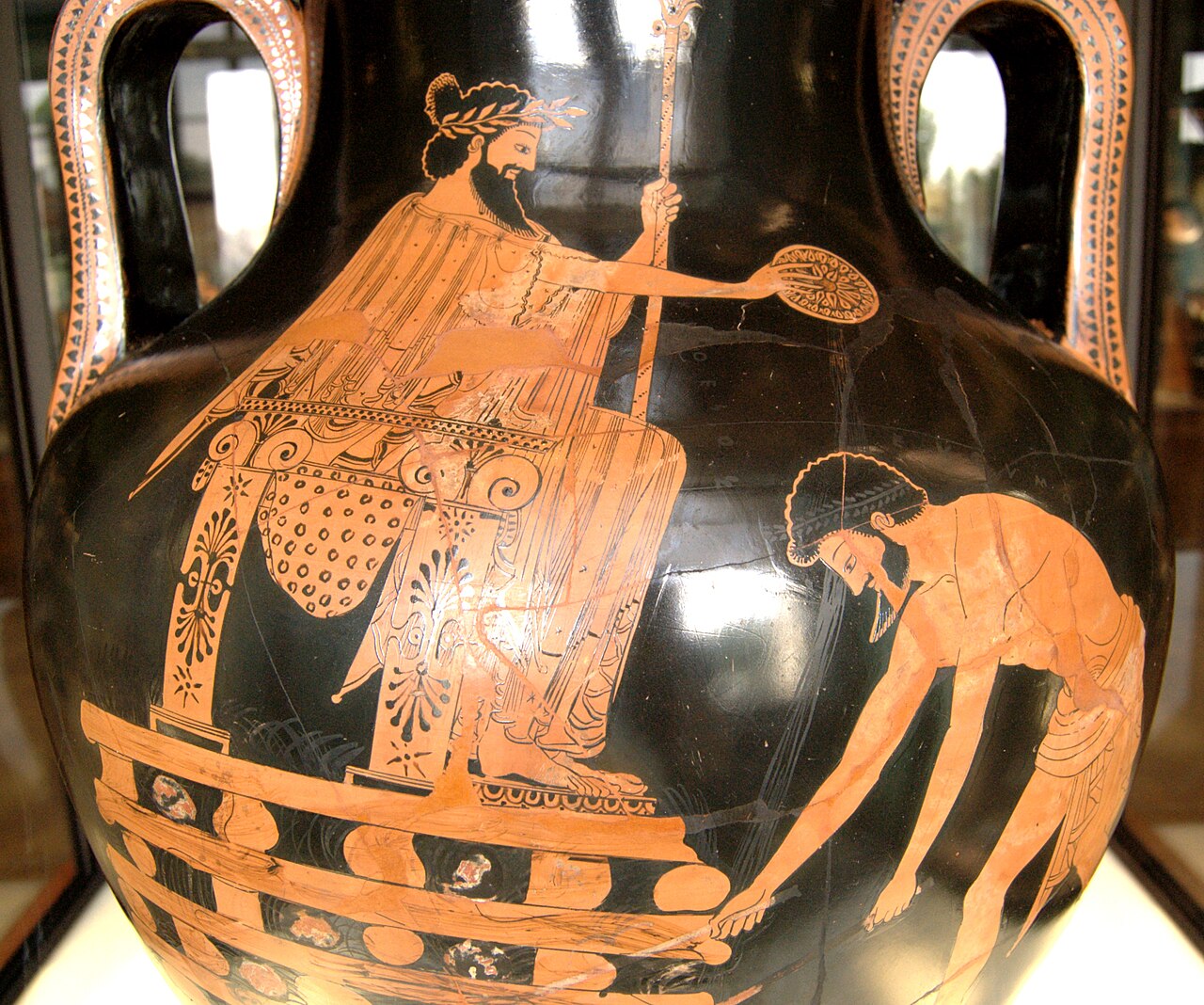
- The Myson amphora (c. 500–490 BCE): the earliest image, shown above, has Croesus enthroned on the pyre pouring a libation, which fits a voluntary, ritual death better than an execution.
- Ctesias: Croesus was spared and given a city near Ecbatana.
If the Babylonian Nabonidus Chronicle refers to Lydia (see below), it says Cyrus “killed its king”, which would mean Croesus did not survive. Many historians think the pyre stories began as accounts of his death and were softened into a tale of rescue and wisdom.
The date problem
The date of 547 BCE rests on one damaged line. The Nabonidus Chronicle says that in the ninth year of Nabonidus (547/546 BCE) Cyrus marched against a country whose name is broken, killed its king and left a garrison. The surviving sign was long restored as “Lydia”. Some scholars, including Robert Rollinger, have argued that the sign does not fit and that the country was Urartu in eastern Anatolia. On that view Sardis could have fallen a few years later. Recent collations of the tablet at the British Museum have revived the Lydia reading, so the question remains open; 547 BCE is a convenient date, not a certain one.
Lydia under Persia
Cyrus left a Persian, Tabalus, in charge of the citadel and a Lydian, Pactyes, to collect the treasury. Pactyes almost at once rebelled with Lydian and Greek support, which led to the Persian campaigns described on The Persian Conquest of Ionia and Asia Minor. Sardis became the main Persian capital in the west and the western end of the later Royal Road. Lydia’s gold and silver coinage, among the earliest in the world, continued under Persian rule until Darius introduced the daric, discussed on The Daric: Achaemenid Coinage and Economy.
For the wider story of Cyrus’s reign, see the site’s main article on Cyrus the Great.
Persian words from this page
| کرزوس | Kerzus | Croesus |
| لیدیه | Lidiye | Lydia |
| سارد | Sârd | Sardis |
| شتر | shotor | camel |
| اسب | asb | horse |
| طلا | talâ | gold |
Sources and further reading
- Herodotus, Histories 1.46–94.
- Xenophon, Cyropaedia, book 7; Bacchylides, Ode 3.
- The Nabonidus Chronicle (ABC 7), in A. K. Grayson, Assyrian and Babylonian Chronicles (1975).
- N. Cahill, “The Persian Sack of Sardis”, in N. Cahill (ed.), The Lydians and Their World (Istanbul, 2010).
- Pierre Briant, From Cyrus to Alexander: A History of the Persian Empire (Eisenbrauns, 2002).
- Amélie Kuhrt, The Persian Empire: A Corpus of Sources from the Achaemenid Period (Routledge, 2007).
Want to learn Persian? Get the free Starter Pack
Get the 14-page printable Starter Pack (all 32 letters, a 7-day reading plan, 100 core words and 20 survival phrases) and a short 5-email course. Free.
More in The Achaemenid Empire (550–330 BCE)
- Achaemenes, Teispes and the Early Persian Kings of Anshan
- Cyrus the Great: Birth, Legends and Rise to Power
- Cyrus Conquers Lydia: Croesus and the Battle of Thymbra
- The Persian Conquest of Ionia and Asia Minor
- Cyrus Takes Babylon (539 BCE)
- The Cyrus Cylinder
- Cyrus and the Return of the Jews
- The Death of Cyrus and the Massagetae
- Pasargadae: Cyrus’s Capital and Tomb
- The Tomb of Cyrus through History
- Cambyses II
- Cambyses Conquers Egypt: The Battle of Pelusium
- Bardiya and Gaumata: The Usurper Question
- Darius the Great Takes the Throne
- The Great Revolts of 522–521 BCE
- The Behistun Inscription
- The Persian Conquest of the Indus Valley
- Darius’s Scythian Campaign
- Darius’s Canal from the Nile to the Red Sea
- Darius’s Reforms: Satrapies, Taxes and Law
- The Royal Road and the Persian Postal System
- The Daric: Achaemenid Coinage and Economy
- The Ionian Revolt (499–493 BCE)
- The Greco-Persian Wars: An Overview
- Mardonius and the First Persian Expedition to Greece (492 BCE)
- The Battle of Marathon (490 BCE)
- The Death of Darius I and the Succession of Xerxes
- The Royal Tombs of Naqsh-e Rostam
- Xerxes I: King of Kings (486–465 BCE)
- Xerxes’ Invasion of Greece (480–479 BCE)
- The Battle of Thermopylae (480 BCE)
- The Battle of Artemisium (480 BCE)
- The Persian Capture of Athens (480–479 BCE)
- The Battle of Salamis (480 BCE)
- The Battle of Plataea and the End of the Invasion (479 BCE)
- The Palace of Darius at Susa
- Building Persepolis: How Darius and Xerxes Built Parsa
- The Persepolis Fortification and Treasury Tablets
- Herodotus and the Persians
- The Apadana Reliefs: Nations Bringing Gifts
- The Achaemenid Paradise Gardens
- The Persian Immortals and the Achaemenid Army
- The Achaemenid Navy
- Religion of the Achaemenid Kings
- Women of the Achaemenid Court
- Old Persian Language and Cuneiform
- Egypt under Persian Rule
- Babylon under Persian Rule
- Artaxerxes I
- The Peace of Callias
- Darius II and the Peloponnesian War
- Famous Satraps of the Persian Empire
- Artaxerxes II Mnemon
- Cyrus the Younger and the Battle of Cunaxa
- The King’s Peace (387 BCE)
- The Great Satraps’ Revolt
- Artaxerxes III and the Reconquest of Egypt
- Darius III, the Last Achaemenid King
- The Battle of the Granicus (334 BCE)
- The Battle of Issus (333 BCE)
- Alexander Takes Tyre, Gaza and Egypt (332 BCE)
- The Battle of Gaugamela (331 BCE)
- Ariobarzanes and the Battle of the Persian Gate
- The Burning of Persepolis (330 BCE)
- The Death of Darius III and Bessus
- The Legacy of the Achaemenid Empire