Ctesiphon was the capital of the Parthian and then the Sasanian Empire for about 800 years, from the 2nd century BCE until the Arab conquest in 637 CE. It stood on the east bank of the Tigris, about 35 km southeast of modern Baghdad, facing the Greek city of Seleucia across the river. Its ruins, including the great brick arch of Taq Kasra, lie near the town of Salman Pak in Iraq.
| Location | East bank of the Tigris, near Salman Pak, Iraq |
|---|---|
| Founded | A settlement by the Seleucid period; Parthian royal residence from the late 2nd century BCE |
| Capital of | Parthian (Arsacid) Empire; Sasanian Empire, 226–637 CE |
| Sacked by Rome | 116, 165 and 197/198 CE |
| Captured by the Arabs | 637 CE |
| Other names | Persian Tisfun (تیسفون); Arabic al-Madâ’en, “the cities”; Aramaic Mahoze |
A camp across the river from Seleucia
When the Parthian king Mithridates I conquered Mesopotamia around 141 BCE, the leading city of the region was Seleucia on the Tigris, founded by Alexander’s general Seleucus I around 305 BCE. It was a large, self-governing Greek city with its own council and a mixed population of Greeks, Babylonians, Syrians and Jews.
The Parthian kings did not move into Seleucia. Instead they used a site on the opposite bank, already known by the Greek name Ctesiphon in the Seleucid period. The geographer Strabo, writing around the start of the Common Era, says the kings spent their winters there because of its mild climate, and did so to spare the Seleucians from having Scythian soldiers quartered among them. He calls it a village that had grown to the size of a city. Pliny the Elder, by contrast, says the Parthians founded Ctesiphon to drain the life out of Seleucia, and the city’s later history suggests both motives were real.
The Parthian court moved with the seasons. Summers were spent on the cooler Iranian plateau, at Ecbatana (Hamadan) and elsewhere, and winters at Ctesiphon. Over time Ctesiphon became the main royal seat and the centre of Parthian government in the west. The earlier capitals are covered on the pages Nisa: The First Parthian Capital and Hamadan.
A target for Roman armies
Its position on the Tigris made Ctesiphon both rich and exposed. Roman armies could reach it by sailing down the Euphrates and crossing to the Tigris on the canals that joined the two rivers. Trajan took it in 116 CE and captured the Parthian king’s golden throne. Avidius Cassius burned the royal palace in 165, and Septimius Severus sacked the city in 197 or 198, carrying off, Cassius Dio says, about 100,000 captives. The stories are told on Trajan’s Invasion of Parthia and Roman Campaigns of the 2nd Century.
Each time, the Parthian kings returned once the Romans had gone, which shows how the empire worked. The capital was a place of residence and administration, not the source of royal power. That rested with the noble houses and armies of the Iranian plateau, which no Roman army ever reached.

The Sasanian capital
Ardashir I, founder of the Sasanian dynasty, took Ctesiphon soon after his victory over the last Parthian king in 224, probably in 226, and made it his capital. Across the river, on or beside the ruins of Seleucia, he built a new round city called Veh-Ardashir, “the good city of Ardashir”. Over the following centuries more towns grew up on both banks, and the whole urban complex became known in Aramaic as Mahoze, “the cities”, and in Arabic as al-Madâ’en, with the same meaning.
Ctesiphon under the Sasanians was the seat of the King of Kings, the treasury and the central bureaucracy, though the court still spent part of the year elsewhere. Its population was very mixed. Aramaic-speaking Christians made it the seat of the head of the Church of the East, and the Council of Seleucia-Ctesiphon in 410 organised that church within the Persian empire. A large Jewish community lived nearby, and the Babylonian Talmud mentions Mahoza often.
Roman armies came again. In 363 the emperor Julian won a battle outside the walls but did not attempt a siege, and was killed on the retreat; see Julian’s Invasion of Persia (363). In 627–628 the Byzantine emperor Heraclius advanced close to the city during his last war with Khosrow II, but did not take it.
Taq Kasra
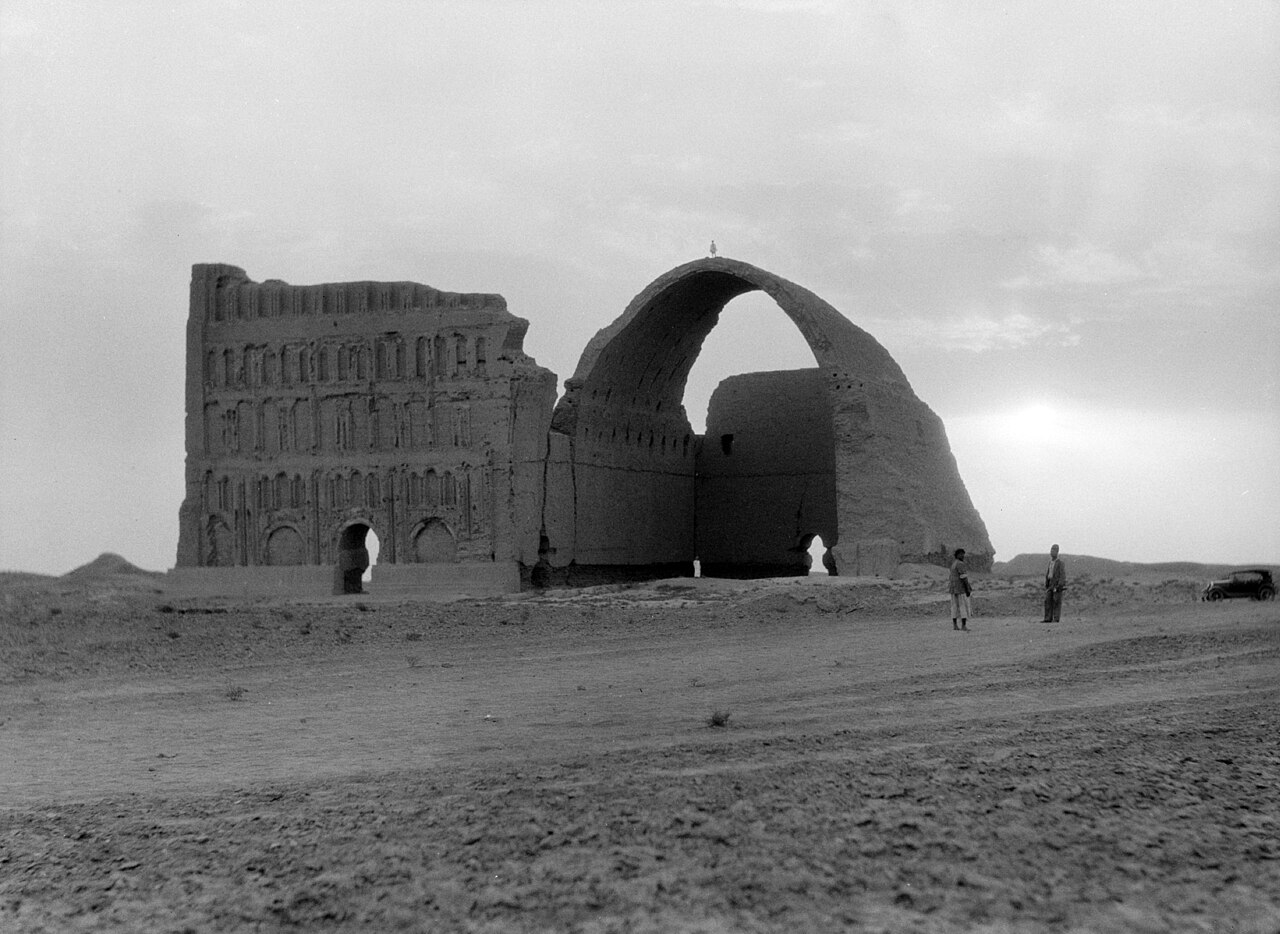
The most famous building of Ctesiphon is the great vaulted hall known as Taq Kasra, the “arch of Khosrow”. Its brick vault, roughly 37 m high, was one of the largest of the ancient world. Its date is debated: most scholars attribute it to Khosrow I in the 6th century, though some argue for Shapur I in the 3rd. Its construction and later history are covered on the page Taq Kasra: The Arch of Ctesiphon.
The fall of the city, 637
After their victory at al-Qadisiyya, Arab Muslim armies under Sa’d ibn Abi Waqqas crossed the Tigris and entered al-Madâ’en in 637. The last Sasanian king, Yazdegerd III, had already fled to the Iranian plateau. Arab historians describe enormous booty, including a vast carpet from the royal palace, which was cut up and shared among the soldiers. This episode is told on the page The Fall of Ctesiphon.
Under the early caliphs al-Madâ’en remained a provincial town. After 762, when the Abbasid caliph al-Mansur founded Baghdad a short distance upstream, it declined quickly. A well-known story says that al-Mansur wanted to pull down Taq Kasra for building material and gave up because the cost of demolition was greater than the value of the bricks. Baghdad itself drew on the bricks of the old cities for centuries.
What remains
Most of Ctesiphon is now low mounds, fields and the shifting bed of the Tigris, which has washed away parts of the site. German expeditions in 1928–29 and a joint German and American expedition with the Metropolitan Museum of Art in 1931–32 excavated houses, a church and parts of the walls, and found stucco decoration now in museums in Berlin and New York. Italian archaeologists from Turin worked at Veh-Ardashir and Seleucia from the 1960s.
The arch of Taq Kasra still stands, though much damaged. The town nearby is named Salman Pak after Salman the Persian, the companion of the Prophet Muhammad, who according to tradition governed al-Madâ’en and is buried there. For Iranians the site has long been a symbol of the lost glory of the Sasanians: the 12th-century poet Khaqani wrote a famous ode, the “Ayvân-e Madâ’en”, on standing among its ruins.
Persian words from this page
| تیسفون | Tisfun | Ctesiphon |
| مدائن | Madâ’en | “the cities”, al-Mada’in |
| طاق کسری | Tâq-e Kasrâ | Taq Kasra, the arch of Khosrow |
| ایوان | eyvân | iwan, vaulted hall |
| دجله | Dejle | the Tigris |
| پایتخت | pâytakht | capital city |
Sources and further reading
- Strabo, Geography 16.1.16; Pliny the Elder, Natural History 6.122.
- Encyclopaedia Iranica, “Ctesiphon” (J. Kröger).
- Al-Tabari, History of Prophets and Kings, the conquest of al-Mada’in (English translation vol. 13, SUNY Press).
- Josef Wiesehöfer, Ancient Persia from 550 BC to 650 AD (I. B. Tauris).
- Touraj Daryaee, Sasanian Persia: The Rise and Fall of an Empire (I. B. Tauris, 2009).
Want to learn Persian? Get the free Starter Pack
Get the 14-page printable Starter Pack (all 32 letters, a 7-day reading plan, 100 core words and 20 survival phrases) and a short 5-email course. Free.
More in The Parthian Empire (247 BCE–224 CE)
- The Parni and Arsaces I
- Nisa: The First Parthian Capital
- Mithridates I and the Making of an Empire
- Phraates II, Artabanus I and the Saka Invasions
- Mithridates II the Great
- The Parthians and the Silk Road
- Parthian Cavalry: Cataphracts and the Parthian Shot
- Surena and the Battle of Carrhae (53 BCE)
- Orodes II and Prince Pacorus
- Mark Antony’s Parthian War
- Phraates IV and the Peace with Augustus
- Queen Musa of Parthia
- Artabanus II of Parthia
- Gotarzes II and Vardanes: A Royal Rivalry
- Vologases I and the War over Armenia
- Trajan’s Invasion of Parthia
- Osroes I and the Parthian Civil Wars
- Roman Campaigns of the 2nd Century: Lucius Verus and Septimius Severus
- The Last Parthian Kings: Vologases V, Vologases VI and Artabanus IV
- The Fall of the Parthian Empire
- Ctesiphon: Capital of Two Empires
- The Great Houses of Parthia
- Religion and Culture in Parthian Iran
- Parthian Art and Architecture
- Parthian Coins and What They Tell Us
- Hatra: The City that Resisted Rome
- The Parthian Language and Its Records
- The Indo-Parthians and Kushans
- The Parthian Legacy