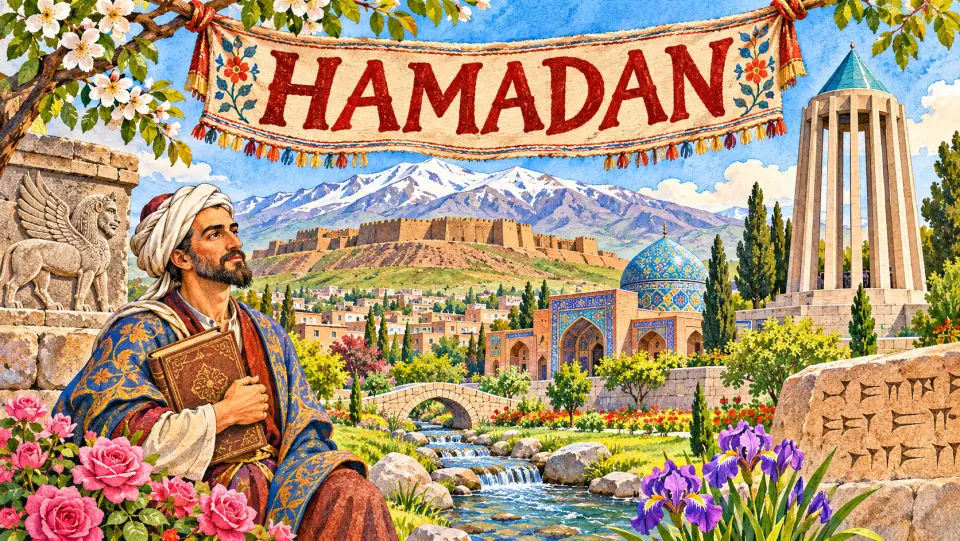
Hamadan (همدان, Hamedân) in western Iran is one of the oldest cities in the world still inhabited, the site of Ecbatana, capital of the Medes and later a summer residence of the Achaemenid kings. It is also the burial place of the philosopher and physician Avicenna, who died here in 1037. The city had 554,406 inhabitants at the 2016 census.
| Persian name | همدان (Hamedân); ancient Hagmatâna, Greek Ekbatana |
|---|---|
| Province | Hamadan (capital) |
| Population | 554,406 (city, 2016 census, Statistical Centre of Iran) |
| Elevation | About 1,800 m, below Mount Alvand (about 3,580 m) |
| Climate | Cool summers, long cold and snowy winters |
| Known for | Ecbatana, Avicenna, Baba Taher, Ganjnameh, Esther and Mordecai, pottery and leather |
Ecbatana, city of the Medes
The Old Persian name Hagmatâna is usually explained as “place of gathering”. The Greeks wrote it as Ekbatana, and the Bible, in the Book of Ezra, as Achmetha, the place where the decree of Cyrus about rebuilding the Temple in Jerusalem was found.
According to Herodotus, the first Median king, Deioces, built Ecbatana as a fortified palace with seven concentric walls, each painted a different colour, the innermost two plated with silver and gold. Historians treat this description with caution; it may reflect Near Eastern ideas about the seven planets more than a real building. Our pages on Ecbatana, capital of the Medes and Herodotus and the Medes look at the evidence.
What is certain is that Cyrus the Great took Ecbatana when he defeated the Median king Astyages around 550 BCE (see The fall of Media), and that the Achaemenid kings kept it as a royal residence for the summer, when the lowland capitals of Susa and Babylon were too hot. Alexander the Great passed through in 330 BCE, and his closest friend Hephaestion died here in 324 BCE.
Hegmataneh hill
In the middle of the modern city a large mound, Tappeh-ye Hegmataneh, has been excavated since the 1980s. Archaeologists have uncovered a grid of mud-brick buildings and streets. Most of what has been dated so far belongs to the Parthian period or later; Median levels, if they survive, lie deeper and are hard to reach under the modern city. A site museum shows the finds.
Ganjnameh: the kings’ inscriptions
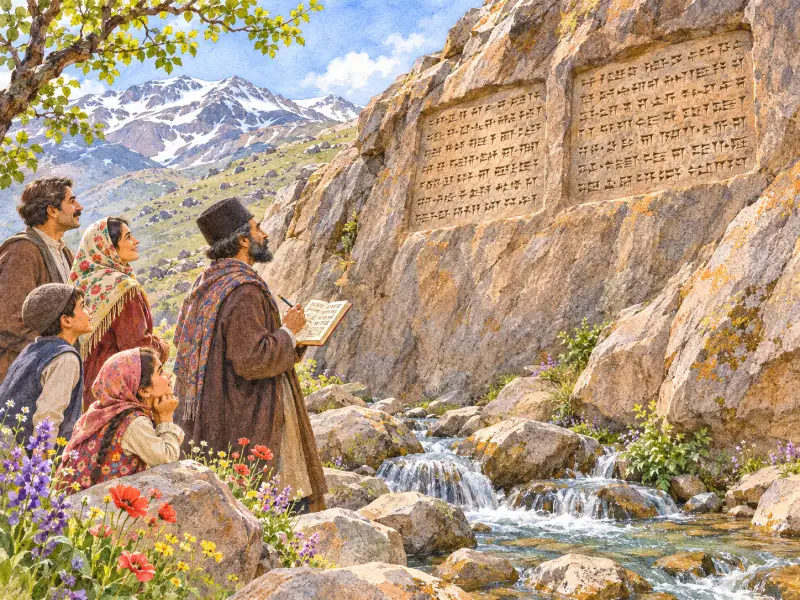
On the slopes of Mount Alvand, a short drive west of the city, two panels are cut into a granite rock beside a stream. One was carved for Darius I, the other for his son Xerxes, each in three languages: Old Persian, Elamite and Babylonian. Both praise Ahura Mazda and give the king’s titles. Local people long believed the signs were a code to a hidden treasure, hence the name Ganjnâme, “treasure book”. The inscriptions helped 19th-century scholars such as Henry Rawlinson in the decipherment of cuneiform. See the Ganjnameh Inscriptions page.

Avicenna and Baba Taher
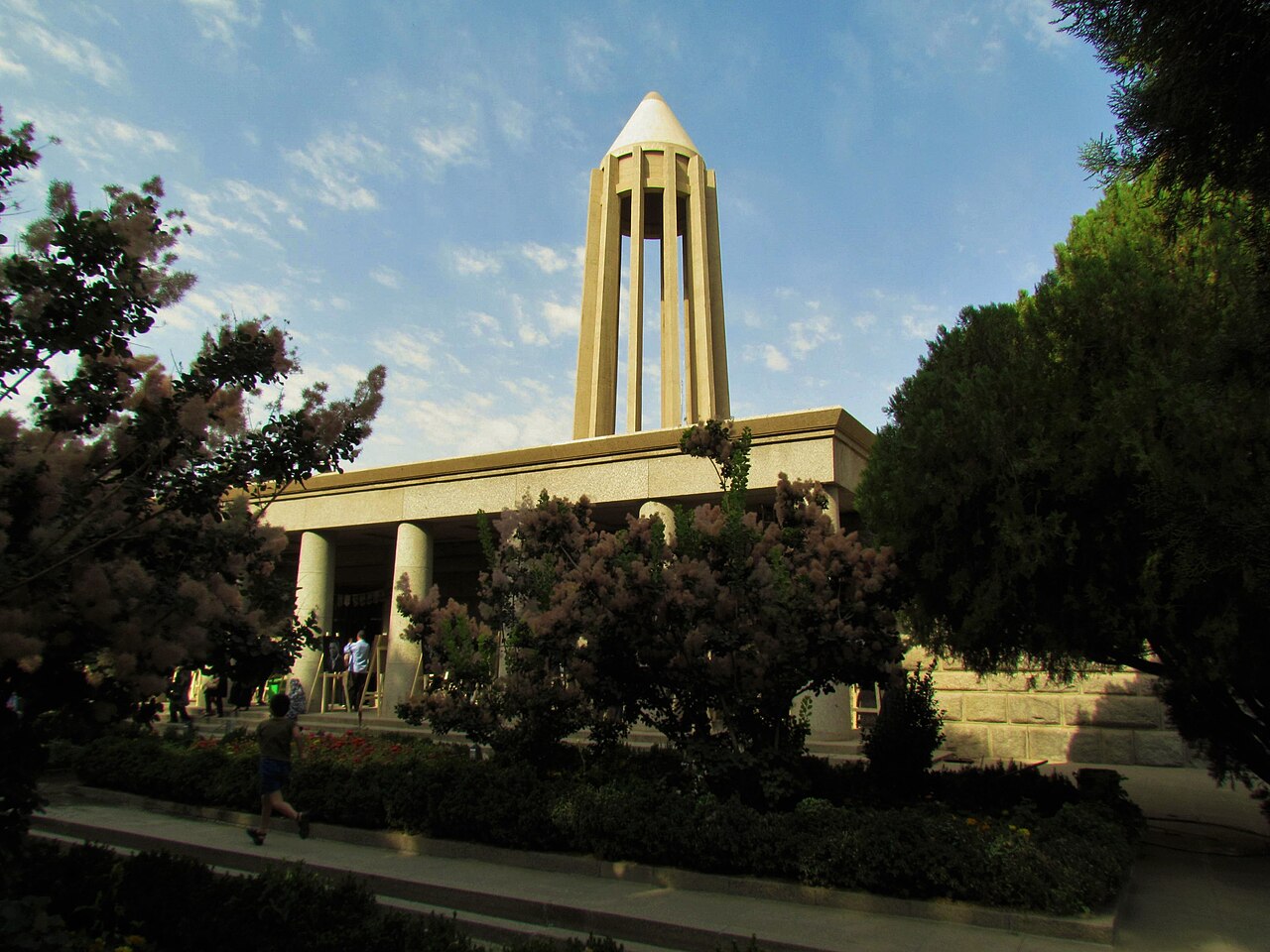
Hamadan’s most famous resident in the Islamic period was Avicenna (Ibn Sina, 980–1037), the author of the Canon of Medicine. He served as physician and vizier to the Buyid ruler of Hamadan, spent time in prison here, moved to Isfahan, and died during a campaign back in Hamadan in 1037. His modern mausoleum, designed by the architect Hooshang Seyhoun and opened in the early 1950s, has a tower inspired by the Gonbad-e Qabus, a library and a small museum. See the Tomb of Avicenna.
A second poet’s tomb stands on a hill in the north of the city. Baba Taher, an 11th-century mystic, wrote short quatrains called do-beyti in a local dialect, simple and direct in tone, which many Iranians still know by heart. His present tomb, a tall modern structure of stone and tilework, was built in the 1960s.
The tomb of Esther and Mordecai
Hamadan has had a Jewish community since ancient times. In the old centre stands a small brick building with a dome that Jewish tradition identifies as the tomb of Queen Esther and her cousin Mordecai, the heroes of the Book of Esther. Scholars debate who is actually buried there; some link the tomb to Shushan-Dokht, a Jewish wife of the Sasanian king Yazdegerd I. It remains the most important Jewish pilgrimage site in Iran.
Seljuk capital and the medieval city
In the 12th century Hamadan was the capital of the Seljuk sultans of western Iran and Iraq. From that period comes the Gonbad-e Alavian, a square tomb tower with some of the most elaborate carved stucco in Iran. Hamadan was sacked by the Mongols in the 1220s and again suffered in later wars between the Ottomans and Safavids.
The stone lion, Sang-e Shir, on a low hill in the city, is badly worn. Local tradition connects it with Alexander, and some scholars suggest it was part of a monument for Hephaestion. Its date is uncertain, but a Hellenistic or Parthian origin is most often proposed.
Modern Hamadan
The present plan of central Hamadan dates from the early Pahlavi period: six avenues radiate from a large round square, Meydan-e Imam, laid out by a German engineer. The bazaar runs off this square. Hamadan is known for leather goods and for the pottery of the village of Lalejin, about 20 km to the north, where workshops still turn and glaze bowls and jugs in blue and turquoise.
Winters are long and snowy; summer is the pleasant season, when people from hotter cities come for the cool air and the walks in the Abbasabad valley on Mount Alvand.
Getting there and nearby trips
Hamadan is about 330 km south-west of Tehran by road, roughly four hours by car or bus, and has an airport with domestic flights. Buses link it with Kermanshah, Qazvin and Isfahan. Inside the city, taxis are the easiest way to move between the scattered sights.
The water cave of Ali Sadr lies about 100 km to the north. To the west, the road continues to Kermanshah, the Behistun inscription and Taq-e Bostan. Check opening times with official sources and follow your own government’s travel advice.
Persian words from this page
| همدان | Hamedân | Hamadan |
| گنجنامه | Ganjnâme | “treasure book”, the inscriptions |
| ابن سینا | Ebn-e Sinâ | Avicenna |
| باباطاهر | Bâbâ Tâher | Baba Taher, the poet |
| دوبیتی | do-beyti | a two-couplet poem |
| سنگ شیر | Sang-e Shir | the stone lion |
| الوند | Alvand | Mount Alvand |
Sources and further reading
- Herodotus, Histories, Book 1 (chapters 96–101 on Deioces and Ecbatana).
- Encyclopaedia Iranica, “Ecbatana” and “Hamadān”.
- Encyclopaedia Iranica, “Avicenna” (life and works).
- Encyclopaedia Iranica, “Ganj-nāma”, on the inscriptions of Darius and Xerxes.
- Amélie Kuhrt, The Persian Empire: A Corpus of Sources from the Achaemenid Period (Routledge, 2007).
- Statistical Centre of Iran, National Population and Housing Census 2016 (1395).
Want to learn Persian? Get the free Starter Pack
Get the 14-page printable Starter Pack (all 32 letters, a 7-day reading plan, 100 core words and 20 survival phrases) and a short 5-email course. Free.
More in Cities of Iran
- Tehran: Iran’s Capital
- Mashhad
- Isfahan
- Shiraz
- Tabriz
- Yazd
- Kashan
- Kerman
- Hamadan
- Qom
- Ahvaz
- Rasht
- Kermanshah
- Urmia
- Ardabil
- Zanjan
- Qazvin
- Sanandaj
- Khorramabad
- Bandar Abbas
- Bushehr
- Zahedan
- Birjand
- Gorgan
- Sari
- Semnan
- Arak
- Ilam
- Yasuj
- Shahr-e Kord
- Bojnurd
- Karaj
- Abadan and Khorramshahr
- Kish Island
- Qeshm Island
- Hormuz Island
- Masuleh
- Abyaneh
- Kandovan
- Bam
- Neyshabur (Nishapur)
- Shush (Susa) Today