Ganjnameh (گنجنامه, “treasure book”) is a pair of royal inscriptions carved by the Achaemenid kings Darius I and Xerxes I on a granite rock face on Mount Alvand, about 12 km south-west of Hamadan. Each text is written in three languages, Old Persian, Elamite and Babylonian, and both praise the god Ahuramazda and the king who ordered them. The name comes from local people who believed the strange script held the key to a hidden treasure.
| Date | Early 5th century BCE (reigns of Darius I, 522–486, and Xerxes I, 486–465 BCE) |
|---|---|
| Location | Abbasabad valley on Mount Alvand, about 12 km south-west of Hamadan; altitude about 2,000 m |
| What it is | Two trilingual cuneiform inscriptions, each panel about 2 × 3 m |
| Languages | Old Persian, Elamite, Babylonian |
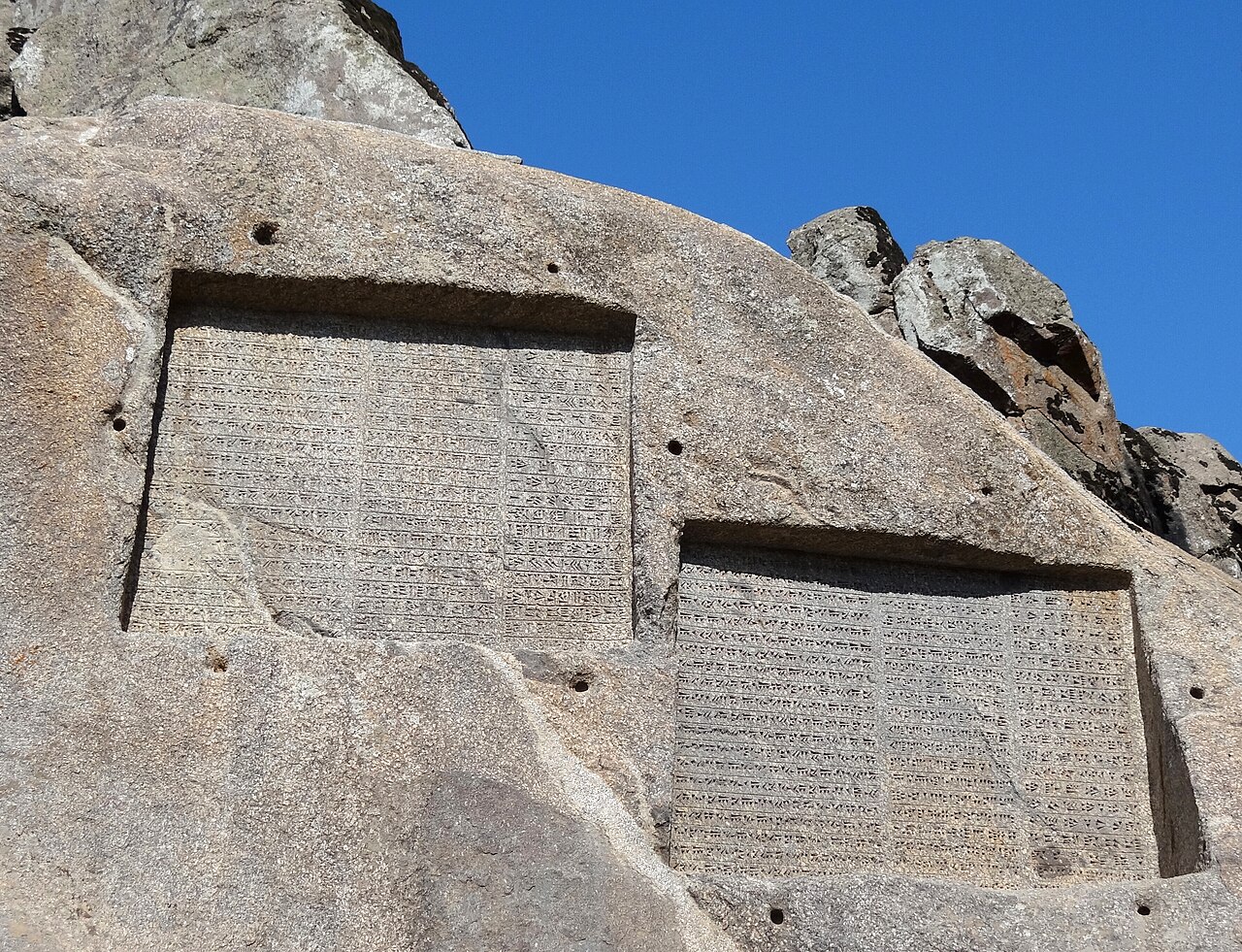

Inscriptions on a mountain pass
In the Achaemenid period Hamadan was Ecbatana, the old capital of the Medes and a summer residence of the Persian kings, who escaped the heat of Susa and Babylon in its cool climate. The valley of Ganjnameh carried a road west across the Alvand range, and in the centuries before Alexander this was probably the main east-west pass through the mountains. Anyone travelling it passed the kings’ words.
The two inscriptions sit side by side on a smoothed rock face above a stream. The panel on the upper left belongs to Darius I; the one on the lower right to his son Xerxes. Apart from the royal names and titles, the texts are almost identical. In translation, they begin by calling Ahuramazda the great god who created this earth, the sky above and mankind, and who made the king king. Each king then names himself, his titles and his father.
Holes cut around the panels probably held fittings for protective covers, which suggests the texts were meant to last and perhaps to be shown on special occasions. Excavation above the inscriptions found a rock-cut terrace, whose purpose is not known.
Treasure hunters and decipherers
For centuries no one in the region could read cuneiform. The rows of wedges looked like a code, and the story grew that they recorded where treasure was buried, hence the name ganj-nâmeh. European travellers copied the texts from the 18th and 19th centuries on, and because the Old Persian versions were short and clearly laid out, they became useful material for scholars working on the decipherment of Old Persian, alongside the much longer Behistun inscription. For the story of that decipherment, see The Behistun Inscription.
What to see
- The inscriptions: you can stand right below them. Each panel holds three columns of text, one for each language. Old Persian cuneiform has few signs and a word divider, so you can pick out separate words even without reading them.
- Information panels: modern stone tablets beside the rock give translations of the texts in Persian and other languages.
- The waterfall and valley: a short walk up the valley brings you to a waterfall. In summer the valley is full of families from Hamadan escaping the heat; in winter it can be snowy, and the waterfall sometimes freezes.
- Mountain activities: the valley is a base for walks and climbs on Alvand, and there are cable cars and ski slopes higher up. Facilities change; check locally.
Practical notes
- Getting there: Ganjnameh is a short taxi ride from central Hamadan, up the Abbasabad road. Combine it with the Tomb of Avicenna in town.
- When: late spring to early autumn is best. The valley is much cooler than the city, and weekends and holidays can be crowded.
- Tickets and hours: check current official information.
- Safety: rocks by the stream and waterfall are slippery. Follow your own government’s travel advice for Iran.
For the city and its other sights, see our guide to Hamadan, and for the Persian kings who left these texts, the Persian Empire.
Persian words from this page
| گنج | ganj | treasure |
| نامه | nâmeh | letter, book |
| کتیبه | katibeh | inscription |
| خط میخی | khatt-e mikhi | cuneiform (“nail script”) |
| داریوش | Dâryush | Darius |
| خشایارشا | Khashâyârshâ | Xerxes |
| آبشار | âbshâr | waterfall |
Sources and further reading
- Encyclopaedia Iranica, “GANJ-NĀMA” (Stuart C. Brown).
- Roland G. Kent, Old Persian: Grammar, Texts, Lexicon (American Oriental Society, 2nd ed. 1953), texts DE and XE.
- Amélie Kuhrt, The Persian Empire: A Corpus of Sources from the Achaemenid Period (Routledge, 2007).
- Encyclopaedia Iranica, “HAMADĀN i. Geography“.
Want to learn Persian? Get the free Starter Pack
Get the 14-page printable Starter Pack (all 32 letters, a 7-day reading plan, 100 core words and 20 survival phrases) and a short 5-email course. Free.
More in Top Places to Visit in Iran
- Naqsh-e Jahan Square
- Shah (Imam) Mosque, Isfahan
- Sheikh Lotfollah Mosque
- Ali Qapu Palace
- Jameh Mosque of Isfahan
- Si-o-se Pol and Khaju Bridge
- Vank Cathedral
- Hasht Behesht Palace
- Naqsh-e Rostam
- Eram Garden, Shiraz
- Nasir al-Molk (Pink) Mosque
- Tomb of Hafez (Hafezieh)
- Tomb of Saadi (Saadieh)
- Shah Cheragh Shrine
- Arg of Karim Khan
- Fin Garden, Kashan
- Historic Houses of Kashan
- Jameh Mosque of Yazd
- Yazd Fire Temple and Towers of Silence
- Dowlatabad Garden and Windcatcher
- Amir Chakhmaq Complex
- Golestan Palace
- National Museum of Iran
- Treasury of National Jewels
- Tehran Grand Bazaar
- Milad Tower
- Imam Reza Shrine, Mashhad
- Tomb of Ferdowsi, Tus
- Tomb of Omar Khayyam, Neyshabur
- Tomb of Avicenna, Hamadan
- Ganjnameh Inscriptions, Hamadan
- Behistun (Bisotun): Visiting the Site
- Taq-e Bostan: Visiting the Site
- Tabriz Historic Bazaar
- Takht-e Soleyman
- Armenian Monastic Ensembles of Iran
- Sheikh Safi al-Din Shrine, Ardabil
- Dome of Soltaniyeh
- Alamut Castle
- Falak-ol-Aflak Castle
- Shushtar Historical Hydraulic System
- Chogha Zanbil: Visiting the Ziggurat
- Susa Archaeological Site
- Arg-e Bam
- Ganjali Khan Complex, Kerman
- Shazdeh Garden, Mahan
- Rayen Castle
- Dasht-e Lut (Lut Desert)
- Maranjab Desert and Caravanserai
- Varzaneh Desert
- Mount Damavand
- Hyrcanian Forests
- Lake Urmia
- Badab-e Surt Springs
- Ali Sadr Cave
- The Kaluts of Shahdad
- Qeshm Geopark
- Hormuz Island Colours
- Visiting Persepolis: A Day Trip from Shiraz
- Visiting Pasargadae
- Persian Caravanserais
- The Qanat of Gonabad
- Meymand Village
- Sasanian Sites of Fars: Firuzabad, Bishapur and Sarvestan
- Gonbad-e Qabus: Visiting the Tower
- Zayandeh Rud and Isfahan’s Bridges
- Tochal and Darband: Hiking Above Tehran
- Mount Sabalan
- Skiing in Iran: Dizin and Shemshak
- Golestan National Park