Pasargadae was the first capital of the Persian Empire, built by Cyrus the Great from the 540s BCE on the Morghab plain in Fars, and the place where he was buried in 530 BCE. Instead of a walled city it was a royal park: palaces, pavilions and a formal irrigated garden spread across open ground, with Cyrus’s tomb on its edge. Its mixture of Iranian, Mesopotamian, Lydian and Egyptian ideas shows the new empire inventing a royal style, and it remained a sacred place for Persian kings long after Darius moved the court to Persepolis.
| Built | c. 546–530 BCE, under Cyrus II; some work continued under his successors |
|---|---|
| Location | Dasht-e Morghab (Morghab plain), Fars province, north-east of Persepolis |
| Name | Greek Pasargadai, also the name of Cyrus’s tribe; Batrakataš in Elamite tablets from Persepolis |
| Main monuments | Tomb of Cyrus, Gate R, Audience Palace (S), Residential Palace (P), royal garden, Tall-e Takht, Zendan-e Soleyman, sacred precinct |
| Excavated | Ernst Herzfeld (1928), Ali Sami (1949–55), David Stronach (1961–63); Iranian-French surveys from 1999 |
| UNESCO | World Heritage Site since 2004 |
This page looks at Pasargadae as a capital and a piece of history. For a tour of the monuments one by one, read the site’s guide to Pasargad, and for practical advice see Visiting Pasargadae.
Why Cyrus built here
The Greek geographer Strabo says Cyrus founded Pasargadae on the spot where he defeated Astyages and the Medes, around 550 BCE. Whether or not that is literally true, the site lay in the heartland of the Persian tribes. Herodotus says the Pasargadae were the noblest of those tribes and that the royal Achaemenid clan belonged to them, so the name tied the capital to Cyrus’s own people. The older royal centre of Anshan, discussed on Achaemenes, Teispes and the Early Persian Kings of Anshan, lay further south-west.
The plain is high, at roughly 1,900 metres, and watered by the Pulvar river, which made a large irrigated park possible. Most of the stone buildings seem to date after the conquest of Lydia around 547 BCE: their fine masonry, iron clamps and use of the toothed chisel point to stonemasons from Lydia and Ionia, brought east after Sardis fell.
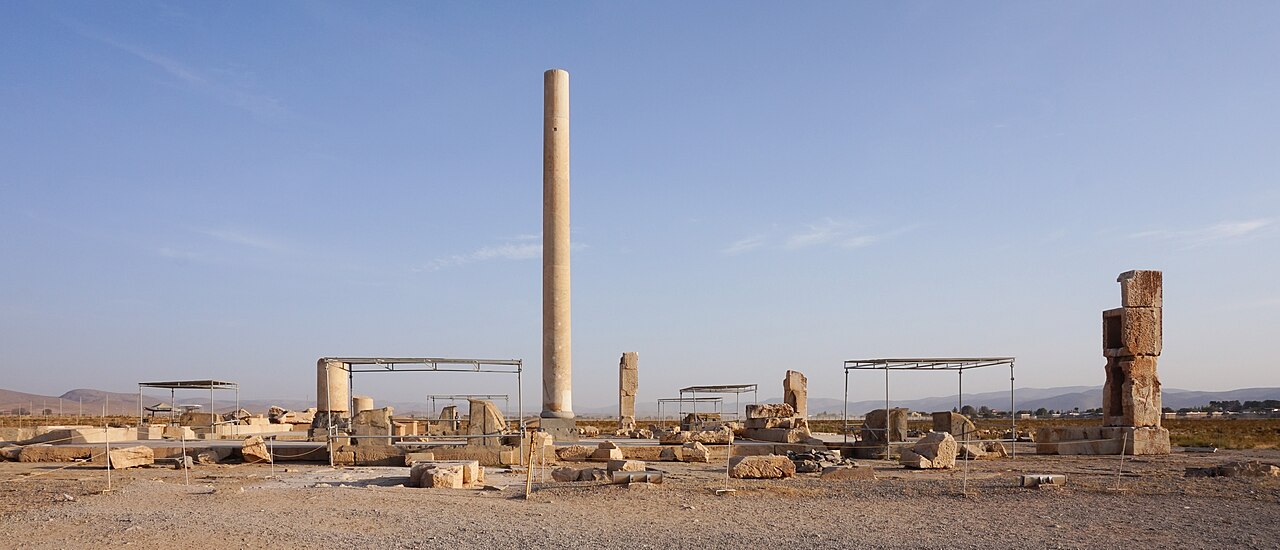

A capital without walls
What makes Pasargadae unusual is its layout. There was no great walled city around a palace. The buildings stood far apart in landscaped grounds over several square kilometres, linked by paths and water channels.
The gate and the palaces
Visitors arriving from the south-east passed through Gate R, a hall once guarded by colossal bull figures in Assyrian style. On one of its door jambs survives the famous relief of a four-winged figure wearing an Egyptian-style crown. Beyond it, the Audience Palace (Palace S) had a tall central hall with columns on black and white stone bases and reliefs at its doors, including a figure in a fish cloak and a bull-man, both drawn from Mesopotamian art. The Residential Palace (Palace P) had a long portico facing the garden, with a throne seat placed at its centre.
The royal garden
In front of Palace P, David Stronach’s excavations in the 1960s found limestone water channels about 25 cm wide, with square basins every 13 to 14 metres, framing a formal garden. Stronach proposed that the garden was divided into four parts, making it the earliest known chahârbâgh, the four-fold garden that later became the model of the Persian garden. The excavated channels in fact show two large rectangles, and the four-part plan remains a hypothesis. Geophysical surveys led by Rémy Boucharlat and colleagues between 2003 and 2008 suggest the garden was larger than once thought and included a large pool or channel fed from the Pulvar. The Persian idea of the walled royal park, pairidaeza, is explained on The Achaemenid Paradise Gardens.
Tall-e Takht and Zendan-e Soleyman
On a hill to the north, Cyrus began an enormous platform of dressed limestone blocks, now called Tall-e Takht (“throne hill”). It was left unfinished at his death and later topped with a mudbrick citadel that stayed in use long after the Achaemenids. Nearby stands Zendan-e Soleyman (“Solomon’s prison”), a square stone tower almost identical to the Ka’ba-ye Zartosht at Naqsh-e Rostam. Its purpose, whether a tomb, a fire sanctuary or a store for royal objects, is unknown. To the north-west, a sacred precinct with two stone plinths was probably used for open-air rituals.
The tomb of Cyrus
About a kilometre south of the palaces stands the tomb: a small gabled stone chamber on six receding steps, about 11 metres high in all. Its design has parallels in Anatolian and Mesopotamian architecture, but its combination is unique. Arrian, using the eyewitness account of Alexander’s officer Aristobulus, says the tomb stood in a grove watered by channels, and that inside were a golden coffin, a couch, fine textiles and jewellery. A group of Magi lived beside it and received a sheep a day and a horse a month for sacrifice.
Alexander visited the tomb when he passed through Persis in 330 BCE. When he returned in 324 BCE he found it plundered and ordered Aristobulus to restore it, and he had the Magi questioned under torture. In the Islamic period the monument survived because it was renamed the tomb of the mother of Solomon, مشهد مادر سلیمان (Mashhad-e Mâdar-e Soleymân). Its full later history is on The Tomb of Cyrus through History.
Who wrote “I am Cyrus”?
Short inscriptions on Gate R and the palaces read, in Old Persian, Elamite and Babylonian: “I am Cyrus the king, an Achaemenid.” Many scholars believe these were added under Darius I, for two reasons. Darius claimed to have created the Old Persian script himself, and he had a political interest in calling Cyrus an Achaemenid, since he used that name to link himself to the founder. If so, the inscriptions show Pasargadae being reshaped to fit a later dynasty’s story.
A sacred city after Cyrus
Darius built new capitals at Susa and Persepolis, and the administrative heart of the empire moved there. Pasargadae did not lose its importance. Elamite tablets from Persepolis record supplies and a treasury there. Plutarch says that each new king was initiated at Pasargadae in a sanctuary of a warrior goddess: he took off his own robe, put on the robe Cyrus had worn before becoming king, ate a cake of figs, chewed terebinth and drank a cup of sour milk. The rite tied every later king to the founder.
Rediscovery
European travellers from the seventeenth century on described the ruins, and by the nineteenth century the identification with Pasargadae was generally accepted. Ernst Herzfeld made the first excavations in 1928. Ali Sami of the Iranian archaeological service excavated from 1949 to 1955, and David Stronach of the British Institute of Persian Studies led major excavations in 1961–63 that remain the basis of what we know. Since 1999 Iranian and French teams have mapped the wider landscape with geophysical survey, revealing traces of buildings and water works far beyond the excavated monuments.
UNESCO added Pasargadae to the World Heritage List in 2004, and its garden is also part of the serial listing of the Persian Garden. For Cyrus’s life as a whole, see the site’s article on Cyrus the Great; for the gardens that followed this model over two and a half thousand years, see The Persian Garden (Pardis) through History.
Persian words from this page
| پاسارگاد | Pâsârgâd | Pasargadae |
| دشت مرغاب | Dasht-e Morghâb | the Morghab plain |
| آرامگاه کوروش | Ârâmgâh-e Kurosh | the tomb of Cyrus |
| کاخ | kâkh | palace |
| چهارباغ | chahârbâgh | four-part garden |
| تل تخت | Tal-e Takht | “throne hill” |
| زندان سلیمان | Zendân-e Soleymân | “Solomon’s prison” tower |
Sources and further reading
- David Stronach, Pasargadae: A Report on the Excavations Conducted by the British Institute of Persian Studies from 1961 to 1963 (Oxford, 1978).
- Arrian, Anabasis of Alexander 6.29; Strabo, Geography 15.3.7–8; Plutarch, Life of Artaxerxes 3; Herodotus 1.125.
- The Metropolitan Museum of Art, Heilbrunn Timeline of Art History, “Pasargadae” (on the garden and the 2003–2008 surveys).
- UNESCO World Heritage Centre, “Pasargadae” (list no. 1106).
- Encyclopaedia Iranica, “Pasargadae”, by David Stronach and Hilary Gopnik.
Want to learn Persian? Get the free Starter Pack
Get the 14-page printable Starter Pack (all 32 letters, a 7-day reading plan, 100 core words and 20 survival phrases) and a short 5-email course. Free.
More in The Achaemenid Empire (550–330 BCE)
- Achaemenes, Teispes and the Early Persian Kings of Anshan
- Cyrus the Great: Birth, Legends and Rise to Power
- Cyrus Conquers Lydia: Croesus and the Battle of Thymbra
- The Persian Conquest of Ionia and Asia Minor
- Cyrus Takes Babylon (539 BCE)
- The Cyrus Cylinder
- Cyrus and the Return of the Jews
- The Death of Cyrus and the Massagetae
- Pasargadae: Cyrus’s Capital and Tomb
- The Tomb of Cyrus through History
- Cambyses II
- Cambyses Conquers Egypt: The Battle of Pelusium
- Bardiya and Gaumata: The Usurper Question
- Darius the Great Takes the Throne
- The Great Revolts of 522–521 BCE
- The Behistun Inscription
- The Persian Conquest of the Indus Valley
- Darius’s Scythian Campaign
- Darius’s Canal from the Nile to the Red Sea
- Darius’s Reforms: Satrapies, Taxes and Law
- The Royal Road and the Persian Postal System
- The Daric: Achaemenid Coinage and Economy
- The Ionian Revolt (499–493 BCE)
- The Greco-Persian Wars: An Overview
- Mardonius and the First Persian Expedition to Greece (492 BCE)
- The Battle of Marathon (490 BCE)
- The Death of Darius I and the Succession of Xerxes
- The Royal Tombs of Naqsh-e Rostam
- Xerxes I: King of Kings (486–465 BCE)
- Xerxes’ Invasion of Greece (480–479 BCE)
- The Battle of Thermopylae (480 BCE)
- The Battle of Artemisium (480 BCE)
- The Persian Capture of Athens (480–479 BCE)
- The Battle of Salamis (480 BCE)
- The Battle of Plataea and the End of the Invasion (479 BCE)
- The Palace of Darius at Susa
- Building Persepolis: How Darius and Xerxes Built Parsa
- The Persepolis Fortification and Treasury Tablets
- Herodotus and the Persians
- The Apadana Reliefs: Nations Bringing Gifts
- The Achaemenid Paradise Gardens
- The Persian Immortals and the Achaemenid Army
- The Achaemenid Navy
- Religion of the Achaemenid Kings
- Women of the Achaemenid Court
- Old Persian Language and Cuneiform
- Egypt under Persian Rule
- Babylon under Persian Rule
- Artaxerxes I
- The Peace of Callias
- Darius II and the Peloponnesian War
- Famous Satraps of the Persian Empire
- Artaxerxes II Mnemon
- Cyrus the Younger and the Battle of Cunaxa
- The King’s Peace (387 BCE)
- The Great Satraps’ Revolt
- Artaxerxes III and the Reconquest of Egypt
- Darius III, the Last Achaemenid King
- The Battle of the Granicus (334 BCE)
- The Battle of Issus (333 BCE)
- Alexander Takes Tyre, Gaza and Egypt (332 BCE)
- The Battle of Gaugamela (331 BCE)
- Ariobarzanes and the Battle of the Persian Gate
- The Burning of Persepolis (330 BCE)
- The Death of Darius III and Bessus
- The Legacy of the Achaemenid Empire