Around 513 BCE Darius I led a large army across the Bosporus into Europe, bridged the Danube and marched into the steppes north of the Black Sea against the nomadic Scythians. The Scythians refused battle and retreated, burning grass and filling wells, until Darius had to withdraw. The campaign failed to conquer Scythia, but it brought Thrace and, soon after, Macedon under Persian control and made Persia a European power.
| Date | c. 513 BCE; proposed dates range from about 519 to 512 |
|---|---|
| Route | Bosporus bridge, Thrace, Danube bridge, then the steppe of modern Moldova and Ukraine |
| Persian side | Darius I; Ionian Greek fleet guarding the Danube bridge |
| Scythian leader | Idanthyrsus, according to Herodotus |
| Army size | 700,000 men and 600 ships in Herodotus 4.87; modern historians reject such figures |
| Result | Scythians not conquered; Thrace subdued; Macedon soon sends earth and water |
Who were the Scythians?
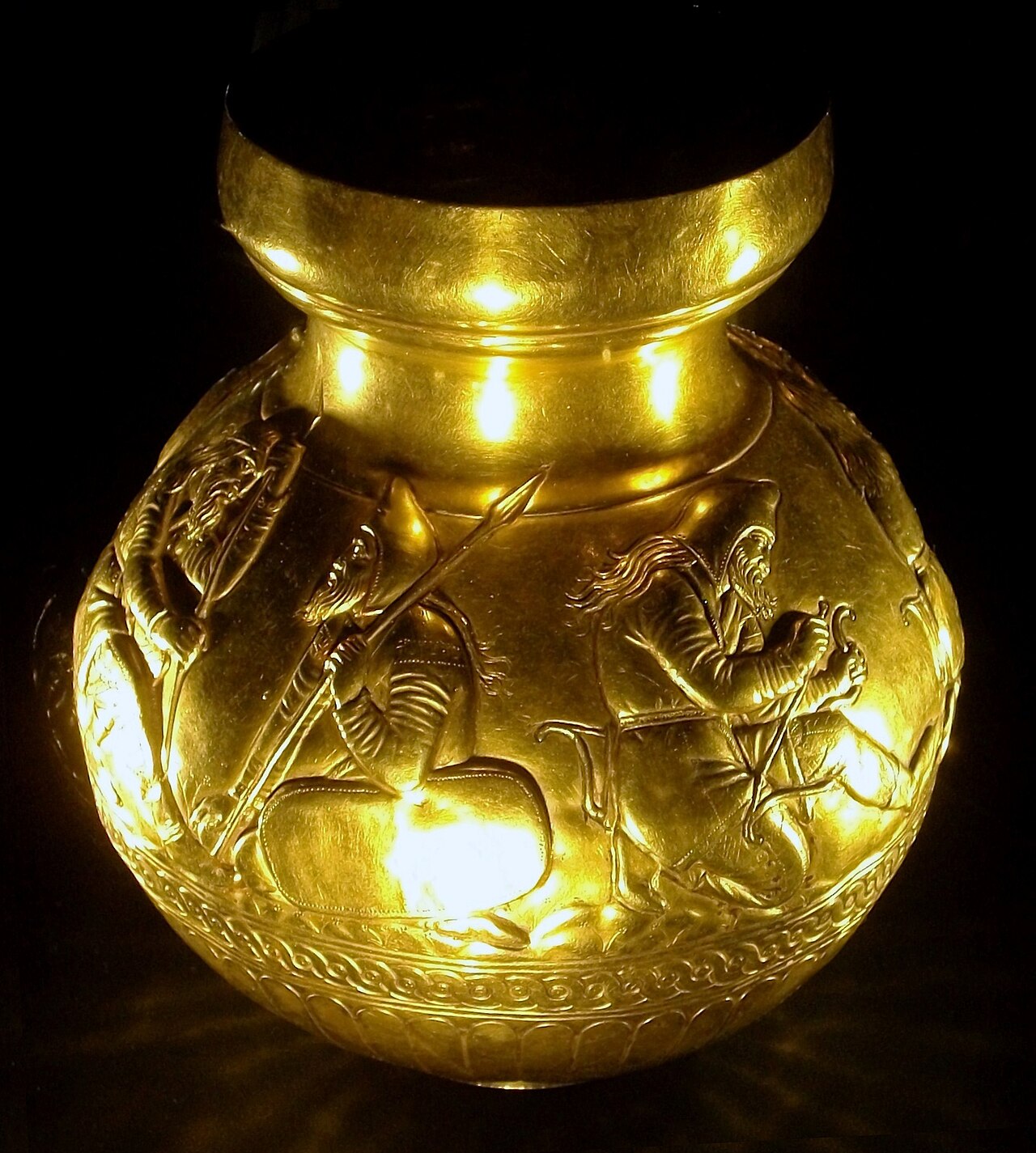
The Persians called the Iranian-speaking nomads of the steppes Saka, and the Greeks called those north of the Black Sea Scythians. They were horse archers who lived in wagons, moved with their herds and buried their leaders in rich mounds. Herodotus gives the whole of Book 4 to them, and his account of Darius’s invasion is the only detailed one we have.
This European campaign is different from Darius’s earlier war against the Saka “with pointed caps” in Central Asia around 519 BCE, whose leader Skunkha appears on the Behistun relief (see the Behistun Inscription). Darius’s later inscriptions list several Saka peoples, including the “Saka beyond the sea”, usually identified with the European Scythians.
Why Darius went
Herodotus gives a single reason: revenge for a Scythian invasion of Media more than a century earlier. Modern historians look for practical aims. Possible motives include securing the Black Sea grain and timber trade, taking control of Thrace with its gold and silver mines, protecting the northern flank of the empire, or making a show of power to the Greek world. Herodotus also says Darius’s brother Artabanus warned him against the expedition.

Bridges over two continents
The army crossed into Europe on a bridge of boats over the Bosporus, designed by Mandrocles of Samos. Herodotus says Mandrocles was so proud of it that he dedicated a painting of the crossing in the temple of Hera on Samos, showing Darius watching from a throne. Darius set up two marble pillars on the shore listing the peoples in his army, one in “Assyrian” letters, meaning cuneiform, and one in Greek.
Marching through Thrace, the army subdued the Getae, who resisted, and reached the Danube, where the Ionian Greek fleet had sailed up the river and built a second bridge of boats. Herodotus says Darius gave the Ionian commanders a leather strap tied with sixty knots and told them to untie one each day; if he had not returned when the knots were gone, they were to sail home.
The war without battles
The Scythians knew they could not face the Persian army in the open. In Herodotus’s account they sent their families and wagons north, split into groups, and retreated always a day’s march ahead of the Persians, destroying grass and wells as they went. They drew Darius east across the Don and back again through the lands of neighbouring peoples.
Darius sent a message to the Scythian king Idanthyrsus: stand and fight, or send earth and water and submit. Idanthyrsus replied that the Scythians had no towns or fields to fear for. They would fight only if the Persians found and attacked the tombs of their fathers.
The riddle of the gifts
Finally, Herodotus says, the Scythians sent Darius a strange gift: a bird, a mouse, a frog and five arrows. Darius took it as surrender, since a mouse lives in the earth, a frog in water, a bird is like a horse and arrows are the Scythians’ strength. Gobryas, one of the seven conspirators of 522, read it differently: unless the Persians became birds and flew away, or mice and hid underground, or frogs and leapt into the lakes, they would never return home but be shot down by these arrows. The story is a classic piece of Greek storytelling, but it captures the problem Darius faced.
Retreat to the Danube
With supplies running out, Darius withdrew at night, leaving the sick and the army’s donkeys in camp with the fires burning so that the braying would make the Scythians think the army was still there. The Scythians, being horsemen, reached the Danube first and urged the Ionians to break the bridge and leave the Persians to die.
Herodotus says Miltiades, the Athenian ruler of the Chersonese and later the victor of Marathon, wanted to agree. Histiaeus, the tyrant of Miletus, persuaded the others that their own power depended on Darius. The Ionians took apart only the northern end of the bridge, and Darius crossed back. Some historians suspect the story of Miltiades was told later in Athens to make him look like an early opponent of Persia.
Gains in Europe
Darius returned to Sardis, but he left the general Megabazus in Europe with a large army, which Herodotus puts at 80,000. Megabazus conquered the Greek cities along the Hellespont and the Thracian coast, subdued the Paeonians and sent envoys to Macedon, whose king Amyntas I gave earth and water. A Persian province, often called Skudra in Persian lists, now existed in Europe. Histiaeus was rewarded with land at Myrcinus in Thrace, a reward that would later bring him to Susa and play a part in the Ionian Revolt.
A defeat or a limited success?
Greek writers presented the campaign as a humiliation, and in Scythia itself it was a failure. But many historians argue that Herodotus exaggerated the depth of the march; no Persian forts have been found on the steppe, and his route is hard to follow. Seen from Persia, the expedition secured Thrace and the straits, showed Persian power in Europe and prepared the ground for the first Persian expedition to Greece in 492 BCE.
Persian words from this page
| سکا | Sakâ | Saka, Scythians |
| پل | pol | bridge |
| تیر | tir | arrow |
| پرنده | parande | bird |
| موش | mush | mouse |
| قورباغه | qurbâghe | frog |
Sources and further reading
- Herodotus, Histories, Book 4, chapters 1 and 83–144; Book 5, chapters 1–2 and 11–18.
- Pierre Briant, From Cyrus to Alexander (2002), chapter 3.
- Encyclopaedia Iranica, “Darius iii. Darius I the Great”.
- The Cambridge History of Iran, vol. 2, The Median and Achaemenian Periods (1985).
Want to learn Persian? Get the free Starter Pack
Get the 14-page printable Starter Pack (all 32 letters, a 7-day reading plan, 100 core words and 20 survival phrases) and a short 5-email course. Free.
More in The Achaemenid Empire (550–330 BCE)
- Achaemenes, Teispes and the Early Persian Kings of Anshan
- Cyrus the Great: Birth, Legends and Rise to Power
- Cyrus Conquers Lydia: Croesus and the Battle of Thymbra
- The Persian Conquest of Ionia and Asia Minor
- Cyrus Takes Babylon (539 BCE)
- The Cyrus Cylinder
- Cyrus and the Return of the Jews
- The Death of Cyrus and the Massagetae
- Pasargadae: Cyrus’s Capital and Tomb
- The Tomb of Cyrus through History
- Cambyses II
- Cambyses Conquers Egypt: The Battle of Pelusium
- Bardiya and Gaumata: The Usurper Question
- Darius the Great Takes the Throne
- The Great Revolts of 522–521 BCE
- The Behistun Inscription
- The Persian Conquest of the Indus Valley
- Darius’s Scythian Campaign
- Darius’s Canal from the Nile to the Red Sea
- Darius’s Reforms: Satrapies, Taxes and Law
- The Royal Road and the Persian Postal System
- The Daric: Achaemenid Coinage and Economy
- The Ionian Revolt (499–493 BCE)
- The Greco-Persian Wars: An Overview
- Mardonius and the First Persian Expedition to Greece (492 BCE)
- The Battle of Marathon (490 BCE)
- The Death of Darius I and the Succession of Xerxes
- The Royal Tombs of Naqsh-e Rostam
- Xerxes I: King of Kings (486–465 BCE)
- Xerxes’ Invasion of Greece (480–479 BCE)
- The Battle of Thermopylae (480 BCE)
- The Battle of Artemisium (480 BCE)
- The Persian Capture of Athens (480–479 BCE)
- The Battle of Salamis (480 BCE)
- The Battle of Plataea and the End of the Invasion (479 BCE)
- The Palace of Darius at Susa
- Building Persepolis: How Darius and Xerxes Built Parsa
- The Persepolis Fortification and Treasury Tablets
- Herodotus and the Persians
- The Apadana Reliefs: Nations Bringing Gifts
- The Achaemenid Paradise Gardens
- The Persian Immortals and the Achaemenid Army
- The Achaemenid Navy
- Religion of the Achaemenid Kings
- Women of the Achaemenid Court
- Old Persian Language and Cuneiform
- Egypt under Persian Rule
- Babylon under Persian Rule
- Artaxerxes I
- The Peace of Callias
- Darius II and the Peloponnesian War
- Famous Satraps of the Persian Empire
- Artaxerxes II Mnemon
- Cyrus the Younger and the Battle of Cunaxa
- The King’s Peace (387 BCE)
- The Great Satraps’ Revolt
- Artaxerxes III and the Reconquest of Egypt
- Darius III, the Last Achaemenid King
- The Battle of the Granicus (334 BCE)
- The Battle of Issus (333 BCE)
- Alexander Takes Tyre, Gaza and Egypt (332 BCE)
- The Battle of Gaugamela (331 BCE)
- Ariobarzanes and the Battle of the Persian Gate
- The Burning of Persepolis (330 BCE)
- The Death of Darius III and Bessus
- The Legacy of the Achaemenid Empire