In the early first millennium BCE, north-west Iran around Lake Urmia was a frontier between three powers: the Mannaean kingdom south of the lake, Urartu to the north, and Assyria in the west. Its archaeology is spectacular, from the burnt citadel of Hasanlu with its golden bowl to the Ziwiye treasure. The Medes later absorbed this region, so its peoples formed part of the background to the first Iranian kingdom.
| Period | c. 1000–600 BCE |
|---|---|
| Region | West Azerbaijan and Kurdistan provinces, around Lake Urmia |
| Mannaea | Kingdom south and south-east of Lake Urmia, 9th–7th century BCE |
| Urartu | Kingdom centred on Lake Van (Turkey), expanding into north-west Iran from c. 800 BCE |
| Key sites | Hasanlu, Qalaichi, Ziwiye, Bastam |
Hasanlu and the golden bowl
Tepe Hasanlu is a large mound in the Solduz valley near Naqadeh, south of Lake Urmia. Between 1956 and 1977 the American archaeologist Robert H. Dyson, Jr., of the University of Pennsylvania Museum, excavated it with Iranian colleagues. The most dramatic level, called Hasanlu IVB, was a fortified citadel with columned halls, temples and storerooms, destroyed in a fierce attack and fire around 800 BCE.
The destruction preserved a frozen moment. Hundreds of people died in the burning buildings, and their skeletons were found where they fell, among weapons, horse harness, ivories and metal vessels. In one room, two skeletons lying together became famous as the “Hasanlu lovers”.
The best-known find came in 1958. Three soldiers lay in the ruins of a collapsed building, and with one of them was a gold bowl about 20 centimetres high. It seems they were trying to carry it out of the burning citadel when the floor or roof fell in. The bowl is covered with scenes in relief: gods riding in chariots drawn by bulls and mules, a hero fighting a monster that rises from a mountain, and women holding mirrors. Its meaning is debated. Some scholars link the scenes to Hurrian myths of the storm god, others to local religion. The bowl is now in the National Museum of Iran in Tehran.
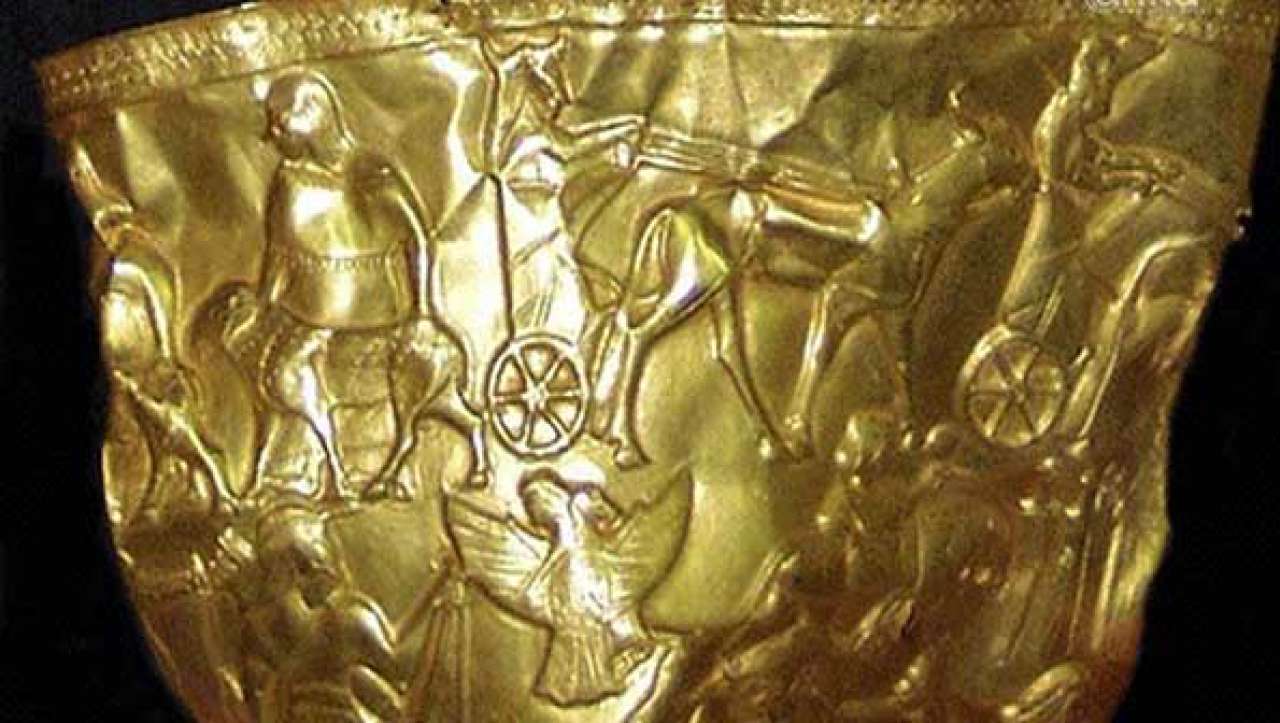

Who burned Hasanlu is not known for sure, but most archaeologists think it was the army of Urartu, which was then expanding south from Lake Van. Whether the people of Hasanlu were Mannaeans, or an earlier group of the same region, is also uncertain.
The Mannaean kingdom
The Mannaeans (Assyrian Mannai) appear in Assyrian annals from the ninth century BCE. By the late eighth century they had a kingdom south and south-east of Lake Urmia, with a capital called Izirtu, and kings whose names Assyrian scribes recorded: Iranzu, his sons Aza and Ullusunu, and later Ahsheri.
Mannaea was rich in horses and lay on the routes between Assyria, Urartu and Media. Its kings played the great powers against each other. In 716 BCE Aza, who favoured Assyria, was killed in a revolt that Urartu backed. In 714 BCE Sargon II of Assyria began his famous eighth campaign by restoring Ullusunu as an Assyrian ally, then marched north, defeated the Urartian king Rusa I and plundered the temple of the god Haldi at Musasir. Sargon’s long letter to the god Ashur describing the campaign is one of the most vivid documents of the ancient Near East and describes the landscape of north-west Iran in detail.
The Mannaean language is not known. Personal names suggest it was not Iranian, and it may have been related to Hurrian, but this is unproven. The site of Qalaichi near Bukan, with glazed bricks and a fragmentary Aramaic stele of the eighth century BCE, has been suggested as Izirtu.
In the seventh century, Mannaea weakened under pressure from Assyria, from the Scythians who arrived from the north, and from the rising Medes. Babylonian chronicles mention Mannaeans fighting on Assyria’s side in 616 BCE, near the end of the Assyrian empire. Soon after, the region became part of Media. Its later story belongs to the Median Empire.
Urartu in north-west Iran
Urartu (its own name was Biainili) was a mountain kingdom centred on Lake Van in what is now eastern Turkey, with its capital at Tushpa. From the late ninth century BCE its kings, among them Ishpuini, Menua and Argishti I, pushed south and east. A bilingual stele in Urartian and Assyrian on the Kelishin pass, on today’s Iran–Iraq border, records Ishpuini and Menua’s pilgrimage to Musasir.
Urartian kings built stone fortresses on rocky spurs in Iranian Azerbaijan, with massive walls, storerooms of huge jars for grain and wine, and temples to Haldi. The largest known in Iran is Bastam, north of Khoy, built by Rusa II in the seventh century BCE and excavated by a German team under Wolfram Kleiss between 1968 and 1978. Urartian rock inscriptions are also found in the region. The kingdom collapsed in the early sixth century BCE, and its lands passed to the Medes and then to the Persians, who listed Armenia as a province.
The Ziwiye treasure
In 1947 villagers near Ziwiye, east of Saqqez in Kurdistan province, found a hoard of gold, silver and ivory objects, reportedly inside a bronze coffin decorated with Assyrian-style scenes. The objects were quickly divided and sold, and pieces reached museums in Tehran, New York, Paris and elsewhere.
Ziwiye objects mix several styles: Assyrian, Urartian, local Iranian, and the animal style associated with the Scythians, such as a gold pectoral with rows of animals and a gold plaque with crouching stags. They are usually dated to the seventh century BCE, when Scythians were active in the region. But because the hoard was never excavated, nobody can say which objects really belonged together. Oscar White Muscarella has argued that many pieces sold as “Ziwiye” came from other places or are modern forgeries. The real core of the find remains important, and frustrating.
Why this region matters
North-west Iran was where Iranian speakers met older peoples of the Zagros and the Caucasus. The Medes who rose here learned from Assyrian, Urartian and Mannaean neighbours how to build fortresses, keep horses and run a state. For the Iranian-speaking newcomers, see the arrival of the Iranian peoples, and for the bronzes of the neighbouring mountains, the Luristan bronzes.
Persian words from this page
| دریاچه ارومیه | Daryâche-ye Orumiye | Lake Urmia |
| حسنلو | Hasanlu | Hasanlu |
| جام طلا | jâm-e talâ | gold bowl |
| زیویه | Ziviye | Ziwiye |
| سقز | Saqqez | Saqqez |
| نقده | Naqade | Naqadeh |
| قلعه | ghal’e | fortress |
Sources and further reading
- Dyson, R. H., Jr., “Hasanlu and Early Iran”, Archaeology 13 (1960).
- Winter, I. J., “The Hasanlu Gold Bowl: Thirty Years Later”, Expedition 31 (1989), Penn Museum.
- Muscarella, O. W., “‘Ziwiye’ and Ziwiye: The Forgery of a Provenience”, Journal of Field Archaeology 4 (1977).
- Sargon II, “Letter to the god Ashur” on the eighth campaign (714 BCE): F. Thureau-Dangin, Une relation de la huitième campagne de Sargon, Paris, 1912.
- Kroll, S., Gruber, C., Hellwag, U., Roaf, M. and Zimansky, P. (eds), Biainili-Urartu, Peeters, 2012.
- Encyclopaedia Iranica, “Hasanlu” and “Mannea” (iranicaonline.org).
Want to learn Persian? Get the free Starter Pack
Get the 14-page printable Starter Pack (all 32 letters, a 7-day reading plan, 100 core words and 20 survival phrases) and a short 5-email course. Free.
More in Early Iran and Elam (c. 3200–700 BCE)
- Prehistoric Iran: The First Villages of the Iranian Plateau
- Proto-Elamite Civilization and the First Writing in Iran
- The Jiroft Culture and the Halil Rud Treasures
- Shahr-e Sukhteh: The Burnt City of Sistan
- Elam: Iran’s First Great Kingdom
- The Middle Elamite Kingdom and Untash-Napirisha
- The Neo-Elamite Period and the Assyrian Sack of Susa
- Susa: 6,000 Years of an Ancient City
- Chogha Zanbil Ziggurat
- Elamite Language and Writing
- The Arrival of the Iranian Peoples
- The Mannaeans, Urartu and North-West Iran
- Marlik and the Gilan Hill Cultures
- The Luristan Bronzes
- Zoroaster and the Avesta