The Parthian Empire fell between about 220 and 228 CE, when Ardashir, a vassal king from Pars, defeated and killed the last Great King, Artabanus IV, at the Battle of Hormozgan on 28 April 224, and then took Ctesiphon. Arsacid rule in Iran ended, but the family did not vanish: a branch kept the throne of Armenia for two more centuries, and several great Parthian noble houses kept their lands and power under the new Sasanian kings.
| Period | c. 220–228 CE |
|---|---|
| Last Great King | Artabanus IV (c. 213–224) |
| Decisive battle | Hormozgan, 28 April 224 (date from the account preserved by al-Tabari) |
| Location | Unknown; Ram-Hormoz in Khuzestan is the leading proposal |
| Last Arsacid coin in Iran | Tetradrachm of Vologases VI, 227/228 |
| Survivors | Arsacid kings of Armenia (to 428); the houses of Suren and Karen |
This page looks at the end of the Arsacids from the Parthian side. Ardashir’s background and rise are told on The Origins of the Sasanian Family and Ardashir I, Founder of the Sasanian Empire, and the reigns of the last kings on The Last Parthian Kings.
Artabanus IV after Nisibis
In 217 Artabanus IV had defeated the Roman emperor Macrinus at Nisibis, and in the peace that followed Rome paid him a very large sum: Dio Cassius puts it at 200 million sesterces. In the eyes of Rome he was now the Parthian king. Yet his position at home was weaker than this victory suggests. His brother Vologases VI still struck coins at Seleucia, so the richest city of the empire was not securely his. Years of war had cost money and men. And the Parthian king depended on a ring of vassal kings and great lords to hold the provinces, from Media to the Persian Gulf.
That ring was breaking in the south. In Pars, Ardashir had made himself master of the old homeland of the Persians and then attacked his neighbours. One by one the rulers who answered to Artabanus fell: the kings of Kerman and Isfahan, the rulers of Elymais and Khuzestan, and the king of Mesene at the head of the Persian Gulf. Each defeat removed a buffer between Ardashir and the heart of the empire, and showed other vassals that the Great King could not protect them.
A slow response
The Arabic and Persian histories, which drew on Sasanian court tradition, say Artabanus at first treated Ardashir as an insolent subordinate rather than a rival. He wrote to rebuke him and sent a vassal to bring him in chains; the expedition failed. Sasanian tradition had every reason to make Artabanus look arrogant, but the slow reaction is plausible. Artabanus’ attention had been on Rome and on his brother, and a revolt in Pars may have looked like one more local quarrel of the kind Parthian kings had settled many times before.
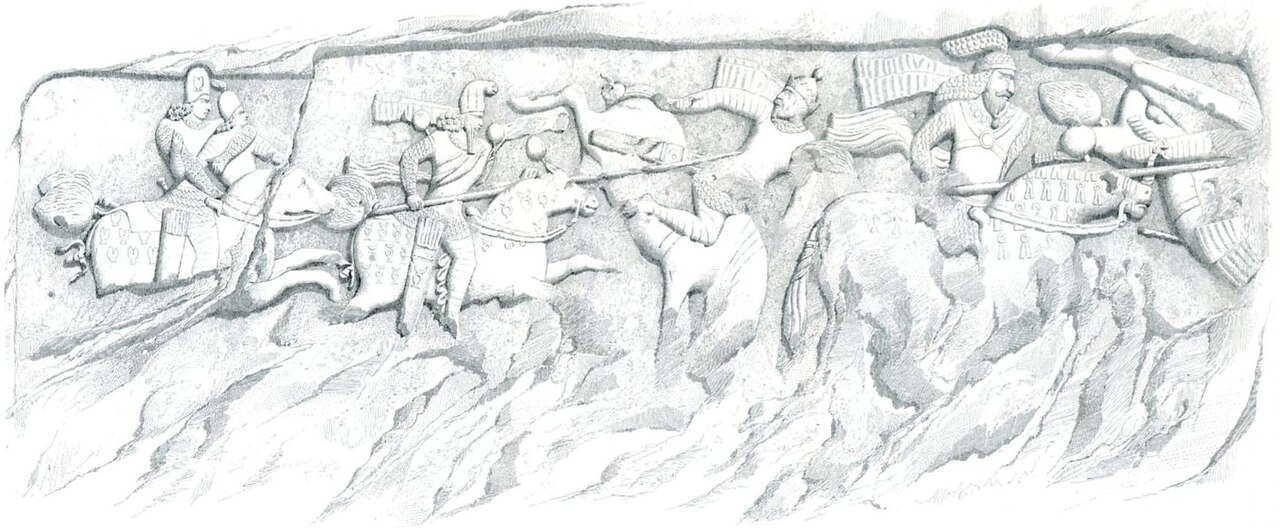

The Battle of Hormozgan, 224
By 224 Artabanus had no choice but to fight in person. According to al-Tabari’s account, the two kings agreed to meet on the plain of Hormozgan at the end of the month of Mihr. Ardashir arrived first, took possession of a spring and dug a ditch to protect his position. Later tradition gives Artabanus the larger army.
The battle, fought on 28 April 224 by the modern conversion of the date, ended with Artabanus dead. Sasanian tradition says Ardashir killed him with his own hand, and the relief at Firuzabad shows exactly that: Ardashir’s lance throwing the Parthian king from his horse. Artabanus’ chief secretary, Dad-windad, was captured and executed afterwards.
Where the battle took place is unknown. One medieval Arabic chronicle gives a name that the scholar Geo Widengren read as Golpayegan in central Iran, which seems unlikely given where Ardashir was campaigning, while the historian Bal’ami places it at Khosh-Hormoz, another name for the town of Ram-Hormoz in Khuzestan, about 65 km east of Ahvaz. Modern scholars such as A. Sh. Shahbazi favoured Ram-Hormoz, whose wide plain suits a cavalry battle. The plain has nothing to do with the modern province of Hormozgan on the Persian Gulf.
After the king’s death
One battle did not end Parthian resistance. Dio Cassius, writing at the time in Rome, says Ardashir defeated the Parthians in three battles and killed their king. Vologases VI held on in Mesopotamia: his last dated tetradrachm, struck at Seleucia, belongs to 227/228. Ctesiphon fell to Ardashir in about 226, and with it the last Arsacid foothold in the lowlands.
Dio adds that when Ardashir then marched on Armenia, he met resistance from the Armenians, from some of the Medes and from the sons of Artabanus. The Arsacid princes who escaped Hormozgan had fled north, to the one kingdom still ruled by their own family. Ardashir also failed to take the desert city of Hatra, an old Parthian ally.
The Arsacids of Armenia
Armenia had been ruled by a junior branch of the Arsacid house since Tiridates I was crowned in Rome in 66 CE. After 224 its kings regarded the Sasanians as usurpers who had killed their kinsman, and for much of the 3rd century Armenia fought with Roman support against Ardashir and his son Shapur.
Armenian tradition remembered the conflict in personal terms. The history attributed to Agathangelos tells that a Parthian noble named Anak, sent by the Persian king, murdered the Armenian king Khosrov, and that Anak’s infant son survived to become Saint Gregory the Illuminator, who converted Armenia to Christianity. The story is told centuries later, and the chronology of 3rd-century Armenian kings is much disputed, but it shows how the Arsacid feud entered Armenian memory. The Armenian Arsacid kingdom lasted until 428, when the Sasanian king Bahram V removed its last king. A branch of the family also ruled Iberia in the Caucasus in the 3rd century.
The noble houses that changed sides
The great Parthian families had always chosen between Arsacid candidates. In 224 they chose a new dynasty. The houses of Suren and Karen made terms with Ardashir and kept their estates, the Surens in Sistan and the Karens around Nahavand, and later the Mihran house also rose to prominence. Their position is described on The Great Houses of Parthia.
These families shaped the Sasanian state to its end. Parvaneh Pourshariati has argued that Sasanian power rested on a lasting partnership, a “Sasanian-Parthian confederacy”, with these houses, and that its breakdown helped bring the empire down in the 7th century. The Mihranid general Bahram Chobin, who seized the Sasanian throne in 590, is the clearest example of Parthian nobles’ continuing strength; see Bahram Chobin’s Rebellion. The Karen family still ruled parts of Tabaristan, south of the Caspian, in the late 8th century, long after both dynasties had gone.
Legend: Ardavan in the Shahnameh
Iranian epic told the end of the Arsacids as a romance. In the Middle Persian Book of Deeds of Ardashir and in Ferdowsi’s Shahnameh, Ardashir serves as a young man at the court of Ardavan (Artabanus) and escapes with the help of Golnar, a slave girl of the king. In the Book of Deeds, a daughter of Ardavan later marries Ardashir and is urged by her brothers to poison him, but her son Shapur survives to unite the two houses. These tales make the Sasanians heirs of the Arsacids by marriage, a claim that history does not support, but which suited a new dynasty that needed the old nobility.
- 217–218 Artabanus IV defeats Macrinus at Nisibis; Rome pays for peace
- c. 220–223 Ardashir defeats Artabanus’ vassals in Kerman, Isfahan, Khuzestan and Mesene
- 28 April 224 Battle of Hormozgan; Artabanus IV killed
- c. 226 Ardashir takes Ctesiphon
- 227/228 Last dated coin of Vologases VI
- 220s–230s Sons of Artabanus resist from Armenia
- 428 End of the Arsacid kingdom of Armenia
Why the dynasty fell
Historians usually combine three causes. Repeated Roman invasions in the 2nd century had damaged Mesopotamia and the king’s prestige. The split between Artabanus IV and Vologases VI meant there was no single centre of loyalty. And Ardashir was an exceptional organiser who picked off the southern vassals before Artabanus took him seriously. A fourth factor followed from the Parthian system itself: once the great houses judged that the Arsacids could no longer protect them, they had little reason to die for the dynasty. Their survival under Sasanian rule is part of the Parthian legacy.
Persian words from this page
| اردوان | Ardavân | Artabanus |
| اردشیر | Ardashir | Ardashir |
| هرمزگان | Hormozgân | Hormozgan |
| رامهرمز | Râmhormoz | Ram-Hormoz |
| گلنار | Golnâr | Golnar, the slave girl of the legend |
| نبرد | nabard | battle |
Sources and further reading
- Dio Cassius, Roman History, books 79–80
- Al-Tabari, The History of al-Tabari, vol. 5: The Sasanids, the Byzantines, the Lakhmids, and Yemen, trans. C. E. Bosworth (1999)
- K. Schippmann, “Arsacids ii. The Arsacid dynasty”, Encyclopaedia Iranica
- A. Sh. Shahbazi, “Hormozdgān”, Encyclopaedia Iranica
- Parvaneh Pourshariati, Decline and Fall of the Sasanian Empire: The Sasanian-Parthian Confederacy and the Arab Conquest of Iran (2008)
- Touraj Daryaee, Sasanian Persia: The Rise and Fall of an Empire (2009)
Want to learn Persian? Get the free Starter Pack
Get the 14-page printable Starter Pack (all 32 letters, a 7-day reading plan, 100 core words and 20 survival phrases) and a short 5-email course. Free.
More in The Parthian Empire (247 BCE–224 CE)
- The Parni and Arsaces I
- Nisa: The First Parthian Capital
- Mithridates I and the Making of an Empire
- Phraates II, Artabanus I and the Saka Invasions
- Mithridates II the Great
- The Parthians and the Silk Road
- Parthian Cavalry: Cataphracts and the Parthian Shot
- Surena and the Battle of Carrhae (53 BCE)
- Orodes II and Prince Pacorus
- Mark Antony’s Parthian War
- Phraates IV and the Peace with Augustus
- Queen Musa of Parthia
- Artabanus II of Parthia
- Gotarzes II and Vardanes: A Royal Rivalry
- Vologases I and the War over Armenia
- Trajan’s Invasion of Parthia
- Osroes I and the Parthian Civil Wars
- Roman Campaigns of the 2nd Century: Lucius Verus and Septimius Severus
- The Last Parthian Kings: Vologases V, Vologases VI and Artabanus IV
- The Fall of the Parthian Empire
- Ctesiphon: Capital of Two Empires
- The Great Houses of Parthia
- Religion and Culture in Parthian Iran
- Parthian Art and Architecture
- Parthian Coins and What They Tell Us
- Hatra: The City that Resisted Rome
- The Parthian Language and Its Records
- The Indo-Parthians and Kushans
- The Parthian Legacy