Ardashir I (ruled 224 to c. 242 CE) was the founder of the Sasanian Empire. Starting as a local ruler in Fars, he defeated and killed the last Parthian king, Artabanus IV, in 224, took the title “king of kings of Iran” and spent the rest of his reign turning a patchwork of vassal kingdoms into a more centralised state that would last more than four hundred years.
| Reign | 224 to c. 242 CE (co-ruler with his son Shapur from 240) |
|---|---|
| Father | Papak, ruler of Istakhr |
| Decisive battle | Hormozgan, 224 CE, against Artabanus IV |
| Title | “Mazda-worshipping lord Ardashir, king of kings of Iran, whose lineage is from the gods” |
| Capitals | Istakhr and Ardashir-Khwarrah in Fars; Ctesiphon and Veh-Ardashir in Mesopotamia |
| Successor | Shapur I |

From Fars to the throne of Iran
When Ardashir took control of Istakhr around 211 or 212, after the death of his brother Shapur (the story is told on our page on the origins of the Sasanian family), he was only one of several lords in Fars. Over the next decade he subdued the rest of the province and then pushed outward, taking Kerman and the lands around the head of the Persian Gulf, including Mesene (Characene) at the mouth of the Tigris.
The Parthian king Artabanus IV at first treated him as a rebellious vassal. According to al-Tabari, he ordered the king of Ahvaz to bring Ardashir to him in chains, and the expedition ended in defeat for Artabanus’s ally. Ardashir also built himself a fortified base at Ardashir-Khwarrah (modern Firuzabad), deliberately out of reach in a mountain valley, described on our page on Firuzabad, Ardashir’s round city.
The decisive battle took place in 224 at a plain called Hormozgan (not to be confused with the modern province of that name). Artabanus was killed. Later Sasanian art shows the fight as a duel between kings: on a rock relief near Firuzabad, Ardashir unseats Artabanus with his lance while his son Shapur unhorses the Parthian vizier. The details of the battle itself are covered on The Fall of the Parthian Empire.
Wars of consolidation
Victory over Artabanus did not make Ardashir master of the whole Parthian realm at once. Members of the Arsacid family held out in the north, and the Arsacid kings of Armenia remained hostile for decades. Ardashir campaigned in Media, took Ctesiphon, and according to al-Tabari received the submission of the rulers of the Kushans, Turan and Makran in the east. Whether that “submission” meant real control or just an exchange of envoys is uncertain, but Sasanian coins struck in the former Kushan lands show that the east came under Sasanian authority within a generation.
Clashing with Rome
Ardashir soon turned to the west. Around 230 he invaded Roman Mesopotamia and besieged Nisibis. Roman writers, notably Herodian and the later Cassius Dio epitomes, said he claimed all the lands once ruled by the Achaemenids, as far as the Aegean. Many historians now doubt that he made such a specific claim; it may reflect Roman fears more than Sasanian policy. The emperor Severus Alexander answered with a three-pronged invasion in 232. The result was bloody and inconclusive, and both sides claimed success.
Later in the decade, around 235 to 238, while Rome was weakened by its own civil wars, Ardashir took Nisibis and Carrhae. The Arab caravan city of Hatra, which had resisted him for years, fell around 240 or 241. The father and son team of Ardashir and Shapur had shown they could beat Rome, a pattern that continued in the next reign.
How Ardashir governed
Historians often describe the shift from Parthian to Sasanian rule as a move from a loose federation to a centralised monarchy. That contrast is useful but can be overstated. The great Parthian noble houses, such as the Suren and the Karen, survived and served the new dynasty. What changed was the balance. Ardashir removed most of the sub-kings and replaced them with members of his own family or appointed governors, and he made the king of kings the clear centre of power.
He also founded or refounded cities, often named after himself: Veh-Ardashir on the site of Seleucia opposite Ctesiphon, Rev-Ardashir in Fars, and Hormizd-Ardashir (Ahvaz) in Khuzestan. New cities brought revenue, settled populations and spread the royal name across the land.
Religion and the royal image
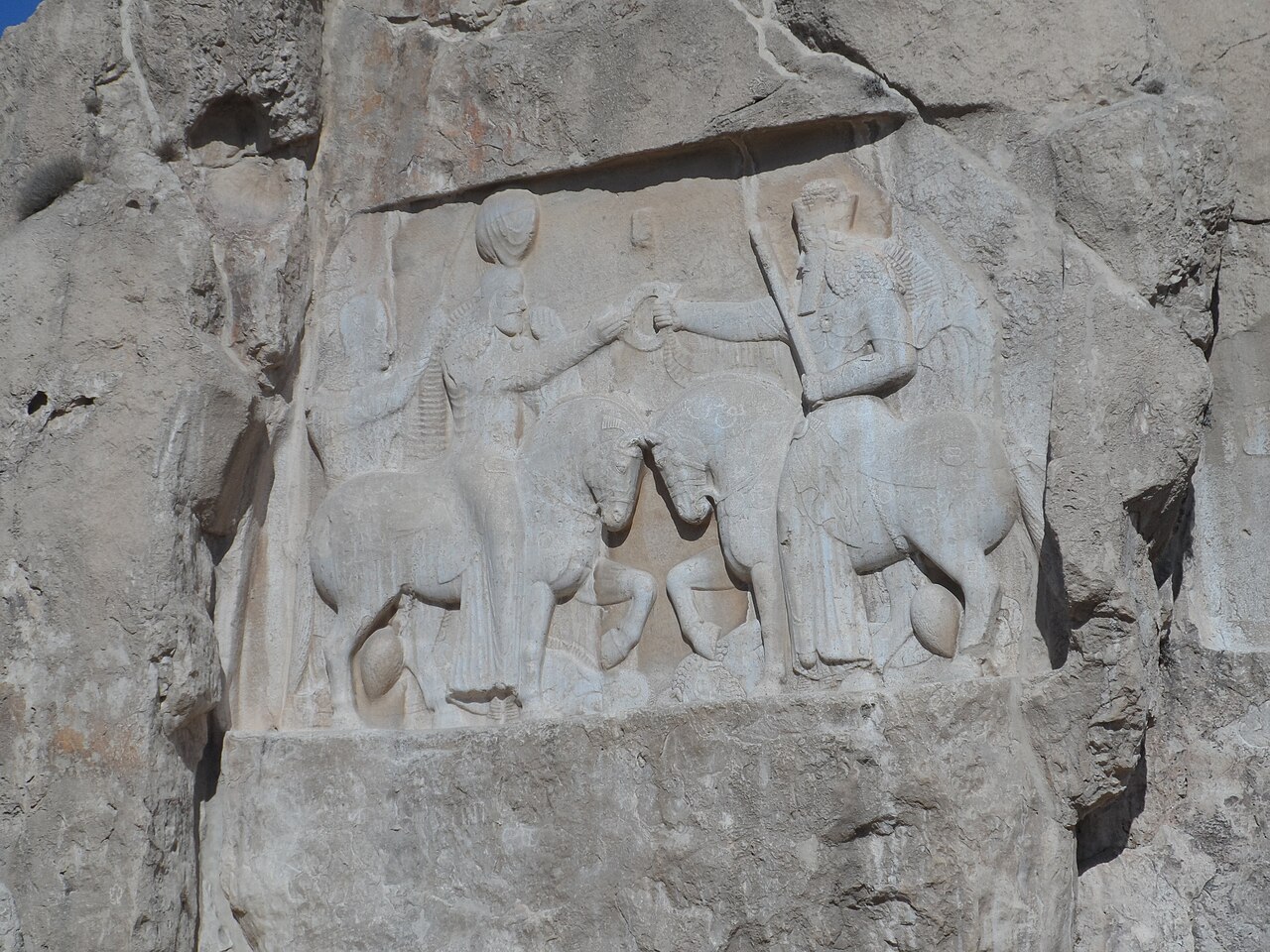
Ardashir’s coins show a fire altar on the reverse, a design that stayed on Sasanian coins for four centuries. His investiture relief at Naqsh-e Rostam shows Ahura Mazda on horseback handing him the ring of kingship, with the body of Artabanus under Ardashir’s horse and the evil spirit Ahriman under the god’s. The message is plain: Ardashir rules by divine choice, and his victory over the Parthians mirrors the god’s victory over evil. Later Zoroastrian tradition remembered him as the king who gathered the scattered teachings of the faith, together with a high priest named Tansar (or Tosar). How much organisation of the church really happened under Ardashir, rather than later, is debated.
Ardashir’s Testament and the Letter of Tansar
Two texts attributed to Ardashir’s circle shaped his reputation as a wise founder. The Testament of Ardashir (‘Ahd Ardashir), preserved in Arabic, is a book of advice to his successors. Its best-known line says that religion and kingship are twin brothers: neither can stand without the other. The Letter of Tansar survives in a Persian translation of an Arabic version and presents Tansar defending Ardashir’s reforms to a northern king.
Most scholars think both works were written or heavily reworked later, probably in the sixth century under Khosrow I, when the court was keen to present its own reforms as a return to the founder’s ideals. They tell us more about how later Sasanians saw Ardashir than about what he actually did, though they may contain older material. The same idealised figure appears in the Shahnameh as Ardashir-e Babakan.
- c. 211/212 Ardashir takes power in Istakhr
- 224 Victory at Hormozgan; death of Artabanus IV
- 226 Commonly given date for his coronation at Ctesiphon
- c. 230 First invasion of Roman Mesopotamia
- 232 Severus Alexander’s counter-offensive
- c. 235–238 Capture of Nisibis and Carrhae
- 240 Shapur made co-ruler; Hatra falls around 240/241
- c. 242 Death of Ardashir
Legacy
Ardashir died around 242, having already raised Shapur to share his throne. He left his son a state with a clear dynastic ideology, a working army and a habit of war with Rome. The best introduction to what came next is our page on Shapur I. For a visitor’s view of his monuments, see Sasanian Sites of Fars and Naqsh-e Rostam.
Persian words from this page
| اردشیر بابکان | Ardeshir-e Bâbakân | Ardashir son of Papak |
| اردوان | Ardavân | Artabanus |
| شاهنشاه | shâhanshâh | king of kings |
| تنسر | Tansar | Tansar, Ardashir’s high priest |
| آتشدان | âtashdân | fire altar |
| اهورامزدا | Ahurâmazdâ | Ahura Mazda |
Sources and further reading
- Al-Tabari, The History of al-Tabari, vol. 5, trans. C. E. Bosworth (SUNY Press, 1999).
- Herodian, History of the Empire after Marcus, Book 6.
- Encyclopaedia Iranica, “Ardašīr I” (history and art sections).
- Mary Boyce (trans.), The Letter of Tansar (Istituto Italiano per il Medio ed Estremo Oriente, 1968).
- Touraj Daryaee, Sasanian Persia: The Rise and Fall of an Empire (I.B. Tauris, 2009).
- Matthew P. Canepa, The Two Eyes of the Earth: Art and Ritual of Kingship between Rome and Sasanian Iran (University of California Press, 2009).
Want to learn Persian? Get the free Starter Pack
Get the 14-page printable Starter Pack (all 32 letters, a 7-day reading plan, 100 core words and 20 survival phrases) and a short 5-email course. Free.
More in The Sasanian Empire (224–651 CE)
- The Origins of the Sasanian Family
- Ardashir I, Founder of the Sasanian Empire
- Firuzabad: Ardashir’s Round City
- Shapur I, King of Kings of Iran and Non-Iran
- Bishapur: Shapur’s City
- The Battle of Edessa and the Capture of Valerian
- The Ka’ba-ye Zartosht Inscription of Shapur I
- Mani and Manichaeism
- Hormizd I and Bahram I
- Kartir and the Zoroastrian Church
- Bahram II
- Narseh and the Peace of Nisibis
- Shapur II the Great
- Julian’s Invasion of Persia (363)
- Christians in the Sasanian Empire
- Shapur III and the Partition of Armenia
- Yazdegerd I
- Bahram V Gur
- Yazdegerd II
- The Battle of Avarayr (451)
- The Hephthalites and Iran’s Eastern Frontier
- Peroz I and the Hephthalite Disaster
- Kavad I
- Zamasp and Kavad’s Return
- Mazdak and the Mazdakite Movement
- Khosrow I Anushirvan the Just
- The Sasanian–Byzantine Wars of the 6th Century
- The Battle of Dara (530)
- Khosrow I Sacks Antioch (540)
- The Lazic War (541–562)
- The Reforms of Khosrow I
- The Academy of Gondishapur: History and Legend
- Borzuya, Chess and Kalila wa Dimna
- Taq Kasra: The Arch of Ctesiphon
- The Sasanian Conquest of Yemen
- The Sasanians and the Western Turks
- Hormizd IV
- Bahram Chobin’s Rebellion
- Khosrow II Parviz
- The Last Great War: Byzantium and Persia, 602–628
- The Siege of Constantinople (626)
- Heraclius Strikes Back
- Shirin: Queen and Legend
- Shahrbaraz, the General Who Became King
- Civil War and the Queens Boran and Azarmidokht
- Yazdegerd III, the Last Sasanian King
- The Sasanian Army
- Sasanian Society and the Class System
- Zoroastrianism under the Sasanians
- Sasanian Art: Silver, Reliefs and Silk
- The Sasanian Reliefs of Naqsh-e Rostam
- Taq-e Bostan
- Sasanian Cities, Palaces and Bridges
- Middle Persian (Pahlavi) Language and Literature
- Sasanian Coins and Silverwork
- Women in the Sasanian Empire
- Polo, Hunting and Games at the Sasanian Court
- The Sasanian Legacy