Bisotun (بیستون, also Behistun) is a limestone mountain beside the old road from Mesopotamia to the Iranian plateau, about 30 km east of Kermanshah, where people have left their mark since the Old Stone Age. Its most famous monument is the relief and trilingual inscription of Darius the Great, carved high on the cliff around 520 BCE, but the site, a UNESCO World Heritage Site since 2006, also holds a reclining Heracles, Parthian reliefs, a vast Sasanian rock face and Safavid caravanserais. This page is a guide to visiting the whole site.
| Location | Bisotun, Kermanshah province, on the Kermanshah–Hamadan road |
|---|---|
| Periods | Palaeolithic to Qajar; main monuments Achaemenid, Seleucid, Parthian, Sasanian, Ilkhanid and Safavid |
| Highlight | Relief and inscription of Darius I, c. 520 BCE |
| UNESCO | Inscribed 2006 (site 1222); about 187 ha |
| Name | Old Persian *Bagastâna, “place of the gods”, as reconstructed from Greek sources |
For the text of Darius’s inscription, how it was copied and how Henry Rawlinson used it to decipher cuneiform, read The Behistun Inscription. Here we walk through the site as a visitor sees it.

Why this mountain
Bisotun rises sheer from the plain beside strong springs, at a point where the great road from Babylon to Ecbatana (Hamadan) and on to Central Asia passed close under the cliff. A holy mountain, a water source and a highway in one place made it a natural spot for kings to speak to passers-by. The Greek writer Ctesias, who mistook Darius’s relief for a monument of the legendary queen Semiramis, already called the mountain sacred to Zeus. The modern name comes from Persian Behestun or Bisotun, popular forms of the ancient name.
A walk along the cliff
Most monuments lie along a path at the foot of the mountain. Roughly in the order you meet them from the main entrance:
The Heracles statue
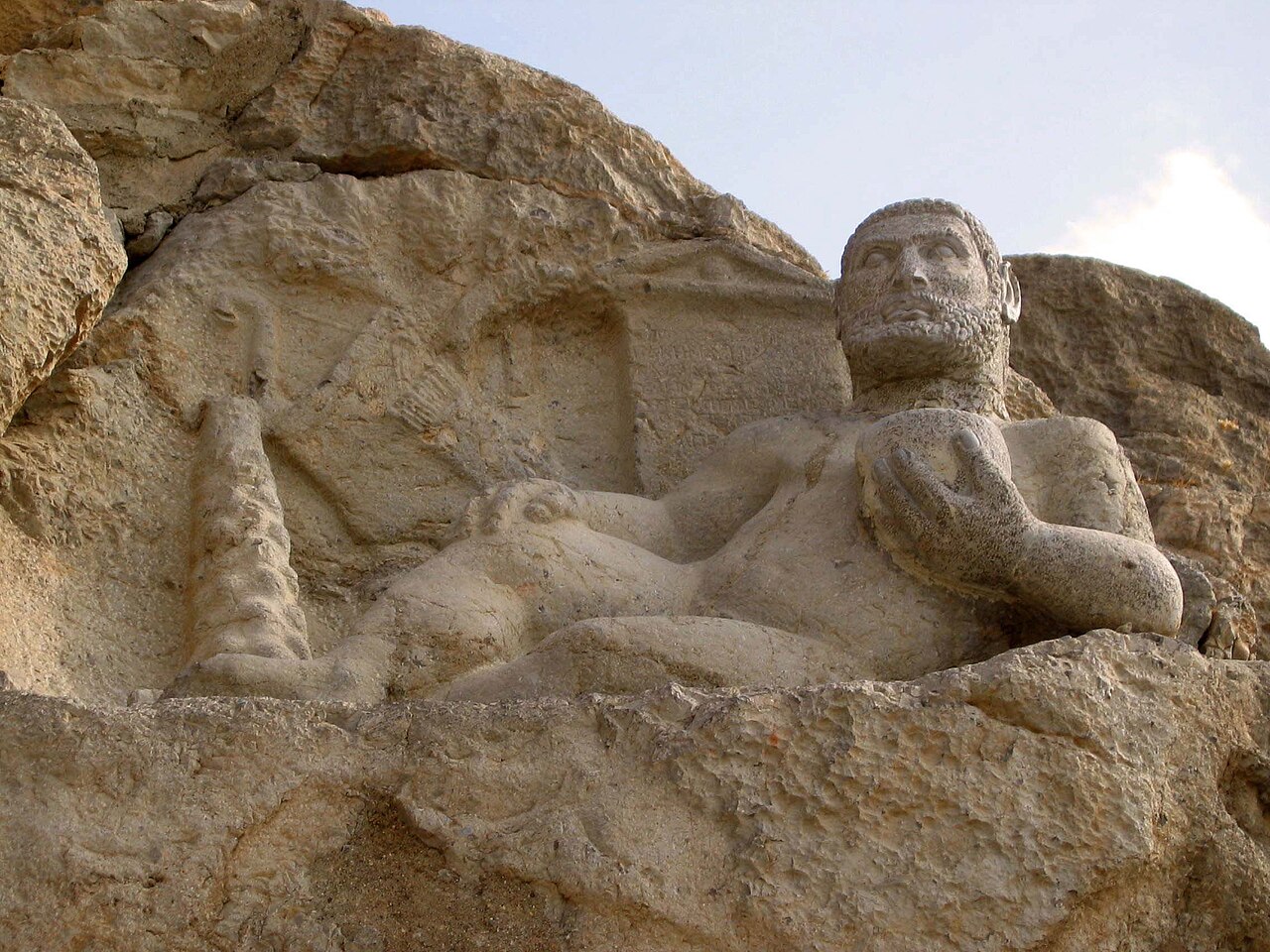
Near the start of the path, a figure of Heracles reclines on a lion skin, cup in hand, carved in such high relief that it almost seems free-standing. A Greek inscription dates it to 148 BCE, in the last years of Seleucid rule, just before the Parthians took the region. It is the only clearly datable Hellenistic rock sculpture of its kind in Iran, and a reminder that Greek gods were worshipped here after Alexander’s conquest.
Parthian reliefs
Further along, worn reliefs show Parthian kings: Mithridates II (123–87 BCE) receiving dignitaries, and Gotarzes II (1st century CE) on horseback defeating an enemy, with a winged Victory above. They are badly weathered, and part of the Mithridates relief was cut away in 1684–1685 for an endowment inscription by the Safavid vizier Sheikh Ali Khan Zanganeh. For their background, see the Parthian Empire.
The relief of Darius
The main monument is carved about 60 m above the springs, deliberately out of reach. The relief, about 3 m high and 5.5 m wide, shows Darius with his foot on the prostrate Gaumata, the man he says usurped the throne, and nine rebel kings roped together at the neck before him, with the winged Ahuramazda figure above. Local people called the figures “the nine dervishes”. Around the relief are about 1,200 lines of text in Old Persian, Elamite and Babylonian telling how Darius won the throne in 522–521 BCE. From the path you see it from below; bring binoculars or a zoom lens to make out the figures.
Farhad Tarash
Beyond the Darius relief is the most puzzling sight at Bisotun: a smoothed rock face about 200 m long and 30 m high, with a massive retaining wall in front. It is the largest work of its kind in Iran. Many archaeologists now link it to the late Sasanian building programme at Bisotun, perhaps an unfinished palace or monument of Khosrow II. Legend has a better story: in Nezami’s poem Khosrow and Shirin, Farhad, the stonecutter in love with Shirin, hews the mountain to win her, and the place is still called Farhad Tarash, “Farhad’s cutting”.
Bridges, capitals and caravanserais
On the plain are traces of a Sasanian bridge and dam on the Gamasiab river, and fine Sasanian capitals carved with royal figures. The Safavid caravanserai built by Sheikh Ali Khan Zanganeh still stands near the road, and there are remains of an Ilkhanid building close by. Together they show that Bisotun stayed a stop on the road from antiquity to the age of motor traffic.
Prehistoric caves
Caves in the cliff, such as the Hunters’ Cave (Shekarchian), have produced Palaeolithic stone tools and animal bones, the oldest evidence of people at the springs.
Practical notes
- Getting there: Bisotun town lies about 30 km east of Kermanshah on the main road to Hamadan; taxis and buses run from Kermanshah. Many visitors combine it with Taq-e Bostan on the edge of the city.
- Time needed: two hours for the main path, more if you explore the plain.
- Weather: there is little shade along the cliff, and midsummer middays can be very hot.
- Tickets and hours: check current official information.
- Safety: follow your own government’s travel advice for Iran, including any advice on Kermanshah province.
For the city, see our guide to Kermanshah.
Persian words from this page
| بیستون | Bisotun | the mountain and village |
| سنگنگاره | sang-negâreh | rock relief |
| کتیبه | katibeh | inscription |
| فرهاد | Farhâd | the stonecutter of the legend |
| شیرین | Shirin | the Sasanian queen of the legend |
| کاروانسرا | kârvânsarâ | caravanserai |
Sources and further reading
- UNESCO World Heritage Centre, “Bisotun” (inscribed 2006).
- Encyclopaedia Iranica, “BISOTUN i. Introduction” (Rüdiger Schmitt) and “BISOTUN ii. Archaeology“.
- Darius I, the Behistun inscription (DB), in Amélie Kuhrt, The Persian Empire: A Corpus of Sources from the Achaemenid Period (Routledge, 2007).
- Nezami Ganjavi, Khosrow and Shirin, for the legend of Farhad.
Want to learn Persian? Get the free Starter Pack
Get the 14-page printable Starter Pack (all 32 letters, a 7-day reading plan, 100 core words and 20 survival phrases) and a short 5-email course. Free.
More in Top Places to Visit in Iran
- Naqsh-e Jahan Square
- Shah (Imam) Mosque, Isfahan
- Sheikh Lotfollah Mosque
- Ali Qapu Palace
- Jameh Mosque of Isfahan
- Si-o-se Pol and Khaju Bridge
- Vank Cathedral
- Hasht Behesht Palace
- Naqsh-e Rostam
- Eram Garden, Shiraz
- Nasir al-Molk (Pink) Mosque
- Tomb of Hafez (Hafezieh)
- Tomb of Saadi (Saadieh)
- Shah Cheragh Shrine
- Arg of Karim Khan
- Fin Garden, Kashan
- Historic Houses of Kashan
- Jameh Mosque of Yazd
- Yazd Fire Temple and Towers of Silence
- Dowlatabad Garden and Windcatcher
- Amir Chakhmaq Complex
- Golestan Palace
- National Museum of Iran
- Treasury of National Jewels
- Tehran Grand Bazaar
- Milad Tower
- Imam Reza Shrine, Mashhad
- Tomb of Ferdowsi, Tus
- Tomb of Omar Khayyam, Neyshabur
- Tomb of Avicenna, Hamadan
- Ganjnameh Inscriptions, Hamadan
- Behistun (Bisotun): Visiting the Site
- Taq-e Bostan: Visiting the Site
- Tabriz Historic Bazaar
- Takht-e Soleyman
- Armenian Monastic Ensembles of Iran
- Sheikh Safi al-Din Shrine, Ardabil
- Dome of Soltaniyeh
- Alamut Castle
- Falak-ol-Aflak Castle
- Shushtar Historical Hydraulic System
- Chogha Zanbil: Visiting the Ziggurat
- Susa Archaeological Site
- Arg-e Bam
- Ganjali Khan Complex, Kerman
- Shazdeh Garden, Mahan
- Rayen Castle
- Dasht-e Lut (Lut Desert)
- Maranjab Desert and Caravanserai
- Varzaneh Desert
- Mount Damavand
- Hyrcanian Forests
- Lake Urmia
- Badab-e Surt Springs
- Ali Sadr Cave
- The Kaluts of Shahdad
- Qeshm Geopark
- Hormuz Island Colours
- Visiting Persepolis: A Day Trip from Shiraz
- Visiting Pasargadae
- Persian Caravanserais
- The Qanat of Gonabad
- Meymand Village
- Sasanian Sites of Fars: Firuzabad, Bishapur and Sarvestan
- Gonbad-e Qabus: Visiting the Tower
- Zayandeh Rud and Isfahan’s Bridges
- Tochal and Darband: Hiking Above Tehran
- Mount Sabalan
- Skiing in Iran: Dizin and Shemshak
- Golestan National Park