Parthian art and architecture (c. 247 BCE–224 CE) blended Greek technique with Iranian and Mesopotamian traditions and produced two lasting innovations: the iwan, a great vaulted hall open at one end, and the frontal style, in which figures stare straight out at the viewer. Its best-known works include the bronze statue from Shami, the temples of Hatra and the rock reliefs of Behistun and Elymais, and the iwan went on to shape Iranian buildings, from Sasanian palaces to the four-iwan mosques of Isfahan.
| Period | c. 247 BCE–224 CE |
|---|---|
| Key innovations | The iwan; strict frontality in sculpture and painting |
| Major sites | Nisa (Turkmenistan); Assur and Hatra (Iraq); Shami, Bard-e Neshandeh and Masjed-e Soleyman (Khuzestan); Behistun (Kermanshah); Kuh-e Khwaja (Sistan) |
| Famous object | Bronze statue of a nobleman from Shami, National Museum of Iran |
| Materials | Mud brick, baked brick and rubble with gypsum mortar; stucco; bronze; ivory; glazed pottery |
A mixed inheritance
When the Parthians took over the Seleucid lands in the 2nd century BCE, they inherited cities full of Greek art and craftsmen. Early Parthian works, such as the carved ivory drinking horns (rhytons) from the royal treasury at Nisa, are largely Hellenistic in style, with Greek gods and scenes from Greek myth. They are described on the page Nisa: The First Parthian Capital, and the wider background on Greek Culture in Iran.
Over the next two centuries a distinct style emerged across the empire, from Mesopotamia to the Iranian plateau. The historian Michael Rostovtzeff, studying finds from Dura-Europos on the Euphrates in the 1930s, was the first to call it “Parthian art”. Not all of it was made by Parthians. Much comes from the semi-independent kingdoms of Elymais in Khuzestan, Hatra in the Iraqi desert and Palmyra in Syria, which lay inside or on the edge of the Parthian world. What unites it is a shared visual language.
The frontal style
The most recognisable feature of Parthian art is frontality. Whether they show a king, a god or a worshipper, sculptors and painters turned their figures to face the viewer directly, with wide open eyes, even when the figure is shown taking part in an action, such as sacrificing at an altar or receiving a ring of office. The French archaeologist Daniel Schlumberger argued that this was a deliberate choice: the figure addresses the person standing before it, as if in a religious or royal audience.
Clothing is shown in detail. Men wear long-sleeved tunics, wide trousers often gathered at the ankles, and belts with daggers; their hair is bushy, often held by a band. Patterns on the cloth, jewellery and weapons are carved with great care, while the body underneath is simplified. The effect is formal and still, very different from the movement of classical Greek sculpture. Scholars have long debated how far this style later influenced the frontal icons of Byzantine and early Christian art.
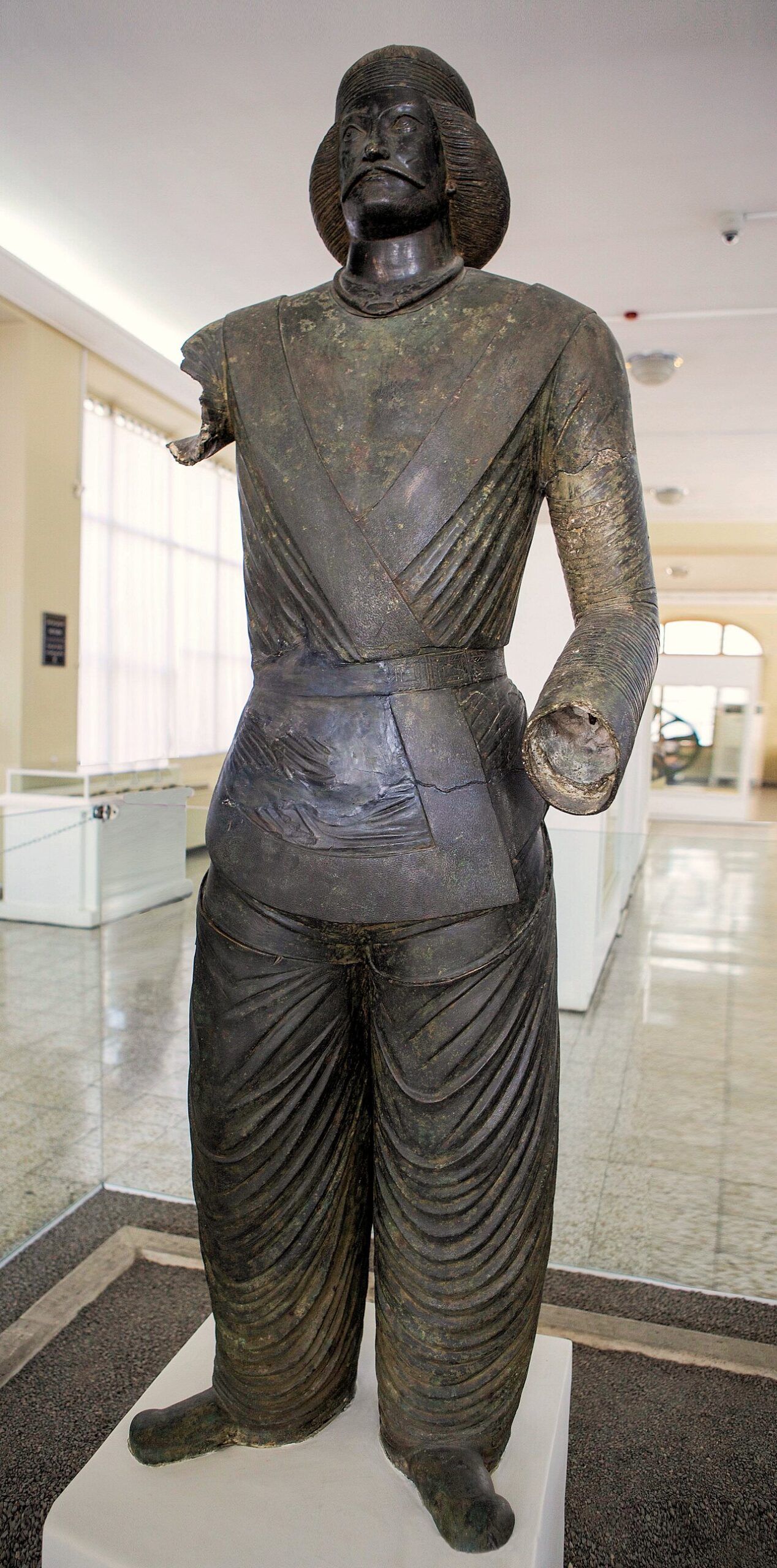

The bronze statue from Shami
The finest single work of Parthian sculpture was found by local villagers in the mid-1930s (1934 or 1935, according to different accounts) at Shami, near Izeh (Malamir) in the mountains of Khuzestan, in the ruins of a shrine. It is a bronze statue of a man, nearly two metres tall, standing in frontal pose with his arms at his sides. He wears a crossover tunic, a heavy belt and trousers, with a band around his thick hair and a torque around his neck. The head is smaller than the body would suggest and made of a different bronze alloy, so it may have been cast separately, or even taken from another statue.
The statue is usually dated between the 1st century BCE and the 2nd century CE and is thought to show a local prince or nobleman of Elymais, a kingdom within the Parthian sphere. It has sometimes been labelled as Surena, the victor of Carrhae, but nothing on the statue names him. It is now one of the main exhibits of the National Museum of Iran in Tehran. Fragments of other bronze statues were found at the same site, which suggests the shrine held a gallery of portraits.
Rock reliefs
The Parthians revived the Iranian tradition of carving images on cliff faces. At Behistun, below the great inscription of Darius, a relief of Mithridates II receiving nobles was carved around the end of the 2nd century BCE, and another shows Gotarzes II on horseback defeating a rival, with a Greek inscription. Both are badly damaged. In the mountains of Elymais, reliefs at Hung-e Azhdar and Tang-e Sarvak show local rulers in audience, at sacrifice and in combat, carved in the frontal style. These reliefs lead directly to the great Sasanian rock carvings described on the page Sasanian Art: Silver, Reliefs and Silk.
The iwan
The most influential Parthian contribution to architecture was the iwan (ایوان, eyvân): a rectangular hall roofed with a barrel vault, closed on three sides and open on the fourth to a courtyard. The form may have grown out of tent and pavilion traditions, but its first known monumental examples are Parthian, dating to the 1st and 2nd centuries CE.
At Assur, the old Assyrian capital on the Tigris, a Parthian palace was built with four iwans facing each other across a central courtyard. At Hatra, the great temple complex was built as rows of tall iwans of different sizes standing side by side, with carved heads and figures decorating the arches. Builders used rubble or brick set in fast-drying gypsum mortar, which allowed vaults to be built quickly without timber supports.
The iwan became one of the defining forms of Iranian architecture. Sasanian kings built the vast vault of Taq Kasra at Ctesiphon; after the coming of Islam, the four-iwan courtyard became the standard plan for mosques, madrasas and caravanserais. The Jameh Mosque of Isfahan, described on The Seljuk Domes of Isfahan’s Jameh Mosque, is the classic example, and its plan goes back, through many stages, to buildings like the palace at Assur.
Temples, stucco and painting
In Khuzestan, the French archaeologist Roman Ghirshman excavated terrace sanctuaries at Masjed-e Soleyman and Bard-e Neshandeh, where Parthian-period statues and altars stood on platforms reached by stairs. At Kuh-e Khwaja in Sistan, a hilltop palace and temple complex preserves traces of wall paintings and moulded stucco, though their date is debated. Carved and painted stucco, used to cover walls in bright geometric and plant patterns, was a Parthian speciality that the Sasanians and later Islamic builders developed further.
Smaller arts also flourished. Workshops in Mesopotamia produced green and blue glazed pottery, including large coffins with a slipper-like shape. Bronze and silver vessels, gold jewellery set with stones, and the portraits on Parthian coins, discussed on the page Parthian Coins and What They Tell Us, show the same mix of Greek skill and Iranian taste.
How historians see it
For a long time Parthian art was treated as a decline from Greek classical standards, and the Parthian period as a gap between the Achaemenids and the Sasanians. Scholars such as Rostovtzeff, Schlumberger and Malcolm Colledge changed that view by showing that it had its own logic and its own achievements. Two questions remain open: how far a single “Parthian” style existed across such a varied empire, and how much of it came from the Arsacid court rather than from the vassal kingdoms and trading cities where most of the surviving works were found. The city that holds many of the best examples is covered on the page Hatra: The City that Resisted Rome.
Persian words from this page
| ایوان | eyvân | iwan, vaulted hall |
| تندیس | tandis | statue |
| مفرغ | mofragh | bronze |
| نقش برجسته | naghsh-e barjaste | relief carving |
| گچبری | gachbori | stucco work |
| ایذه | Izeh | Izeh, in Khuzestan |
| موزه ملی ایران | Muze-ye Melli-ye Irân | National Museum of Iran |
Sources and further reading
- Malcolm A. R. Colledge, Parthian Art (Elek, 1977).
- Daniel Schlumberger, L’Orient hellénisé (Paris, 1970).
- M. I. Rostovtzeff, “Dura and the Problem of Parthian Art”, Yale Classical Studies 5 (1935).
- Roman Ghirshman, Iran: Parthians and Sassanians (Thames and Hudson, 1962).
- Encyclopaedia Iranica, “Arsacids ii. The Arsacid dynasty” (K. Schippmann).
Want to learn Persian? Get the free Starter Pack
Get the 14-page printable Starter Pack (all 32 letters, a 7-day reading plan, 100 core words and 20 survival phrases) and a short 5-email course. Free.
More in The Parthian Empire (247 BCE–224 CE)
- The Parni and Arsaces I
- Nisa: The First Parthian Capital
- Mithridates I and the Making of an Empire
- Phraates II, Artabanus I and the Saka Invasions
- Mithridates II the Great
- The Parthians and the Silk Road
- Parthian Cavalry: Cataphracts and the Parthian Shot
- Surena and the Battle of Carrhae (53 BCE)
- Orodes II and Prince Pacorus
- Mark Antony’s Parthian War
- Phraates IV and the Peace with Augustus
- Queen Musa of Parthia
- Artabanus II of Parthia
- Gotarzes II and Vardanes: A Royal Rivalry
- Vologases I and the War over Armenia
- Trajan’s Invasion of Parthia
- Osroes I and the Parthian Civil Wars
- Roman Campaigns of the 2nd Century: Lucius Verus and Septimius Severus
- The Last Parthian Kings: Vologases V, Vologases VI and Artabanus IV
- The Fall of the Parthian Empire
- Ctesiphon: Capital of Two Empires
- The Great Houses of Parthia
- Religion and Culture in Parthian Iran
- Parthian Art and Architecture
- Parthian Coins and What They Tell Us
- Hatra: The City that Resisted Rome
- The Parthian Language and Its Records
- The Indo-Parthians and Kushans
- The Parthian Legacy