Greeks and Iranians lived side by side for centuries, as subjects, mercenaries, doctors, exiles, artists and enemies, long before and long after the famous wars of 490 and 480 to 479 BCE. Much of what the West believed about ancient Persia came from Greek writers, and much of Greek philosophy reached later Iran through translation. This page looks at that exchange and at how each side imagined the other; the battles themselves are covered in the overview of the Persian Wars.
| Old Persian name for Greeks | Yauna (Ionians), modern Persian Yunân |
|---|---|
| First contact | Cyrus’s conquest of Lydia and the Ionian cities, c. 547 to 540s BCE |
| Main Greek sources on Persia | Aeschylus, Herodotus, Ctesias, Xenophon, Plutarch |
| Hellenistic period | Seleucid rule over Iran, 312 to c. 141 BCE |
| Late exchange | Greek philosophers at Khosrow I’s court, c. 531 to 532 CE |
Greeks inside the Persian empire
When Cyrus took Lydia and then the Ionian cities, hundreds of thousands of Greeks became Persian subjects. Old Persian called them Yauna, after the Ionians, and the word survives as modern Persian یونان Yunân. Ionian and Lydian stonemasons are thought to have worked at Pasargadae, and Darius’s foundation text from Susa names Ionians among the craftsmen who built his palace (see the palace of Darius at Susa).
Greek specialists served at the Persian court. Herodotus tells the story of Democedes of Croton, a doctor who cured Darius’s ankle and then tricked his way home. Ctesias of Cnidus was physician to Artaxerxes II and wrote a long, colourful and unreliable Persica. Greek exiles found refuge with the Great King: Themistocles, the victor of Salamis, ended his life as a Persian governor in Asia Minor under Artaxerxes I, and Spartan and Athenian politicians competed for Persian gold. Greek mercenaries fought for both sides in Persian civil wars, most famously the Ten Thousand who marched with Cyrus the Younger to Cunaxa in 401 BCE.
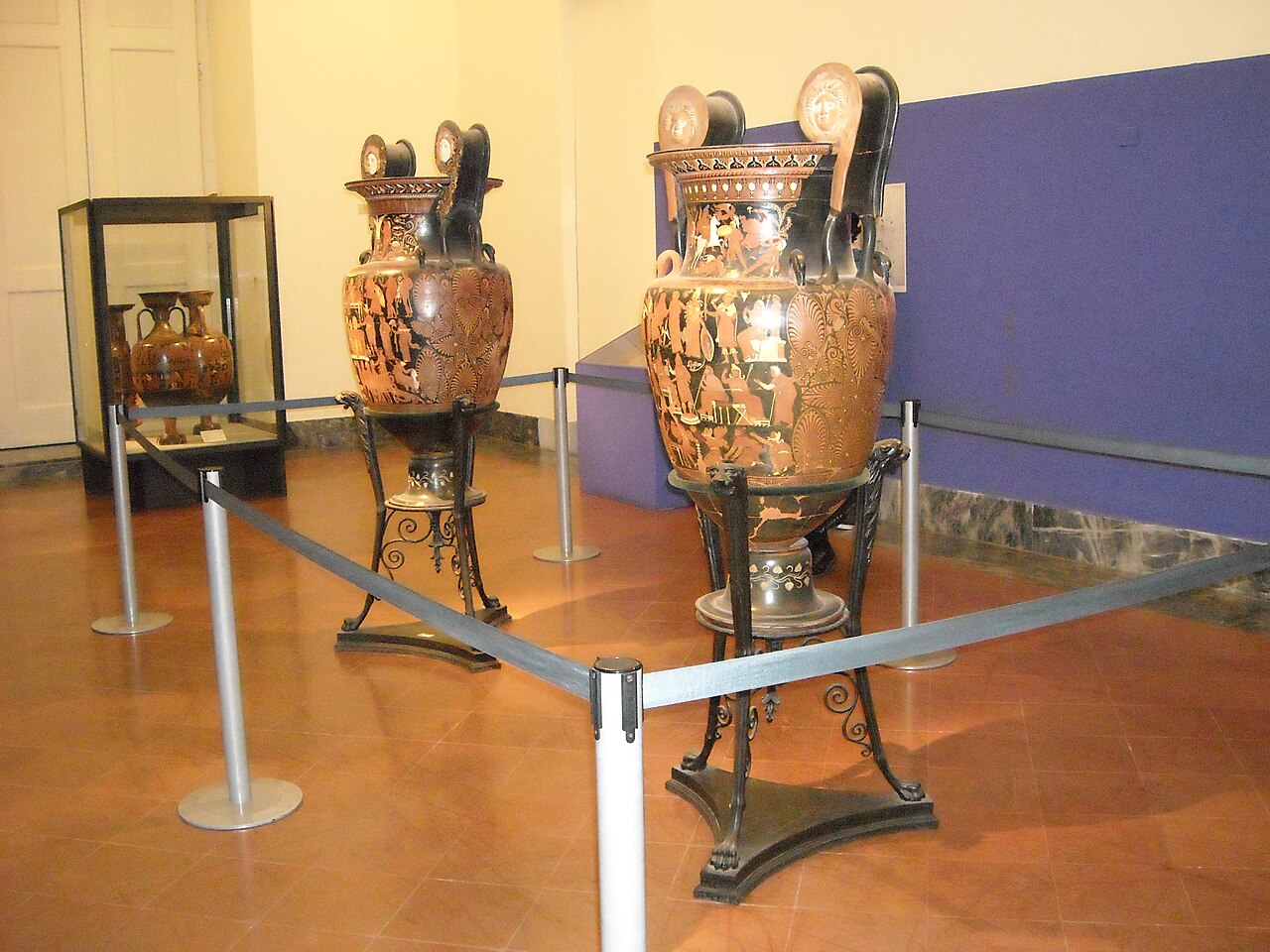

The wars and the invention of “the barbarian”
The Ionian Revolt, Marathon and Xerxes’ invasion loom large in Greek memory but were frontier wars for the Persian empire. Their cultural effect on Greece was enormous. In 472 BCE Aeschylus staged The Persians in Athens, showing the Persian court mourning the defeat at Salamis; it is the oldest surviving Greek tragedy. Greek writers began to use the old word barbaros, someone whose speech sounds like “bar-bar”, for a type: luxurious, despotic and servile, the mirror image of the free Greek citizen.
The picture was never simple. Herodotus admired Persian customs, such as teaching boys “to ride, to shoot and to tell the truth”. Xenophon, who had served Persians, made Cyrus the Great the model ruler of his Cyropaedia. Diplomacy went on throughout: the Peace of Callias and the King’s Peace of 387 BCE, which let Artaxerxes II dictate terms to the Greek cities, show Persia as arbiter of Greek affairs.
Alexander and the Hellenistic centuries
Alexander conquered the empire between 334 and 330 BCE, then adopted Persian dress and court ceremony and married Iranian noblewomen at the Susa weddings, to the anger of many Macedonians. Under the Seleucids Greek colonists settled in Iran and Bactria, Greek became a language of government, and Greek cities with theatres and gymnasiums appeared as far east as Ai Khanoum in Afghanistan. How deep this went is debated; see Hellenism in Iran.
The Parthians who replaced the Seleucids used Greek on their coins and many kings called themselves Philhellen, “friend of the Greeks”. Plutarch reports that the head of the Roman general Crassus, killed at Carrhae in 53 BCE, was brought to the Parthian king during a performance of Euripides’ Bacchae. Greek gradually gave way to Parthian and Middle Persian, and Iranian tradition later remembered Alexander harshly: Zoroastrian texts call him “the accursed” and blame him for burning the sacred books.
Philosophy travels east
After Justinian stopped the teaching of pagan philosophy at Athens in 529, seven Neoplatonist philosophers, among them Damascius and Simplicius, went to the court of Khosrow I. The Byzantine historian Agathias says they were disappointed and soon returned, after Khosrow secured a clause in the peace treaty of 532 that protected them. Khosrow did sponsor translations from Greek, and a scholar called Paul the Persian wrote a treatise on Aristotle’s logic for him.
The larger transfer came under Islam. In Abbasid Baghdad, many of them Iranians, translators and scholars turned Greek medicine, astronomy and philosophy into Arabic (see Baghdad and Persian culture). Avicenna built his philosophy on Aristotle, and Razi argued with Galen. Persian still calls philosophy فلسفه falsafe, from Greek philosophia.
Alexander becomes Iranian
Medieval Persian literature turned the conqueror into a native king. In Ferdowsi’s Shahnameh, Eskandar is the half-brother of Darius III, son of an Iranian king and a Greek princess, so the conquest becomes a family succession. Nizami’s Eskandarnameh made him a philosopher-king who travels the world in search of wisdom.
Modern views
European scholars long read ancient Persia through Greek eyes, as the despotic East defeated by Western freedom. From the 1980s the Achaemenid History workshops led by Heleen Sancisi-Weerdenburg and Amélie Kuhrt pushed historians to start from Persian evidence, such as the Persepolis tablets and royal inscriptions. Popular culture moved more slowly; the 2006 film 300, with its monstrous Persians, drew protests from Iranians and from the Iranian government. Modern Greece and Iran have normal diplomatic relations, and Greek and Iranian scholars now work together on the shared ancient past.
Persian words from this page
| یونان | Yunân | Greece |
| یونانی | yunâni | Greek |
| اسکندر | Eskandar | Alexander |
| فلسفه | falsafe | philosophy |
| هرودوت | Herodot | Herodotus |
| ارسطو | Arastu | Aristotle |
For Iran’s later Western rival, read Persia and Rome.
Sources and further reading
- Herodotus, Histories, especially Books 1, 3 and 7 to 9.
- Aeschylus, The Persians (472 BCE); Xenophon, Anabasis and Cyropaedia.
- Agathias, Histories, Book 2, on Khosrow I and the philosophers.
- Pierre Briant, From Cyrus to Alexander: A History of the Persian Empire (2002).
- Margaret C. Miller, Athens and Persia in the Fifth Century BC: A Study in Cultural Receptivity (1997).
- Encyclopaedia Iranica, “Greece: Greco-Persian Political Relations”.
Want to learn Persian? Get the free Starter Pack
Get the 14-page printable Starter Pack (all 32 letters, a 7-day reading plan, 100 core words and 20 survival phrases) and a short 5-email course. Free.
More in Themes Across Iranian History (3000 BCE–today)
- A History of the Persian Language
- Zoroastrianism through the Ages
- Shi’a Islam in Iranian History
- The Jews of Iran
- The Armenians of Iran
- Christians of Iran
- The Baha’i Faith in Iran
- The Kurds in Iranian History
- Azerbaijanis in Iranian History
- The History of the Iranian Calendar
- Nowruz through History
- The Persian Garden (Pardis) through History
- Qanats: Iran’s Ancient Water Tunnels
- A History of Persian Carpets
- A History of Persian Architecture
- A History of Persian Painting
- A History of Persian Music
- Science in Iranian History
- Women in Iranian History
- Iran and the Silk Road
- Iran and China through History
- Iran and India through History
- Iran and Greece: Perceptions and Exchanges
- Persia and Rome: Seven Centuries of Rivalry
- Iran and the Ottoman Empire
- Iran and Russia through History
- Iran and Britain through History
- Iran and the United States
- How Iran’s Borders Changed
- The Capitals of Iran through History
- Coins of Iran through History: From the Daric to the Rial
- Flags and Symbols of Iran through History
- Myth and History in the Shahnameh: The Epic’s Kings and the Real Past
- Timeline of Iranian History: Key Dates from Elam to Today
- A History of Persian Cuisine: From Royal Banquets to Chelow Kabab
- A History of Persian Poetry: From Rudaki to Forough
- Wine in Iranian History: From Hajji Firuz to Hafez and Prohibition
- Sports in Iranian History: Polo, the Zurkhaneh and Wrestling
- List of Iranian Dynasties and Rulers