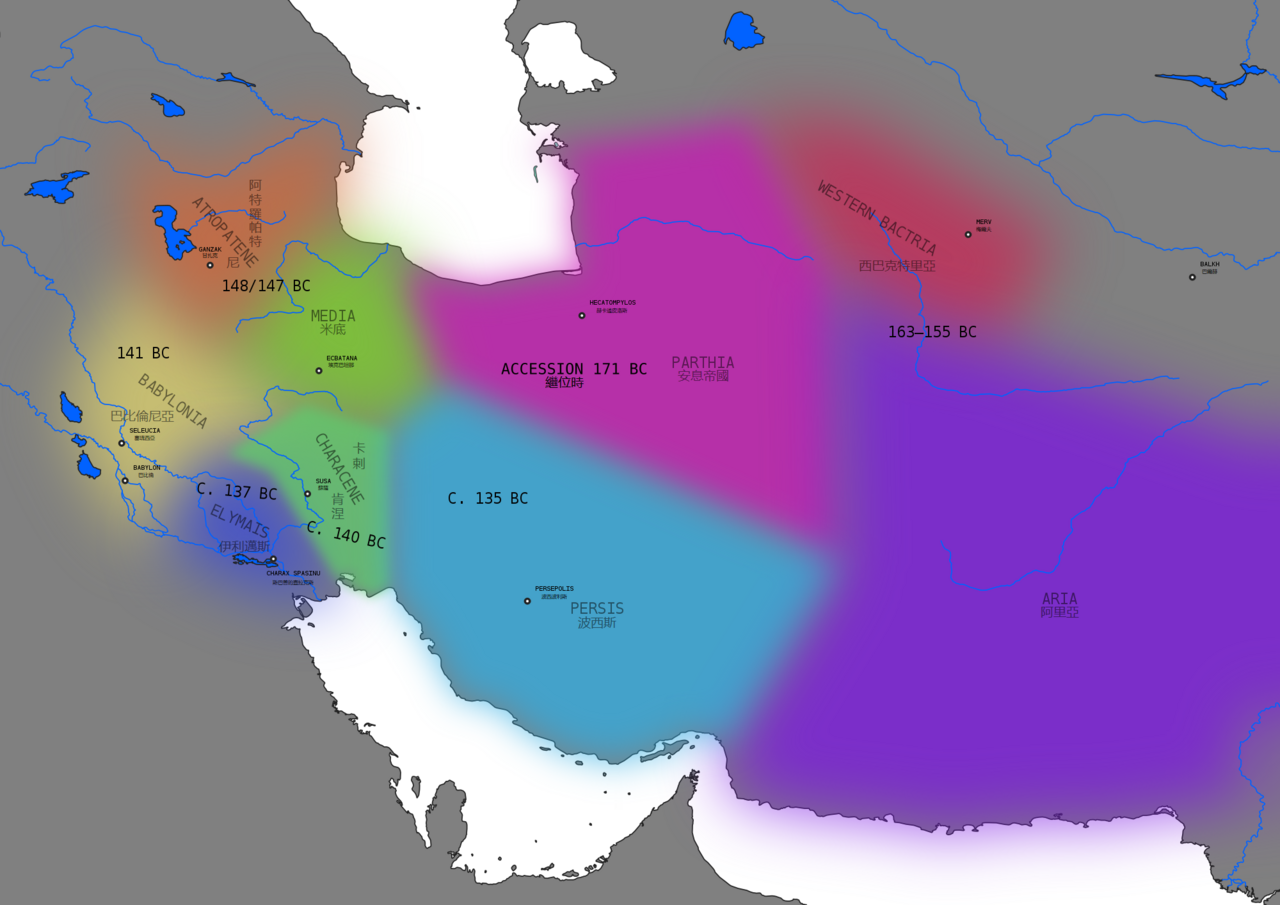
Mithridates I (ruled c. 171 to c. 132 BCE) was the Parthian king who turned a regional kingdom in north-eastern Iran into an empire. In about twenty years he took Media, Babylonia and Elymais from the Seleucids and territory from the Greek kings of Bactria, so that by his death the Arsacids ruled from the edge of Central Asia to the Euphrates.
| Reign | c. 171 to c. 132 BCE (older books give 138 for his death) |
|---|---|
| Father | Phriapatius |
| Predecessor | His brother Phraates I |
| Main conquests | Bactrian borderlands; Media c. 148/147 BCE; Babylonia 141 BCE; Elymais c. 140/139 BCE |
| Titles | “Great King”; “Philhellene” on coins struck in Mesopotamia |
| Persian name | Mehrdad (مهرداد) |
| Successor | His son Phraates II |
A king chosen over his nephews
Mithridates was a son of the Parthian king Phriapatius. His elder brother Phraates I, who had extended Parthian rule west into the Alborz by defeating the Mardi, died young. According to Justin, Phraates passed over his own sons and left the throne to Mithridates, judging him the most capable man of the family. Whether or not that story is a later flattering version, it marks a change: the kingdom was now strong enough to think beyond survival.
His name, “given by Mithra”, was Iranian, and it would be used by many later kings. In modern Persian it is Mehrdad, still a common boy’s name.

First gains in the east
Mithridates began with his eastern neighbour, the Greco-Bactrian kingdom (see the Greco-Bactrian Kingdom). Its king Eucratides was fighting wars on several fronts, and Strabo reports that the Parthians took two Bactrian districts from him. These were frontier lands, but the success showed that Parthia could now take territory from established Hellenistic kings.
Into Media and Mesopotamia
The great opportunity came in the west, where the Seleucid kingdom was weakened by dynastic war after 164 BCE. Mithridates moved into Media around 148/147 BCE. Media, with its horse pastures and its old capital Ecbatana (modern Hamadan), was the gateway from the plateau to Mesopotamia. Justin says he left a governor named Bacasis in charge there.
In 141 BCE he crossed into Babylonia and was accepted at Seleucia on the Tigris, the largest Greek city of the east. Babylonian documents start to be dated by the Parthian king within months. For the Seleucid side of these years, including the capture of Demetrius II, see How the Seleucids Lost Iran.
Elymais and its temple treasures
South-east of Babylonia lay Elymais, the hill country and plains of modern Khuzestan around Susa, ruled by its own dynasty. Its kings had taken advantage of Seleucid weakness and may have tried to profit from the Parthian advance too. Around 140/139 BCE Mithridates invaded, took Susa and plundered the temples. Strabo says the Parthian king carried off 10,000 talents from the sanctuaries of Elymais, a figure that may be exaggerated but shows how much wealth the conquest brought. Elymais remained a vassal kingdom under Parthian overlordship for most of the next three centuries.
Ruling Greeks, Babylonians and Iranians
The new empire was a patchwork: Greek cities in Mesopotamia and Media, Babylonian temple cities, Iranian nobles on the plateau, and local kings in Elymais, Persis and Characene. Mithridates did not try to make them uniform. He left local rulers in place as long as they accepted his authority and paid tribute, an approach closer to the Achaemenids than to the Seleucids.
The Greek historian Diodorus, drawing on earlier sources, praises him as a mild ruler who took the best laws and customs from each conquered people. That judgement may owe something to Greek writers wanting to explain why Greek cities accepted him, but the outcome supports it: Seleucia and the other Greek cities kept their councils and their culture under Parthian rule.
The coins tell the story
Mithridates’ coinage changed with his conquests. His earlier drachms follow the steppe tradition of Arsaces I, with the king in a soft cap. After he took Mesopotamia he began striking large silver tetradrachms in Greek style at Seleucia, showing himself with a Hellenistic diadem and a full beard, and adding titles such as “Great King” and Philhellenos, “friend of the Greeks”. The new title was aimed at his Greek subjects. It stayed on Parthian coins for centuries (see Parthian coins and what they tell us).
Threats on two fronts
The empire Mithridates built had a structural weakness that would trouble his successors. The kings had to defend a long western frontier against Greek and later Roman armies, while the old north-eastern homeland faced the nomads of the steppe. While he was in Mesopotamia, Mithridates had to return east to deal with trouble in Hyrcania, and his son Phraates II would face both a Seleucid counter-attack and nomad invasions at the same time.
Death and reputation
The date of his death is debated. Older works give 138 BCE, but Babylonian astronomical records point to a later date, and many historians now place it around 132 BCE. Where he was buried is not recorded, but the royal fortress at Nisa in the old homeland bore his name as Mithradatkert.
Roman writers such as Orosius later credited him with conquests as far as India. That is an exaggeration, but modern historians agree he was the real founder of the Parthian Empire as a great power: after him the Arsacids were no longer frontier princes but rulers of the old Achaemenid heartlands, with a capital region on the Tigris. The next stage, when the empire reached its height and first met Rome, came under Mithridates II.
- c. 171 BCE Mithridates I succeeds his brother Phraates I
- c. 160s to 150s BCE Gains at the expense of Bactria
- c. 148/147 BCE Conquest of Media
- 141 BCE Seleucia on the Tigris and Babylonia accept Parthian rule
- c. 140/139 BCE Invasion of Elymais and capture of Susa
- 138 BCE Capture of the Seleucid king Demetrius II
- c. 132 BCE Death of Mithridates I (date debated)
Persian words from this page
| مهرداد | Mehrdâd | Mithridates |
| مهر | Mehr | Mithra |
| ماد | Mâd | Media |
| بابل | Bâbel | Babylon |
| شوش | Shush | Susa |
| دجله | Dejle | the Tigris |
| باختر | Bâkhtar | Bactria |
Sources and further reading
- Justin, Epitome of Pompeius Trogus, Book 41.
- Strabo, Geography, Books 11 and 16.
- Diodorus Siculus, Library of History, Book 33 (fragments).
- Encyclopaedia Iranica, “Mithradates I”.
- A. D. H. Bivar, “The Political History of Iran under the Arsacids”, The Cambridge History of Iran, vol. 3(1), 1983.
- Uwe Ellerbrock, The Parthians: The Forgotten Empire, 2021.
Want to learn Persian? Get the free Starter Pack
Get the 14-page printable Starter Pack (all 32 letters, a 7-day reading plan, 100 core words and 20 survival phrases) and a short 5-email course. Free.
More in The Parthian Empire (247 BCE–224 CE)
- The Parni and Arsaces I
- Nisa: The First Parthian Capital
- Mithridates I and the Making of an Empire
- Phraates II, Artabanus I and the Saka Invasions
- Mithridates II the Great
- The Parthians and the Silk Road
- Parthian Cavalry: Cataphracts and the Parthian Shot
- Surena and the Battle of Carrhae (53 BCE)
- Orodes II and Prince Pacorus
- Mark Antony’s Parthian War
- Phraates IV and the Peace with Augustus
- Queen Musa of Parthia
- Artabanus II of Parthia
- Gotarzes II and Vardanes: A Royal Rivalry
- Vologases I and the War over Armenia
- Trajan’s Invasion of Parthia
- Osroes I and the Parthian Civil Wars
- Roman Campaigns of the 2nd Century: Lucius Verus and Septimius Severus
- The Last Parthian Kings: Vologases V, Vologases VI and Artabanus IV
- The Fall of the Parthian Empire
- Ctesiphon: Capital of Two Empires
- The Great Houses of Parthia
- Religion and Culture in Parthian Iran
- Parthian Art and Architecture
- Parthian Coins and What They Tell Us
- Hatra: The City that Resisted Rome
- The Parthian Language and Its Records
- The Indo-Parthians and Kushans
- The Parthian Legacy