The Apadana reliefs are the carved stone stairway facades of the great audience hall at Persepolis, made in the late sixth and early fifth centuries BCE under Darius I and Xerxes I. They show twenty-three delegations from the peoples of the Persian Empire walking in procession with gifts for the king, faced by rows of Persian and Median nobles and guards. They are the fullest picture the Achaemenids left of how they wanted their empire to be seen.
| Where | North and east stairways of the Apadana, Persepolis, Fars |
|---|---|
| Date | c. 515–465 BCE (Darius I to Xerxes I) |
| Subject | 23 delegations bringing gifts; Persian and Median dignitaries and guards |
| Material | Grey limestone, originally painted |
| Excavated | East stairway cleared in the 1930s by the Oriental Institute of Chicago (Ernst Herzfeld, Erich Schmidt) |
| Persian name of the hall | آپادانا (Âpâdânâ) |
How the hall itself was planned and raised is told on the page Building Persepolis. This page stays with the carvings: what they show, how the scenes are arranged, which peoples can be recognised, and how scholars have read them.

Two stairways, one design
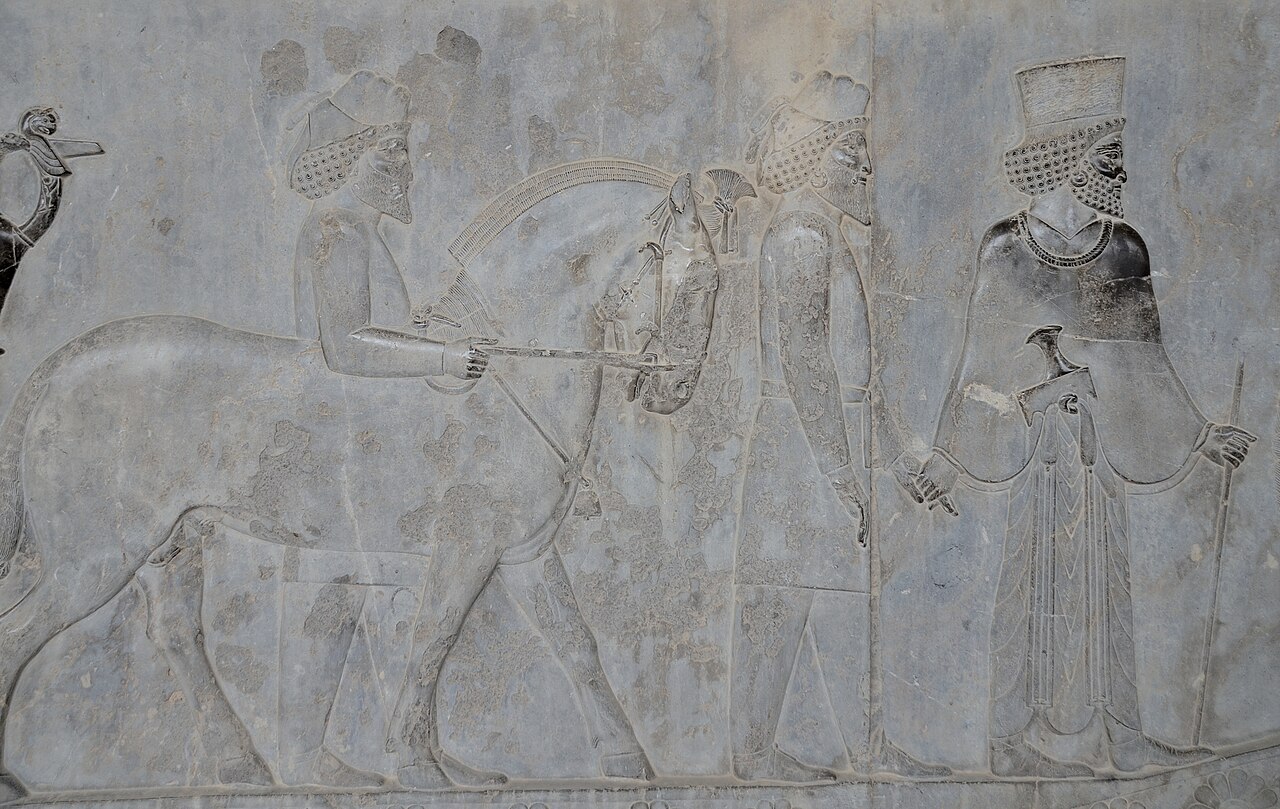
The Apadana stood on a platform about three metres above the terrace, and visitors reached it by two double stairways, on the north and east sides. Each was faced with the same composition, laid out as a mirror image. On one wing, the delegations of the subject peoples climb in three registers toward the centre. On the other wing, Persian and Median dignitaries, the royal guard, grooms with horses and empty chariots stand or walk in step. In the triangular spaces at the ends, a lion attacks a bull, a motif that appears again and again at Persepolis and whose meaning (a seasonal symbol, royal power, or simply decoration) is still argued.
The north stairway was exposed for centuries and is worn. The east stairway lay under debris from the collapse of the hall and came out of the ground in the 1930s with its edges still sharp, which is why most photographs of the reliefs show the east side.
The missing centre
The centre of each stairway originally held a large panel of the king enthroned, with the crown prince behind him and a court official raising his hand to his mouth in greeting before him. In 1936 Erich Schmidt found two such panels not on the Apadana but in a courtyard of the Treasury. The usual explanation, set out by the Italian restorer Ann Britt Tilia, is that they were moved in antiquity, perhaps under Artaxerxes I, and replaced on the stairways by panels with guards. Why they were moved is unknown. The audience panels are now split between the National Museum of Iran in Tehran and the site.
Reading the delegations
Each delegation is led by an usher, a Persian or a Mede, who takes its leader by the hand. Tall conifer trees, often called cypresses, separate one group from the next. Every group is set apart by clothes, headgear, hairstyle and the gifts it carries, and this detail has let scholars identify most of them by comparing the carvings with the lists of lands in the royal inscriptions. The numbering most often used goes back to Schmidt and to the German scholar Gerold Walser.
Some identifications are secure, others are not, and different books will label the same group differently. Among the clearer ones:
- Medes head the procession, bringing vessels, clothing and daggers.
- Elamites lead a lioness, with men carrying her two cubs.
- Armenians bring a horse and a large wine vessel with handles shaped as griffins.
- Babylonians lead a humped bull.
- Lydians bring metal bowls, armlets and a light chariot with a pair of horses.
- Bactrians and Arachosians lead two-humped camels.
- Indians, bare-chested, carry baskets or jars that are usually taken to hold gold dust, and lead a donkey.
- Arabs lead a one-humped dromedary.
- Ethiopians, that is Kushites from south of Egypt, bring an elephant tusk and an animal often identified as an okapi.
The gifts are typical of each land: horses from the uplands, camels from Central Asia, gold from India, ivory from Africa, textiles and fine metalwork from the western cities. The carving says, in images, what Darius says in words at Susa, where he lists the lands that supplied cedar, gold, lapis lazuli and ivory for his palace.
Gift, tribute and the king’s ideal
Older books often call the scene a “tribute procession”. Many historians now prefer the word gifts. Pierre Briant and others distinguish the regular tax, assessed and collected by the satrap, from the gifts brought to the king in person, which Herodotus describes for peoples such as the Arabs and Ethiopians. On the reliefs, nobody is bound, nobody kneels, and the delegates walk upright beside their Persian guides. Margaret Cool Root, in her 1979 study of Achaemenid royal art, argued that this calm is the message: the carvings present an empire of willing peoples gathered around the king, a picture of order rather than a record of conquest.
The same idea appears on the royal tombs at Naqsh-e Rostam, where the peoples of the empire hold up the throne of the king together. The Apadana gives that idea its most crowded and detailed form.
The Nowruz theory
A popular reading holds that the reliefs show a real annual ceremony: at Nowruz, the spring new year, delegations from every province came to Persepolis to present their gifts. The idea was taken up by several twentieth-century scholars and is repeated in many guidebooks and in Iran today.
There is no ancient source that says so. No Achaemenid inscription mentions a new-year festival, Greek writers who describe Persian court life do not tie Persepolis to one, and the Fortification tablets show the king and court moving between Susa, Babylon, Ecbatana and Persepolis through the year. Most specialists now treat the Nowruz link as possible but unproven, and regard the procession as an ideal image that need not depict any single day. It remains a fair question whether Persepolis hosted some seasonal gathering; it is the specific claim that the reliefs record Nowruz that the evidence does not support.
Colour, craft and the people who carved them
The reliefs were not grey when they were new. Traces of blue, red, green and other pigments have been found on the stone, and current research on the polychromy of Persepolis suggests that clothing, hair and objects were painted. Some details, such as crowns and jewellery, may have had metal fittings.
The Persepolis tablets record craftsmen from many lands working on the site, and Darius’s Susa foundation text names Ionians, Sardians, Medes, Egyptians and Babylonians among his workers. The style of the Apadana is a new blend: Assyrian in its long processional friezes, Greek-influenced in the soft folds of some garments, but organised in a strict order that is Persian.
What the reliefs tell historians
The Apadana carvings are a source for clothing, weapons, animals and metalwork across the ancient Near East, and they are one of the few places where the Achaemenids describe their empire on their own terms. Because they are an official image, they tell us how the king wished his rule to be seen, not how the provinces experienced it. Read beside the satrapy and tax system and the records of the Fortification tablets, they show the gap and the link between ideal and administration.
For the site as a whole, see the blog post on Persepolis, and for practical advice the guide to visiting Persepolis.
Persian words from this page
| آپادانا | Âpâdânâ | Apadana, audience hall |
| تخت جمشید | Takht-e Jamshid | Persepolis |
| نوروز | Nowruz | New Year |
| هدیه | hedyeh | gift |
| باج | bâj | tribute |
| پلکان | pellekân | stairway |
| شیر | shir | lion |
Sources and further reading
- Erich F. Schmidt, Persepolis I: Structures, Reliefs, Inscriptions (Oriental Institute, Chicago, 1953).
- Margaret Cool Root, The King and Kingship in Achaemenid Art (Leiden, 1979).
- Gerold Walser, Die Völkerschaften auf den Reliefs von Persepolis (Berlin, 1966).
- Pierre Briant, From Cyrus to Alexander: A History of the Persian Empire (2002), on gifts and tribute.
- Encyclopaedia Iranica, “Apadana”.
- UNESCO World Heritage List, Persepolis.
Want to learn Persian? Get the free Starter Pack
Get the 14-page printable Starter Pack (all 32 letters, a 7-day reading plan, 100 core words and 20 survival phrases) and a short 5-email course. Free.
More in The Achaemenid Empire (550–330 BCE)
- Achaemenes, Teispes and the Early Persian Kings of Anshan
- Cyrus the Great: Birth, Legends and Rise to Power
- Cyrus Conquers Lydia: Croesus and the Battle of Thymbra
- The Persian Conquest of Ionia and Asia Minor
- Cyrus Takes Babylon (539 BCE)
- The Cyrus Cylinder
- Cyrus and the Return of the Jews
- The Death of Cyrus and the Massagetae
- Pasargadae: Cyrus’s Capital and Tomb
- The Tomb of Cyrus through History
- Cambyses II
- Cambyses Conquers Egypt: The Battle of Pelusium
- Bardiya and Gaumata: The Usurper Question
- Darius the Great Takes the Throne
- The Great Revolts of 522–521 BCE
- The Behistun Inscription
- The Persian Conquest of the Indus Valley
- Darius’s Scythian Campaign
- Darius’s Canal from the Nile to the Red Sea
- Darius’s Reforms: Satrapies, Taxes and Law
- The Royal Road and the Persian Postal System
- The Daric: Achaemenid Coinage and Economy
- The Ionian Revolt (499–493 BCE)
- The Greco-Persian Wars: An Overview
- Mardonius and the First Persian Expedition to Greece (492 BCE)
- The Battle of Marathon (490 BCE)
- The Death of Darius I and the Succession of Xerxes
- The Royal Tombs of Naqsh-e Rostam
- Xerxes I: King of Kings (486–465 BCE)
- Xerxes’ Invasion of Greece (480–479 BCE)
- The Battle of Thermopylae (480 BCE)
- The Battle of Artemisium (480 BCE)
- The Persian Capture of Athens (480–479 BCE)
- The Battle of Salamis (480 BCE)
- The Battle of Plataea and the End of the Invasion (479 BCE)
- The Palace of Darius at Susa
- Building Persepolis: How Darius and Xerxes Built Parsa
- The Persepolis Fortification and Treasury Tablets
- Herodotus and the Persians
- The Apadana Reliefs: Nations Bringing Gifts
- The Achaemenid Paradise Gardens
- The Persian Immortals and the Achaemenid Army
- The Achaemenid Navy
- Religion of the Achaemenid Kings
- Women of the Achaemenid Court
- Old Persian Language and Cuneiform
- Egypt under Persian Rule
- Babylon under Persian Rule
- Artaxerxes I
- The Peace of Callias
- Darius II and the Peloponnesian War
- Famous Satraps of the Persian Empire
- Artaxerxes II Mnemon
- Cyrus the Younger and the Battle of Cunaxa
- The King’s Peace (387 BCE)
- The Great Satraps’ Revolt
- Artaxerxes III and the Reconquest of Egypt
- Darius III, the Last Achaemenid King
- The Battle of the Granicus (334 BCE)
- The Battle of Issus (333 BCE)
- Alexander Takes Tyre, Gaza and Egypt (332 BCE)
- The Battle of Gaugamela (331 BCE)
- Ariobarzanes and the Battle of the Persian Gate
- The Burning of Persepolis (330 BCE)
- The Death of Darius III and Bessus
- The Legacy of the Achaemenid Empire