The Achaemenid kings from Darius I onward declared in their inscriptions that they ruled “by the favour of Ahuramazda”, the Wise Lord who created earth, sky and humankind. Their religion was an Iranian faith centred on Ahura Mazda, on truth against “the Lie”, and on fire and the Magi as priests, while the empire supported the gods of its many peoples. Whether these kings were Zoroastrians in any later sense is one of the longest debates in Iranian history.
| Supreme god | Ahuramazda (Old Persian Auramazdā), modern Persian اهورامزدا |
|---|---|
| Other gods named | “The other gods who are”; Mithra and Anahita from Artaxerxes II (404–358 BCE) |
| Key ideas | Arta (truth, right order) against drauga (the Lie) |
| Priests | The Magi |
| Main sources | Royal inscriptions, Persepolis tablets, tomb reliefs, Herodotus |
| Zoroaster mentioned? | Never, in any Achaemenid text |

What the kings say
Cyrus the Great names no Iranian god in his surviving texts. In the Cyrus Cylinder, written for a Babylonian audience, it is the Babylonian god Marduk who chooses him. Ahuramazda appears with Darius I, and from then on he dominates royal speech. At Behistun Darius says, again and again, that he became king and won his battles by the favour of Ahuramazda, who “brought me help, with the other gods who are”.
On his tomb at Naqsh-e Rostam, Darius describes Ahuramazda as the great god who created the earth and the sky, who created man and happiness for man, and who made Darius king. The king is the god’s chosen agent on earth; order in the world and the king’s order are the same thing.
Truth and the Lie
The moral core of these texts is a contrast between arta, truth or right order, and drauga, the Lie. For Darius, the rebels of 522–521 BCE were not only enemies; they “lied” when they claimed to be kings, and the Lie made the provinces rebellious. He urges his successors to protect themselves from the Lie and to punish the man who follows it. The same pairing of truth and lie, under related names, is central in the Avesta, and it is the strongest link between the royal inscriptions and Zoroastrian thought.
Xerxes and the daivas
An inscription of Xerxes found at Persepolis states that in one of the lands of the empire people had worshipped the daivas, that by the favour of Ahuramazda he destroyed their sanctuary and decreed that the daivas should not be worshipped, and that he worshipped Ahuramazda there instead. In the Avesta the daivas are false gods or demons, so the text looks like a Zoroastrian act. But it names no place and no date. Scholars have connected it with Babylon, with Egypt, with the Greek temples burned in 480 BCE and with Iran itself, and some read it as a general statement of royal piety rather than a report of one event.
Gods, Magi and offerings in the tablets
Royal inscriptions show the king’s religion. The Persepolis Fortification tablets show what the state actually supplied for worship around Persepolis around 500 BCE. They record grain, wine and animals issued for offerings to Ahuramazda, but also to other Iranian deities, to Elamite gods such as Humban, and to mountains and rivers. The officiants include men called makuš, the Elamite form of Magus, and Elamite priests. One frequent offering, called lan in Elamite, seems to have been a general state sacrifice. The Dutch scholar Wouter Henkelman, who studied these texts closely, argued that the religion of the Persian heartland was a working blend of Iranian and Elamite traditions, not a strict faith limited to one god.
What Herodotus saw
Herodotus, writing in the fifth century BCE, says that the Persians did not set up statues, temples or altars, which they thought foolish. They climbed mountains to sacrifice to the whole circle of the sky, and also to the sun and moon, earth, fire, water and the winds. No sacrifice could be made without a Magus, who chanted a song about the origin of the gods. He reports that the Magi left their dead to be torn by birds and dogs, while other Persians covered the body in wax and buried it.
Some of this fits the Iranian evidence: the reverence for fire and the elements, and the role of the Magi. Some of it does not: the kings were laid in rock-cut tombs, not exposed, and the reliefs on those tombs show the king standing in prayer before a fire altar. Herodotus is describing what he was told, and Persian practice was neither uniform nor fixed.
The winged symbol
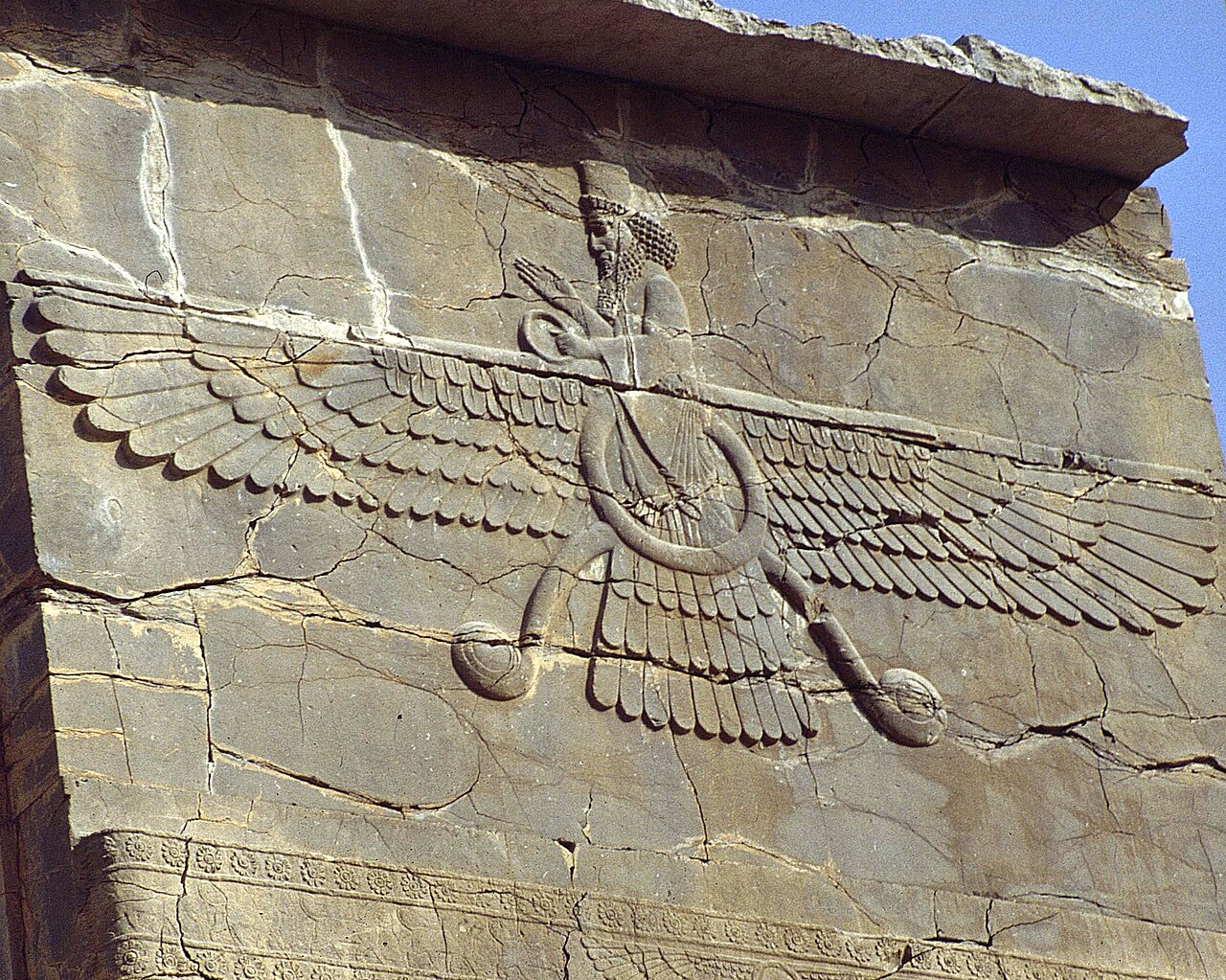
Above the king on the tomb facades and on many reliefs floats a figure in a winged ring, a bearded man rising from it, one hand raised. Today it is known in Iran as the فروهر (Foruhar or Faravahar) and is a symbol of Zoroastrianism and of Iranian identity. Its meaning in the Achaemenid period is disputed. Many scholars see it as an image of Ahuramazda, adapted from the winged disc of Assyrian and Egyptian art. Others, such as A. Shapur Shahbazi, argued that it stands for the royal glory or fortune, and others again for the king’s own guardian spirit.
Mithra and Anahita
For a century the royal inscriptions named Ahuramazda alone. Artaxerxes II (404–358 BCE) broke the pattern: at Susa and Hamadan he prays for the protection of Ahuramazda, Anahita and Mithra. The Babylonian priest Berossus, quoted by later Christian writers, says Artaxerxes was the first to set up statues of Anahita in the great cities of the empire. This is often taken as a turn toward image worship and a broader pantheon, and it is discussed further on the page on Artaxerxes II.
Were the Achaemenids Zoroastrians?
Three broad positions are found in modern scholarship:
- Yes. Mary Boyce argued that the Achaemenids were Zoroastrians, perhaps from Cyrus onward. The cult of Ahura Mazda, the truth and lie pair, the reverence for fire and the role of the Magi all point to the religion of the Avesta.
- No. Other scholars stress that Zoroaster is never named, that the kings mention “other gods”, that no Avestan text is quoted, and that Persian burial and offering customs differ from later Zoroastrian rules. On this view the kings were worshippers of Ahura Mazda, “Mazdaeans”, but not followers of a prophet.
- In between. Many now see a Mazdaean religion in the process of formation, sharing much with the Avesta but not yet the codified Zoroastrianism of the Sasanian period.
The disagreement also depends on the date of Zoroaster himself, which is unknown and placed by scholars anywhere from about 1500 to 600 BCE.
An empire of many gods
Whatever the king’s own faith, the empire did not impose it. Persian rulers funded and honoured local cults when it suited them: Marduk in Babylon, the temple of Jerusalem, the goddess Neith at Sais in Egypt, as the Egyptian official Udjahorresnet records. This was not tolerance as a principle; Xerxes’ daiva inscription and the burning of Greek temples show the other side. But for most subjects, the gods of their cities went on being served under Persian rule.
For the faith that grew from these roots, see the Yazd fire temple and towers of silence and religion in Iran today.
Persian words from this page
| اهورامزدا | Ahurâ Mazdâ | the Wise Lord |
| زرتشت | Zartosht | Zoroaster |
| آتش | âtash | fire |
| مغ | mogh | Magus, priest |
| مهر | Mehr | Mithra |
| ناهید | Nâhid | Anahita |
| فروهر | Foruhar | the winged symbol |
Sources and further reading
- Darius I, Behistun inscription and Naqsh-e Rostam inscription; Xerxes, “Daiva” inscription (Persepolis). Translations in Amélie Kuhrt, The Persian Empire: A Corpus of Sources from the Achaemenid Period (2007).
- Herodotus, Histories, Book 1.131–140.
- Encyclopaedia Iranica, “Achaemenid Religion”.
- Mary Boyce, A History of Zoroastrianism, vol. 2: Under the Achaemenians (Leiden, 1982).
- Wouter F. M. Henkelman, The Other Gods Who Are (Leiden, 2008).
Want to learn Persian? Get the free Starter Pack
Get the 14-page printable Starter Pack (all 32 letters, a 7-day reading plan, 100 core words and 20 survival phrases) and a short 5-email course. Free.
More in The Achaemenid Empire (550–330 BCE)
- Achaemenes, Teispes and the Early Persian Kings of Anshan
- Cyrus the Great: Birth, Legends and Rise to Power
- Cyrus Conquers Lydia: Croesus and the Battle of Thymbra
- The Persian Conquest of Ionia and Asia Minor
- Cyrus Takes Babylon (539 BCE)
- The Cyrus Cylinder
- Cyrus and the Return of the Jews
- The Death of Cyrus and the Massagetae
- Pasargadae: Cyrus’s Capital and Tomb
- The Tomb of Cyrus through History
- Cambyses II
- Cambyses Conquers Egypt: The Battle of Pelusium
- Bardiya and Gaumata: The Usurper Question
- Darius the Great Takes the Throne
- The Great Revolts of 522–521 BCE
- The Behistun Inscription
- The Persian Conquest of the Indus Valley
- Darius’s Scythian Campaign
- Darius’s Canal from the Nile to the Red Sea
- Darius’s Reforms: Satrapies, Taxes and Law
- The Royal Road and the Persian Postal System
- The Daric: Achaemenid Coinage and Economy
- The Ionian Revolt (499–493 BCE)
- The Greco-Persian Wars: An Overview
- Mardonius and the First Persian Expedition to Greece (492 BCE)
- The Battle of Marathon (490 BCE)
- The Death of Darius I and the Succession of Xerxes
- The Royal Tombs of Naqsh-e Rostam
- Xerxes I: King of Kings (486–465 BCE)
- Xerxes’ Invasion of Greece (480–479 BCE)
- The Battle of Thermopylae (480 BCE)
- The Battle of Artemisium (480 BCE)
- The Persian Capture of Athens (480–479 BCE)
- The Battle of Salamis (480 BCE)
- The Battle of Plataea and the End of the Invasion (479 BCE)
- The Palace of Darius at Susa
- Building Persepolis: How Darius and Xerxes Built Parsa
- The Persepolis Fortification and Treasury Tablets
- Herodotus and the Persians
- The Apadana Reliefs: Nations Bringing Gifts
- The Achaemenid Paradise Gardens
- The Persian Immortals and the Achaemenid Army
- The Achaemenid Navy
- Religion of the Achaemenid Kings
- Women of the Achaemenid Court
- Old Persian Language and Cuneiform
- Egypt under Persian Rule
- Babylon under Persian Rule
- Artaxerxes I
- The Peace of Callias
- Darius II and the Peloponnesian War
- Famous Satraps of the Persian Empire
- Artaxerxes II Mnemon
- Cyrus the Younger and the Battle of Cunaxa
- The King’s Peace (387 BCE)
- The Great Satraps’ Revolt
- Artaxerxes III and the Reconquest of Egypt
- Darius III, the Last Achaemenid King
- The Battle of the Granicus (334 BCE)
- The Battle of Issus (333 BCE)
- Alexander Takes Tyre, Gaza and Egypt (332 BCE)
- The Battle of Gaugamela (331 BCE)
- Ariobarzanes and the Battle of the Persian Gate
- The Burning of Persepolis (330 BCE)
- The Death of Darius III and Bessus
- The Legacy of the Achaemenid Empire