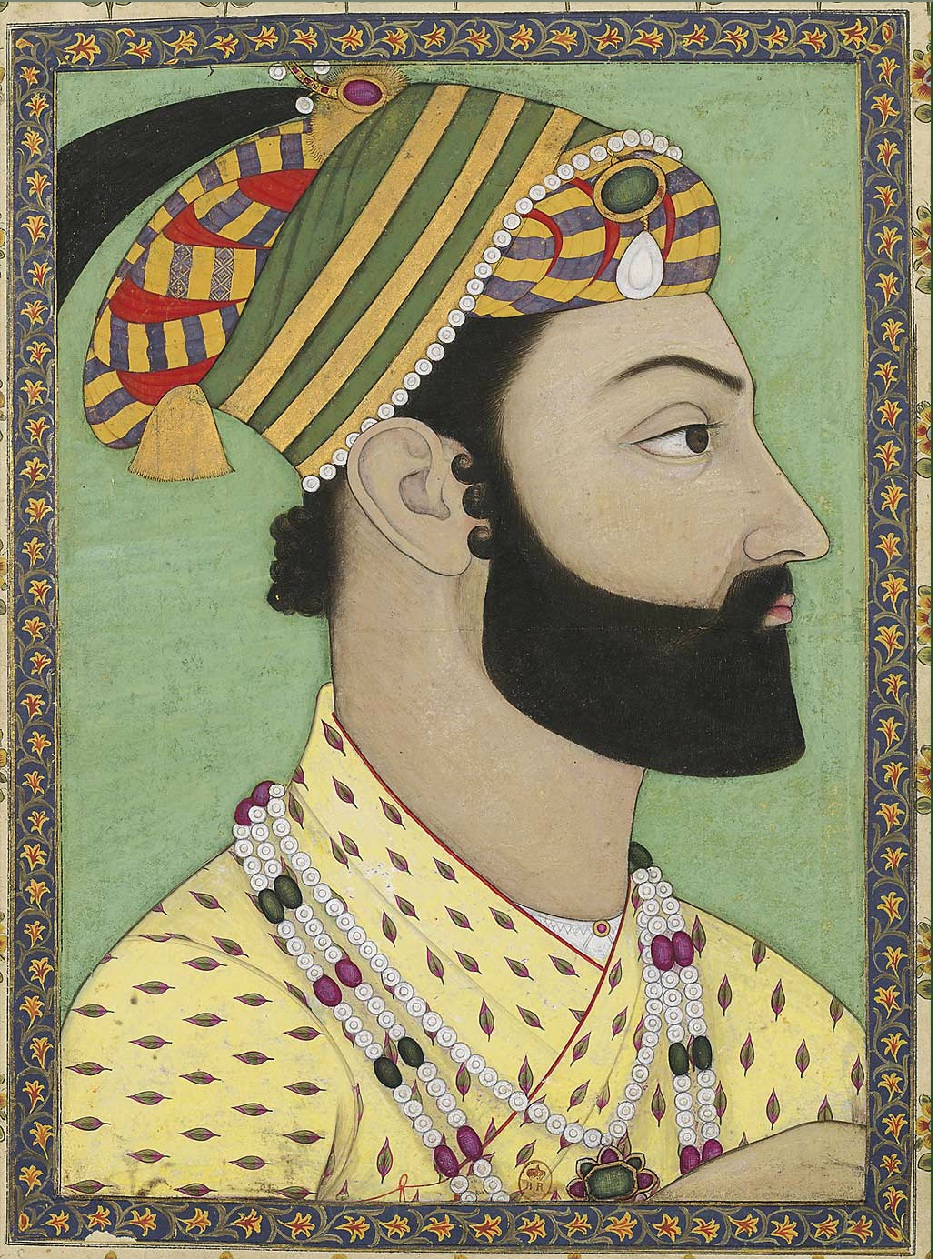
Ahmad Shah Durrani (c. 1720 to 1772), born Ahmad Khan Abdali, was an Afghan commander in Nader Shah’s army who, after Nader’s murder in June 1747, rode back to Kandahar with his Abdali horsemen and was made king that autumn. He built the Durrani empire, stretching from Khorasan to Punjab and Kashmir, and is regarded in Afghanistan as the founder of the modern Afghan state.
| Born | c. 1720 to 1722; Multan and Herat are both given as birthplace |
|---|---|
| Tribe | Sadozai clan of the Popalzai, Abdali (later Durrani) Pashtuns |
| Made king | Autumn 1747, near Kandahar |
| Title | Dorr-e Dorran, “Pearl of Pearls”, from which the name Durrani comes |
| Capital | Kandahar (moved to Kabul by his son Timur Shah) |
| Died | 1772, at Maruf in the hills east of Kandahar; buried in Kandahar |
From prisoner to Nader’s officer
Ahmad was the son of Mohammad Zaman Khan, a chief of the Abdali Afghans of Herat, who died about the time he was born. The Abdalis were rivals of the Ghilzai (Ghaljay) Afghans who had conquered Isfahan in 1722, and after a series of defeats by Nader in the early 1730s many of them entered Nader’s service. Ahmad and his elder brother Zulfiqar ended up as prisoners of the Ghilzai ruler of Kandahar. When Nader took Kandahar in 1738, he freed them.
Ahmad joined Nader’s army and accompanied the Indian campaign that ended in the sack of Delhi. He rose quickly, and in the 1740s he commanded the Abdali cavalry, a few thousand horsemen whom Nader trusted more than many of his Iranian troops. Persian and Afghan sources tell that Nader once predicted a royal future for him, a story that served Durrani propaganda well and may have been invented by it.
The night of the assassination
Ahmad and his Afghans were in the royal camp near Quchan when Nader was murdered on the night of 19 to 20 June 1747, as told in the assassination of Nader Shah. In the confusion they fought Persian troops, reached the royal tent, and then rode east. Some accounts say Ahmad took Nader’s signet ring and the Koh-i-Noor diamond from the tent; others say the diamond came to him later from Nader’s grandson Shahrokh. On the way he seized a convoy carrying tribute to Nader from Sindh and the east, which gave him the money to pay an army.
A king near Kandahar
In the autumn of 1747 the Abdali chiefs gathered near Kandahar to choose a leader. The best-known story says that a tribal council ended in deadlock until a holy man, Sabir Shah, placed a sprig of wheat or grass on Ahmad’s turban as a sign of God’s choice. Modern historians treat this as legend and see the accession rather as the work of a small group of commanders backing the man with the soldiers and the money. Ahmad’s chief rival, Hajji Jamal Khan of the powerful Barakzai clan, was won over with the promise of high office for his family.
Ahmad took the title Dorr-e Dorran, “Pearl of Pearls”, and his tribe became known as the Durrani. He kept a court on Persian lines: Persian was the language of government, his chancery followed Safavid and Afsharid models, and his court history was written in Persian. He also wrote poetry in Pashto.

Building an empire
Ahmad Shah inherited the eastern half of Nader’s empire and enlarged it. He took Ghazni, Kabul and Peshawar, and from 1748 led a series of invasions of northern India. His first attack was beaten at Manupur in 1748, but later campaigns brought Punjab, Kashmir and Sindh under Durrani rule or tribute. In 1757 he sacked Delhi, eighteen years after Nader, and on 14 January 1761 he crushed the Maratha armies at the Third Battle of Panipat, one of the largest battles of the century.
In the west he took Herat in 1750 and twice besieged Mashhad. After its surrender in 1754 he restored Shahrokh as a dependent ruler, making Khorasan a buffer between his own lands and Iran. In 1768 he obtained from the ruler of Bukhara a cloak believed to have belonged to the Prophet Mohammad, which he housed in Kandahar, where it is still kept.
- c. 1720 to 1722 Ahmad born
- 1738 Freed by Nader at Kandahar; joins his army
- June 1747 Nader murdered; Ahmad leaves for Kandahar
- Autumn 1747 Chosen king near Kandahar
- 1748 First invasion of India; defeat at Manupur
- 1750 Herat taken
- 1754 to 1755 Mashhad taken; Shahrokh restored as protégé
- 1757 Delhi sacked
- 14 Jan 1761 Third Battle of Panipat
- 1772 Death at Maruf; burial at Kandahar
Death and the Koh-i-Noor
Constant campaigning and a long illness affecting his face wore Ahmad Shah down, and he died in 1772 at Maruf, in the hills east of Kandahar. His mausoleum stands in Kandahar next to the shrine of the Cloak. His son Timur Shah moved the capital to Kabul. The Koh-i-Noor stayed with the Durrani kings until Shah Shoja, in exile, gave it up to the Sikh ruler Ranjit Singh in 1813.
The birth of Afghanistan
Afghans call Ahmad Shah Baba, “father”, and date their state to 1747. Historians accept that the Durrani kingdom is the direct ancestor of modern Afghanistan, since the Durrani and later Barakzai dynasties ruled it until 1973. They also point out that Ahmad Shah’s empire was a typical post-Afsharid conquest state, much larger than modern Afghanistan and built largely on plunder from India, and that the borders of the present country were fixed only in the late nineteenth century. Seen from Iran, his rise was part of the break-up of Nader’s empire, in the same years that Karim Khan Zand was winning the west.
Persian words from this page
| احمدشاه درانی | Ahmad Shâh Dorrâni | Ahmad Shah Durrani |
| در دوران | Dorr-e Dorrân | “Pearl of Pearls” |
| قندهار | Ghandehâr | Kandahar |
| افغانستان | Afghânestân | Afghanistan |
| کابل | Kâbol | Kabul |
| پشتو | Pashto | Pashto language |
Sources and further reading
- Mahmud al-Hosayni Monshi, Tarikh-e Ahmadshahi, the official Persian history of the reign.
- Daniel Balland, “Dorrānī”, Encyclopaedia Iranica: iranicaonline.org/articles/dorrani.
- Ganda Singh, Ahmad Shah Durrani: Father of Modern Afghanistan (Bombay, 1959).
- Jonathan L. Lee, Afghanistan: A History from 1260 to the Present (London, 2018).
- William Dalrymple and Anita Anand, Koh-i-Noor (London, 2017).
Want to learn Persian? Get the free Starter Pack
Get the 14-page printable Starter Pack (all 32 letters, a 7-day reading plan, 100 core words and 20 survival phrases) and a short 5-email course. Free.
More in The Afsharids and Zands (1736–1796)
- The Rise of Nader
- The Battle of Mihmandust (1729)
- Nader Shah Crowned at the Mughan Plain (1736)
- Nader Shah’s Wars with the Ottomans
- Battle of Karnal and the Sack of Delhi (1739)
- Nader Shah in Central Asia and Dagestan
- Nader Shah’s Navy and the Persian Gulf
- The Assassination of Nader Shah (1747)
- Nader Shah’s Religious Policy
- Shahrokh Afshar and Afsharid Khorasan
- Ahmad Shah Durrani and the Birth of Afghanistan
- Karim Khan Zand
- Shiraz under Karim Khan
- The Persian Capture of Basra (1775–1776)
- Lotf Ali Khan, the Last Zand