Nader Shah was the first Iranian ruler in centuries to build a navy of his own. From 1734 he bought and commissioned warships, based them at Bushehr on the Persian Gulf, and used them to take Bahrain and to intervene in Oman, where his forces held Muscat for a time; he also began a small fleet on the Caspian. The navy declined from about 1745 and fell apart after his death in 1747.
| Founded | 1734 |
|---|---|
| Main base | Bushehr, with a squadron at Bandar Abbas |
| First admiral | Mohammad Latif Khan, with the title daryabegi (lord of the sea) |
| Campaigns | Bahrain (1736); Oman (1737 to 1744); actions against Arab coastal tribes and rebels |
| Ships | Bought from British and other merchants at Bombay and Surat; about fifteen vessels in the Gulf by 1742 |
| Caspian fleet | Built in the 1740s; by 1745 two frigates and four smaller vessels |
A land power without ships
For most of the Safavid period Iran had no real navy. Shah Abbas I took Hormuz from the Portuguese in 1622 with English ships, and later shahs relied on European trading companies or Arab allies for any seaborne force. The cost of this became clear in the early eighteenth century, when Omani fleets raided the Iranian coast and seized Bahrain, and Arab tribes along the Gulf shore paid little attention to Isfahan.
Nader’s own experience pointed the same way. In the Caucasus he had to pay Russian shipowners to carry his supplies across the Caspian, and in the Gulf he could do nothing against rebels who simply sailed away. A ruler who saw himself as the restorer of Iran’s old frontiers needed ships.
Building the Gulf fleet
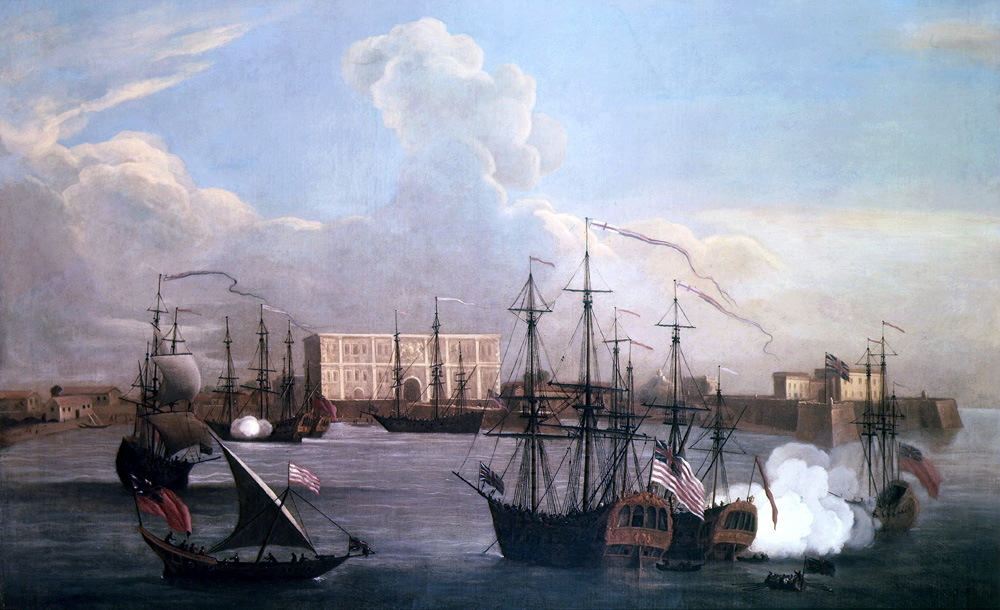
In 1734 Nader appointed Mohammad Latif Khan as admiral and ordered him to create a fleet at Bushehr, a small port that he preferred to the Safavid harbour of Bandar Abbas. Latif Khan began by buying two brigantines from English owners and two vessels from a local Arab sheikh. More purchases followed: in 1736 the East India ship Northumberland was forced into sale at Bushehr and converted into a warship, and a 20-gun frigate bought from Bombay merchants became the Persian flagship, renamed Fath-e Shah.
The fleet relied heavily on hired men. Many sailors were Huwala Arabs of the Gulf coast, and some officers were Europeans: an English captain, Richard Cook, served as Latif Khan’s lieutenant until he was killed in 1737. A report of 1737 described the fleet’s ensign as a red sword, the Zulfiqar, on a white ground.
Nader also tried to build ships at home. He is reported to have ordered timber from the forests of Mazandaran to be carried overland to Bushehr, a journey of more than a thousand kilometres, and the project produced little. From 1741 he turned instead to the shipyards of Surat in India, ordering eleven teak-built vessels. The first arrived in 1741, and by 1742 the Gulf fleet numbered about fifteen ships.

Bahrain and Oman
The fleet’s first success came in 1736, when Persian forces took Bahrain from its Arab rulers. In 1737 Oman was divided by civil war, and one claimant to the imamate, Saif bin Sultan II, asked Nader for help. Latif Khan crossed with troops and won battles inland, but he died later that year, reportedly poisoned. Nader sent a second, larger expedition in 1742 to 1743 under Mohammad Taqi Khan, governor of Fars. Persian troops occupied Muscat, but the Omani leader Ahmad bin Said held out at Sohar.
The expedition ended badly. In January 1744 Taqi Khan rebelled against Nader near Shiraz, one of a wave of revolts against the shah’s taxes. Without reinforcements, the Persian positions in Oman weakened, and Ahmad bin Said drove the remaining garrisons out in the late 1740s. He went on to found the Al Bu Said dynasty that still rules Oman.
Mutiny and decline
The Gulf fleet was always fragile. In 1740 Arab sailors of the fleet mutinied, and the admiral of the time, Mir Ali Khan, was killed in action that year. Supplies, pay and repairs depended on a treasury stretched by wars in Dagestan and Iraq. From about 1745 ships rotted at anchor, and by Nader’s death in 1747 the fleet had largely ceased to exist. Some vessels passed to local rulers; an Omani prize ship, the Rahmani, later caused a dispute between Oman and the Zand ruler Karim Khan.
The Caspian fleet
In the north, Nader hired the English merchant John Elton, of the Russia Company, to build ships for him on the Caspian. Russia watched this with alarm, since the Caspian had been a Russian lake since Peter the Great’s campaign of 1722. By 1745 there were two frigates and four smaller ships, all built locally. After Nader’s death the project collapsed; Elton was killed in the disorders that followed, and one of the ships was reportedly burned near Rasht in 1752 at Russian prompting.
- 1734 Latif Khan appointed admiral; first ships bought
- 1736 Bahrain taken; flagship acquired
- 1737 First Oman expedition; Latif Khan dies
- 1740 Mutiny of Arab sailors
- 1741 to 1742 Teak warships ordered from Surat
- 1742 to 1743 Second Oman expedition; Muscat occupied
- 1744 Revolt of Taqi Khan in Fars
- 1745 to 1747 Decline of the fleet
Legacy
Nader’s navy lasted barely a decade, and some historians, such as Laurence Lockhart, saw it as a costly ambition beyond Iran’s means. Others stress how much it achieved in a short time with almost no naval tradition to draw on. It shows the scale of Nader’s ambitions after the sack of Delhi: he aimed to be master of the sea routes as well as the land. No Iranian government would maintain a serious navy again until the twentieth century.
Persian words from this page
| نیروی دریایی | niru-ye daryâyi | navy |
| دریابیگی | daryâbeygi | admiral, lord of the sea |
| کشتی | kashti | ship |
| بوشهر | Bushehr | Bushehr |
| خلیج فارس | Khalij-e Fârs | the Persian Gulf |
| عمان | Omân | Oman |
Sources and further reading
- Laurence Lockhart, “The Navy of Nadir Shah”, Proceedings of the Iran Society 1 (1936).
- Willem Floor, The Persian Gulf: A Political and Economic History of Five Port Cities, 1500-1730 and later volumes (Washington, 2006 onwards).
- Michael Axworthy, The Sword of Persia (London, 2006).
- Ernest Tucker, “Nāder Shah”, Encyclopaedia Iranica: iranicaonline.org/articles/nader-shah.
- “Būšehr i. The City”, Encyclopaedia Iranica: iranicaonline.org/articles/bushehr.
Want to learn Persian? Get the free Starter Pack
Get the 14-page printable Starter Pack (all 32 letters, a 7-day reading plan, 100 core words and 20 survival phrases) and a short 5-email course. Free.
More in The Afsharids and Zands (1736–1796)
- The Rise of Nader
- The Battle of Mihmandust (1729)
- Nader Shah Crowned at the Mughan Plain (1736)
- Nader Shah’s Wars with the Ottomans
- Battle of Karnal and the Sack of Delhi (1739)
- Nader Shah in Central Asia and Dagestan
- Nader Shah’s Navy and the Persian Gulf
- The Assassination of Nader Shah (1747)
- Nader Shah’s Religious Policy
- Shahrokh Afshar and Afsharid Khorasan
- Ahmad Shah Durrani and the Birth of Afghanistan
- Karim Khan Zand
- Shiraz under Karim Khan
- The Persian Capture of Basra (1775–1776)
- Lotf Ali Khan, the Last Zand