Lotf Ali Khan (c. 1769 to 1794) was the last ruler of the Zand dynasty. He took Shiraz in 1789, at about twenty, and for five years fought the Qajar chief Agha Mohammad Khan with a bravery that made him a romantic hero in Persian memory, until the betrayal of Shiraz in 1791, the fall of Kerman in 1794 and his capture at Bam ended the dynasty.
| Born | c. 1769, son of Jafar Khan Zand and grand-nephew of Karim Khan |
|---|---|
| Ruled | 1789 to 1794, from Shiraz and then on the move |
| Main rival | Agha Mohammad Khan Qajar |
| Turning point | 1791, when Hajji Ebrahim Khan Kalantar handed Shiraz to the Qajars |
| Last stand | Kerman, besieged by the Qajars for about four months in 1794 |
| Died | 1794, in Tehran, after being blinded in captivity |
Ten years of Zand civil war
When Karim Khan died in March 1779, he left no clear heir. In the next ten years his brothers, sons and nephews fought each other for Shiraz. His brother Sadeq Khan, the conqueror of Basra, came back from Iraq to claim the throne and was overthrown and killed by his nephew Ali Morad Khan, who ruled from 1781 until his death in February 1785. Sadeq Khan’s son Jafar Khan then held Shiraz until he was poisoned on 23 January 1789, in a plot led by Ali Morad’s son Sayed Morad Khan.
Meanwhile the Qajar prince Agha Mohammad Khan, who had escaped from Shiraz on the day of Karim’s death, was winning the north. He made Tehran his capital in 1786. By 1789, while the Zands quarrelled over Fars, he controlled most of northern and central Iran.
A young prince takes Shiraz
Lotf Ali Khan, Jafar Khan’s son, was with the army in the south when his father was murdered. He marched on Shiraz, where the city’s chief magistrate, the kalantar Hajji Ebrahim Khan, opened the gates to him. Sayed Morad Khan surrendered and was executed, and in the spring of 1789 Lotf Ali Khan was proclaimed ruler.
Contemporaries agreed on his personal qualities. Persian and European writers, among them the British diplomat Sir John Malcolm, described him as tall, handsome, a superb horseman and swordsman, generous and brave. They also describe him as proud, impatient and quick to punish, faults that cost him dearly.
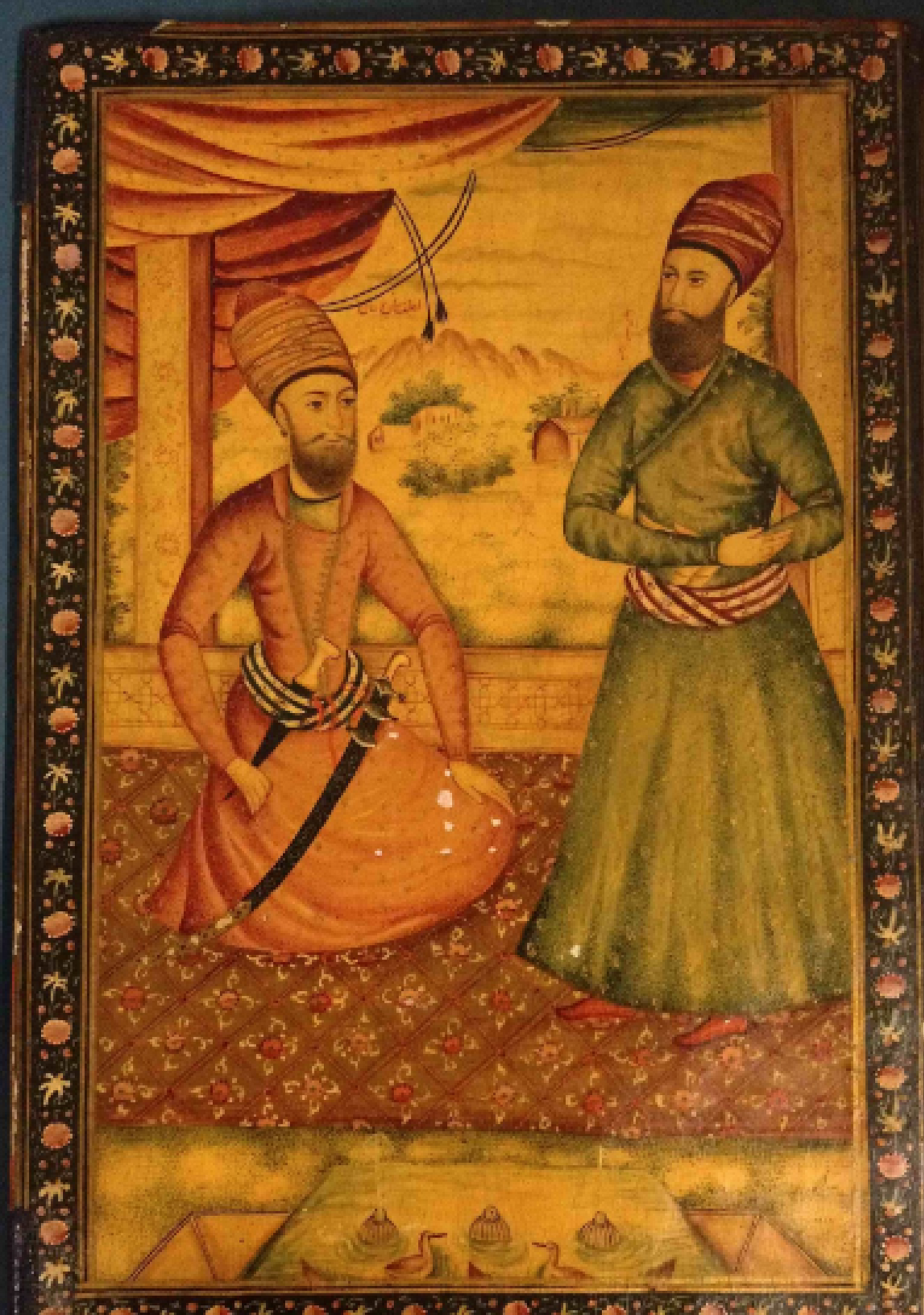

The betrayal of Shiraz, 1791
Agha Mohammad Khan marched south almost at once and defeated the Zands outside Shiraz in 1789, but he could not take the city and withdrew. In 1790 Lotf Ali Khan’s campaign against the governor of Kerman failed in a hard winter. In 1791 he set out to recover Isfahan. He had grown suspicious of Hajji Ebrahim, whose family dominated Shiraz, and he took the kalantar’s son with him as a hostage.
It was not enough. Once the army had gone, Hajji Ebrahim seized Shiraz, arrested the Zand officers, and sent word to his brother in Lotf Ali’s camp. The army mutinied. Lotf Ali rode back with a few hundred loyal men and found the gates shut against him. Most of his remaining soldiers, whose families were inside the walls, deserted him. Hajji Ebrahim offered the city to Agha Mohammad Khan. He later served the Qajars as chief minister, until Fath-Ali Shah had him put to death in 1801.
The night attack near Persepolis
Lotf Ali escaped to the coast, raised a small force with the help of the governor of Bandar Rig, and returned to Fars, where he beat two Qajar armies sent against him. In 1792 Agha Mohammad Khan himself came south with an army reported at 30,000 to 40,000 men. Near Persepolis, Lotf Ali led a few thousand horsemen in a night raid on the Qajar camp. The Qajar troops scattered, and believing that Agha Mohammad had fled, Lotf Ali held his men back from plundering the camp and waited for daylight. At dawn the call to prayer sounded from the royal tent: Agha Mohammad Khan had never left. His army regrouped and Lotf Ali had to retreat. Some accounts say he was misled by a spy who advised him to wait.
Exile and Kerman
Lotf Ali fled east, to Kerman and then to Tabas. In July 1792 the Qajars sent his family and the families of the Zand nobles to Tehran. He tried to reach Kandahar to seek help from the Afghan king Timur Shah, son of Ahmad Shah Durrani, but learned on the way that Timur Shah had died. Chiefs from Bam and Narmashir in the south-east then offered him support, and in 1794 he took Kerman.
Agha Mohammad Khan besieged Kerman for about four months. When disaffected defenders opened a gate in October 1794, Lotf Ali fought his way out by night and escaped to Bam. The punishment Agha Mohammad inflicted on the people of Kerman is described on Agha Mohammad Khan Qajar, and the city’s later history on Kerman.
Capture and death
At Bam, the governor feared for his brother, who had fallen into Qajar hands at Kerman, and betrayed his guest. According to the story told in Kerman, Lotf Ali fought off his captors single-handed for a long time before he was overpowered. He was delivered to Agha Mohammad Khan, who had him blinded, imprisoned and humiliated. He was taken to Tehran and put to death there late in 1794. Tradition places his grave at the shrine of Imamzadeh Zeyd in the Tehran bazaar. With him the Zand dynasty ended, and in 1796 Agha Mohammad Khan was crowned shah.
- Mar 1779 Death of Karim Khan; Zand civil war begins
- 1781 to 1785 Ali Morad Khan rules in Shiraz
- 1785 to 1789 Jafar Khan, Lotf Ali’s father, rules
- 23 Jan 1789 Jafar Khan murdered
- 1789 Lotf Ali Khan takes Shiraz
- 1791 Hajji Ebrahim hands Shiraz to the Qajars
- 1792 Night attack near Persepolis fails
- 1794 Lotf Ali takes Kerman; siege; escape to Bam
- Late 1794 Captured, blinded and killed in Tehran
The last Zand in Persian memory
Lotf Ali Khan lost, but he has had a better press than the man who beat him. Malcolm wrote warmly of his looks and courage; Persian poets and storytellers turned him into a figure from epic, a young prince undone by treachery rather than by an enemy’s strength. In Kerman and Bam his name is still remembered. Historians add that the Zand cause was probably lost before he came to power: the civil wars of the 1780s had exhausted Fars, the Zand tribes were divided, and Agha Mohammad controlled the richer north.
Persian words from this page
| لطفعلیخان زند | Lotf’ali Khân-e Zand | Lotf Ali Khan Zand |
| کلانتر | kalântar | chief magistrate, mayor |
| کرمان | Kermân | Kerman |
| بم | Bam | Bam |
| قاجار | Ghâjâr | Qajar |
| دلیری | daliri | bravery |
Sources and further reading
- John Malcolm, The History of Persia (London, 1815), vol. 2, for the end of the Zands.
- John R. Perry, “Zand Dynasty”, Encyclopaedia Iranica: iranicaonline.org/articles/zand-dynasty.
- John R. Perry, “The Zand Dynasty”, in The Cambridge History of Iran, vol. 7 (1991).
- Gavin R. G. Hambly, “Agha Muhammad Khan and the Establishment of the Qajar Dynasty”, in The Cambridge History of Iran, vol. 7 (1991).
- Abbas Amanat, Iran: A Modern History (New Haven, 2017).
Want to learn Persian? Get the free Starter Pack
Get the 14-page printable Starter Pack (all 32 letters, a 7-day reading plan, 100 core words and 20 survival phrases) and a short 5-email course. Free.
More in The Afsharids and Zands (1736–1796)
- The Rise of Nader
- The Battle of Mihmandust (1729)
- Nader Shah Crowned at the Mughan Plain (1736)
- Nader Shah’s Wars with the Ottomans
- Battle of Karnal and the Sack of Delhi (1739)
- Nader Shah in Central Asia and Dagestan
- Nader Shah’s Navy and the Persian Gulf
- The Assassination of Nader Shah (1747)
- Nader Shah’s Religious Policy
- Shahrokh Afshar and Afsharid Khorasan
- Ahmad Shah Durrani and the Birth of Afghanistan
- Karim Khan Zand
- Shiraz under Karim Khan
- The Persian Capture of Basra (1775–1776)
- Lotf Ali Khan, the Last Zand