Nader Shah fought the Ottoman Empire in two wars, from 1730 to 1736 and from 1743 to 1746, first to win back the western provinces and the Caucasus that the Ottomans had seized during Iran’s collapse, and later to force Istanbul to accept his religious and dynastic terms. His victory at Yeghevard, also called Baghavard, near Yerevan in June 1735 restored Iranian rule over Armenia and Georgia, but the final peace of 1746 essentially returned the border of 1639.
| First war | 1730 to 1736 (Nader as Tahmasp II’s general, then regent for Abbas III) |
|---|---|
| Second war | 1743 to 1746 (Nader as shah) |
| Main battles | Samarra (1733, a defeat), Kirkuk (1733), Yeghevard or Baghavard (1735), Kars (1745) |
| Ottoman commanders | Topal Osman Pasha (killed 1733); Abdullah Pasha Köprülü (killed 1735); Yeğen Mehmed Pasha (1745) |
| Treaties | Constantinople (1736); Kerden (September 1746) |
What the Ottomans held in 1729
While the Afghans held Isfahan in the 1720s, the Ottomans had marched into western Iran and the Caucasus. By 1725 they held Tiflis, Erivan (Yerevan), Ganja, Tabriz, Hamadan and Kermanshah, and a treaty with Russia in 1724 had divided Iran’s northern provinces between the two empires. Recovering this land was Nader’s next task after he defeated the Afghans at Mihmandust in 1729.
The first war, 1730 to 1736
Quick gains, and a shah’s mistake
In the spring and summer of 1730 Nader drove the Ottomans out of Hamadan, Kermanshah and much of Azerbaijan, and he was besieging Erivan when news of an Abdali revolt in Khorasan forced him east. Tahmasp II then led his own campaign, lost, and in early 1732 signed a treaty giving the Caucasus back to the Ottomans. Nader rejected the treaty, deposed Tahmasp, and resumed the war as regent for the infant Abbas III, as told in Nader Shah crowned at the Mughan plain.
Baghdad, Samarra and Kirkuk, 1733
In 1733 Nader besieged Baghdad, defended by its governor Ahmad Pasha. An Ottoman relief army under the veteran general Topal Osman Pasha caught him near Samarra in July and defeated him. It was the only major battlefield defeat of Nader’s career, and he lost thousands of men and much of his baggage. He rebuilt his army within a few months and in the autumn met Topal Osman again near Kirkuk, at a place the Persian sources call Aq Darband or Leylan. This time the Ottomans were beaten and Topal Osman was killed. Baghdad, however, remained in Ottoman hands.
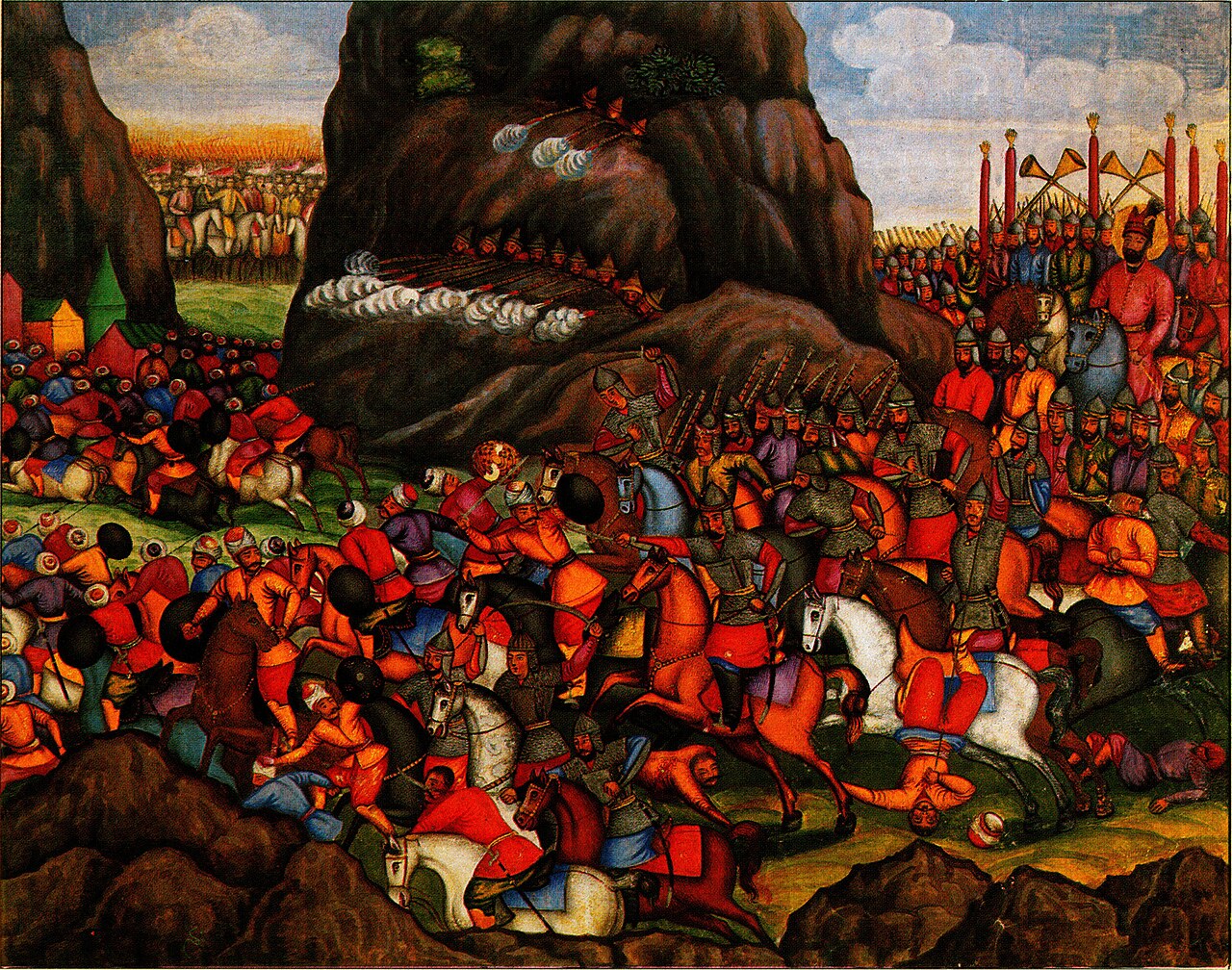
Yeghevard, June 1735
Nader then turned north. He besieged Ganja and in March 1735 signed the Treaty of Ganja with Russia, which returned Baku and Derbent and completed the Russian withdrawal from Iran’s Caspian provinces that had begun with the Treaty of Resht in 1732. In June the main Ottoman army of the Caucasus, under Abdullah Pasha Köprülü, advanced from Kars to relieve the besieged towns. Nader met it at Yeghevard, on the plain north-west of Yerevan, with his advance guard of perhaps 15,000 to 18,000 men, against an Ottoman army that Persian accounts put at 80,000 and modern estimates rather lower.
The Ottoman army was routed before most of Nader’s troops arrived, and Köprülü was killed. Ganja, Tiflis and Erivan surrendered over the following months. In 1736 Ottoman negotiators agreed to restore the frontier of the Treaty of Zuhab of 1639. The question of Nader’s religious proposals was left open.

The second war, 1743 to 1746
Peace held while Nader was in India and Central Asia. In 1743 he attacked again, this time with a political aim as much as a territorial one. He wanted the Ottoman sultan to recognise his “Ja’fari” school of law as an orthodox Islamic school and to give Iranian pilgrims a recognised leader on the hajj. The Ottomans refused, and their senior religious authority declared the Ja’fari idea heretical.
Nader took Kirkuk and laid siege to Mosul in September 1743, but the city held out. Late in 1743 he made a truce with Ahmad Pasha of Baghdad and called a meeting of Sunni and Shi’i scholars at Najaf, where they signed a statement accepting his religious formula; Istanbul ignored it. The meeting is described on Nader Shah’s religious policy. In 1744 Nader besieged Kars without success. On 19 August 1745, near Kars, he destroyed an Ottoman army under Yeğen Mehmed Pasha in what proved to be the last great victory of his career.
The Treaty of Kerden, 1746
By then Nader’s empire was shaking with revolts caused by heavy taxation. Peace was signed at Kerden, north-west of Tehran, in September 1746. It confirmed the 1639 frontier, provided for the safety of Iranian pilgrims to Mecca and to the Shi’i shrines of Iraq, arranged for exchanges of ambassadors and prisoners, and left the Ja’fari school out. The Ottoman sultan sent an embassy with lavish gifts in 1747, but Nader was murdered before it could reach him, as told in the assassination of Nader Shah.
- 1730 Nader recovers Hamadan, Kermanshah and Tabriz
- 1732 Tahmasp II’s treaty rejected; Treaty of Resht with Russia
- July 1733 Defeat by Topal Osman Pasha near Samarra
- Autumn 1733 Victory near Kirkuk; Topal Osman killed
- Mar 1735 Treaty of Ganja with Russia
- June 1735 Victory at Yeghevard (Baghavard)
- 1736 Peace restores the 1639 border
- 1743 Siege of Mosul; Najaf meeting
- 19 Aug 1745 Victory near Kars
- Sept 1746 Treaty of Kerden
Assessment
Militarily the wars showed Nader at his best. Yeghevard and Kars were won by speed, artillery and disciplined infantry against larger armies, and even after Samarra he recovered within months. Politically the result was modest. The 1746 frontier was the one Shah Safi had agreed in 1639, the Ottomans never recognised his religious settlement, and the cost of the second war added to the burden of taxes that turned his own subjects against him. Historians such as Ernest Tucker read the second war less as a land grab than as a campaign for recognition, which Nader wanted as a ruler who was not a Safavid.
Persian words from this page
| عثمانی | Osmâni | Ottoman |
| ایروان | Iravân | Erivan, Yerevan |
| بغداد | Baghdâd | Baghdad |
| صلح | solh | peace |
| پیروزی | piruzi | victory |
| قفقاز | Ghafghâz | the Caucasus |
Sources and further reading
- Mirza Mohammad Mahdi Khan Astarabadi, Tarikh-e Jahangosha-ye Naderi.
- Ernest Tucker, “Nāder Shah”, Encyclopaedia Iranica: iranicaonline.org/articles/nader-shah.
- Michael Axworthy, The Sword of Persia (London, 2006).
- Ernest Tucker, Nadir Shah’s Quest for Legitimacy in Post-Safavid Iran (Gainesville, 2006), on the religious aims of the second war.
- Laurence Lockhart, Nadir Shah (London, 1938).
Want to learn Persian? Get the free Starter Pack
Get the 14-page printable Starter Pack (all 32 letters, a 7-day reading plan, 100 core words and 20 survival phrases) and a short 5-email course. Free.
More in The Afsharids and Zands (1736–1796)
- The Rise of Nader
- The Battle of Mihmandust (1729)
- Nader Shah Crowned at the Mughan Plain (1736)
- Nader Shah’s Wars with the Ottomans
- Battle of Karnal and the Sack of Delhi (1739)
- Nader Shah in Central Asia and Dagestan
- Nader Shah’s Navy and the Persian Gulf
- The Assassination of Nader Shah (1747)
- Nader Shah’s Religious Policy
- Shahrokh Afshar and Afsharid Khorasan
- Ahmad Shah Durrani and the Birth of Afghanistan
- Karim Khan Zand
- Shiraz under Karim Khan
- The Persian Capture of Basra (1775–1776)
- Lotf Ali Khan, the Last Zand