The Battle of Mihmandust, fought near Damghan in north-eastern Iran at the end of September 1729, was the victory in which Nader, then general of the Safavid Shah Tahmasp II, broke the army of the Afghan ruler Ashraf Hotak. It showed that drilled musketeers and well-placed artillery could beat the cavalry that had conquered Isfahan in 1722, and within three months the Afghans had lost the capital.
| Date | 29 September 1729 (some accounts stretch the fighting and pursuit to early October) |
|---|---|
| Place | Mihmandust (Mehmandust), a village near Damghan, Semnan province |
| Also called | Battle of Damghan |
| Commanders | Nader (Tahmasp Qoli Khan) for Tahmasp II; Ashraf Hotak for the Afghans |
| Armies | Estimates: about 25,000 under Nader; 30,000 to 40,000 under Ashraf |
| Result | Decisive Safavid victory; followed by Murcheh Khort (November 1729) and the recovery of Isfahan |
Why Ashraf marched east
By 1729 Ashraf Hotak had ruled Isfahan for four years. He had beaten an Ottoman army in 1726 and made a peace with Istanbul that left him master of central Iran. His remaining enemy was the Safavid heir Tahmasp II, whose general Nader had spent three years building an army in Khorasan. In the summer of 1729 Nader was away in the east fighting the Abdali Afghans of Herat. Ashraf saw a chance to strike Khorasan while its defender was busy, and in August he left Isfahan with an army reported at about 30,000 men.
He was too slow. Nader finished the Herat campaign, returned to Mashhad and set out westward through Sabzevar on 12 September. By the time Ashraf reached Semnan and laid siege to it, his army may have grown to about 40,000 with local levies. Nader’s force is usually put at around 25,000. Ashraf left part of his men at Semnan and marched east to meet him.
The ground and the plan
The two armies met on the open plain east of Damghan, near the village of Mihmandust. Ashraf drew up his army in the usual three divisions of centre and two wings, relying on the shock of mass cavalry charges that had won at Gulnabad seven years earlier. He was confident enough, the chronicles say, to detach a body of horsemen to capture Tahmasp and Nader once the battle was won.
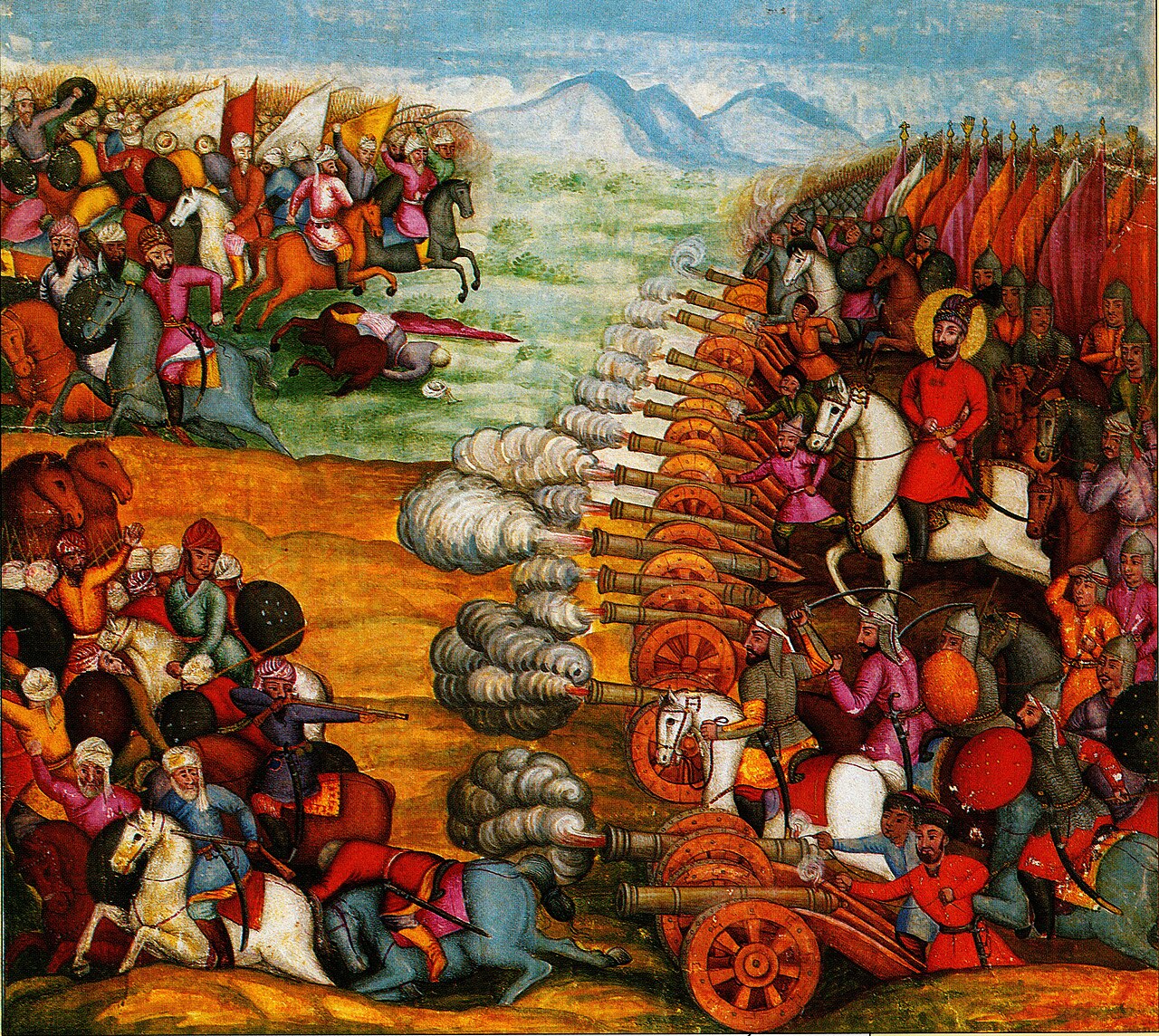
Nader formed his army in four divisions and placed his guns on rising ground behind his infantry, so that they could fire over the heads of his own men. His musketeers, the jazayerchi, had been trained for years to hold their volleys until the enemy was very close.

The battle
The Afghan wings charged first. Artillery fire from the slope cut into them as they came, and the infantry’s close-range volleys stopped the charge before it reached the line. Afghan swivel guns mounted on camels, the zamburak, were knocked out by heavier Persian cannon. When the Afghan attack had lost its force, Nader sent his own troops forward against the centre, and Ashraf’s army broke. Nader allowed only a short pursuit, suspecting an ambush on the road to Semnan.
The figure most often repeated for Afghan losses is about 12,000 dead, a number that, like most battle figures of the period, should be treated as an upper estimate. Persian losses were reported as light.
Murcheh Khort and the road to Isfahan
Ashraf retreated west and tried to recover by setting an ambush in the narrow Khar pass east of Tehran; Nader’s scouts found it and his troops cleared the pass. Ashraf then made a last stand in a fortified position at Murcheh Khort, about 55 kilometres north of Isfahan. On 13 November 1729 Nader attacked and defeated him again.
The Afghans abandoned Isfahan in haste, taking what valuables they could carry. According to the account of the French traveller Jean Otter, Ashraf had intended to burn the city before leaving, but Nader’s rapid advance prevented it. Tahmasp II entered the capital of his ancestors in December. In January 1730 Nader caught the remnants of Ashraf’s army near Zarghan in Fars and scattered them; Ashraf was killed soon after, while fleeing towards Baluchistan.
- Aug 1729 Ashraf leaves Isfahan for Khorasan
- 12 Sept 1729 Nader marches west from Mashhad
- 29 Sept 1729 Battle of Mihmandust
- Oct 1729 Afghan ambush in the Khar pass fails
- 13 Nov 1729 Battle of Murcheh Khort
- Dec 1729 Tahmasp II enters Isfahan
- Jan 1730 Final Afghan defeat near Zarghan; Ashraf killed soon after
Why the battle mattered
Mihmandust ended Hotaki rule in Iran, which had begun with the Afghan victory at Gulnabad in 1722, told in the Afghan revolt and the Battle of Gulnabad. Military historians also see it as a turning point in tactics. The Afghans had won with fast cavalry against a demoralised Safavid army; Nader beat them with the combination that would serve him for the next eighteen years: disciplined musketeers, artillery used on the battlefield and not only in sieges, and tight control of his own troops.
Politically the victory belonged to Nader rather than to Tahmasp. The shah was restored, but the army that had restored him answered to its general. How Nader got there is told in the rise of Nader, and how he turned his victories into a crown in Nader Shah crowned at the Mughan plain.
Sources and their problems
The main Persian account is the court history of Mirza Mahdi Khan Astarabadi, written for Nader and naturally favourable to him. European accounts, such as Otter’s, were written by men who were not present. Numbers in all of them are rough. Even the name varies: the battle is called Mihmandust after the village and Damghan after the nearest town, and the dates given range from the end of September to early October 1729.
Persian words from this page
| مهماندوست | Mehmândust | Mihmandust |
| دامغان | Dâmghân | Damghan |
| اشرف | Ashraf | Ashraf |
| جنگ | jang | battle, war |
| توپ | tup | cannon |
| اصفهان | Esfahân | Isfahan |
Sources and further reading
- Mirza Mohammad Mahdi Khan Astarabadi, Tarikh-e Jahangosha-ye Naderi.
- Michael Axworthy, The Sword of Persia: Nader Shah, from Tribal Warrior to Conquering Tyrant (London, 2006), chapter on the defeat of the Afghans.
- Laurence Lockhart, The Fall of the Safavi Dynasty and the Afghan Occupation of Persia (Cambridge, 1958).
- Ernest Tucker, “Nāder Shah”, Encyclopaedia Iranica: iranicaonline.org/articles/nader-shah.
Want to learn Persian? Get the free Starter Pack
Get the 14-page printable Starter Pack (all 32 letters, a 7-day reading plan, 100 core words and 20 survival phrases) and a short 5-email course. Free.
More in The Afsharids and Zands (1736–1796)
- The Rise of Nader
- The Battle of Mihmandust (1729)
- Nader Shah Crowned at the Mughan Plain (1736)
- Nader Shah’s Wars with the Ottomans
- Battle of Karnal and the Sack of Delhi (1739)
- Nader Shah in Central Asia and Dagestan
- Nader Shah’s Navy and the Persian Gulf
- The Assassination of Nader Shah (1747)
- Nader Shah’s Religious Policy
- Shahrokh Afshar and Afsharid Khorasan
- Ahmad Shah Durrani and the Birth of Afghanistan
- Karim Khan Zand
- Shiraz under Karim Khan
- The Persian Capture of Basra (1775–1776)
- Lotf Ali Khan, the Last Zand