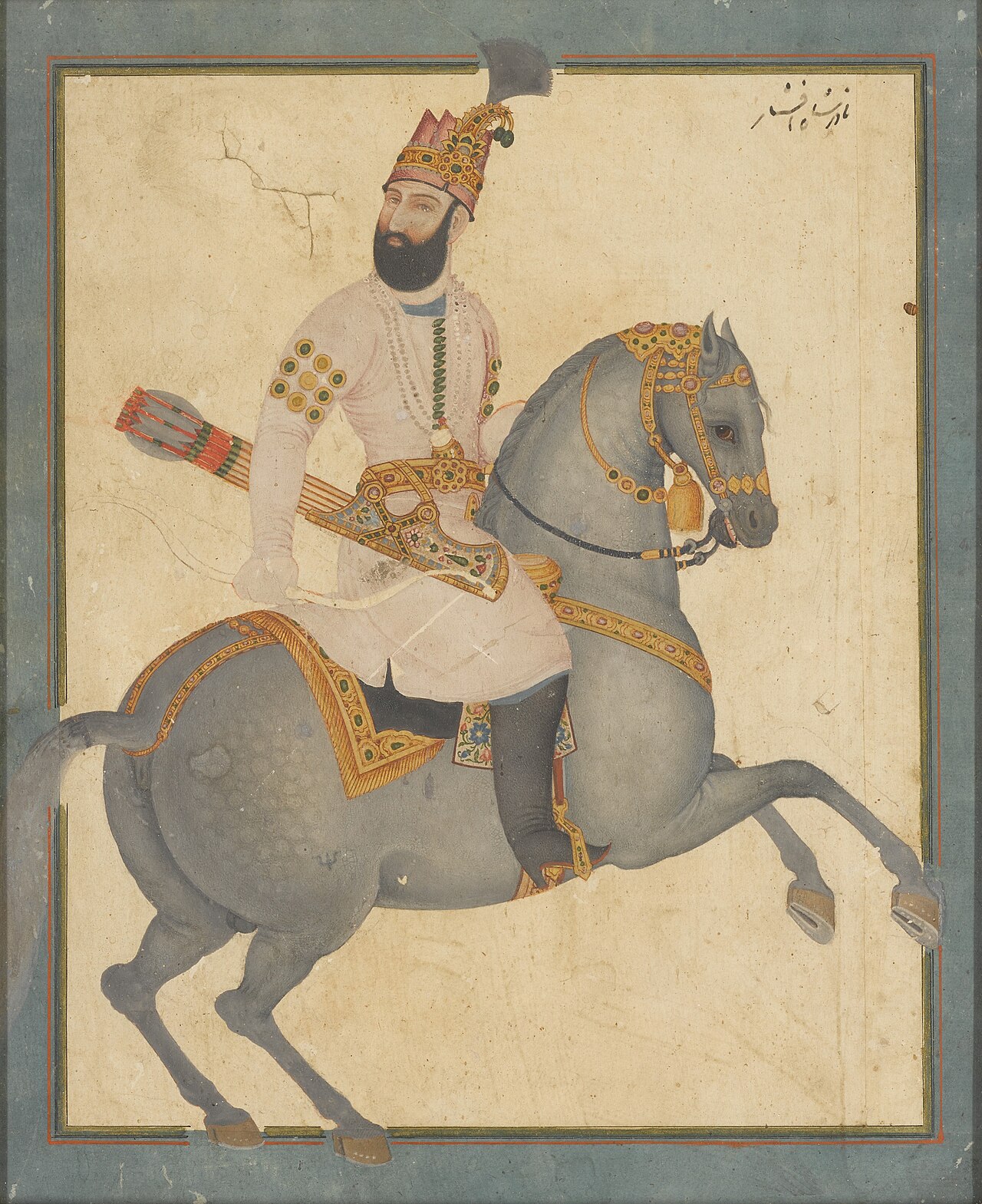
Nader, the future Nader Shah, was born into a modest Turkic clan in northern Khorasan and rose in about seven years from a provincial raider to the commander who saved the Safavid cause. Between 1726 and 1729 he made himself indispensable to the fugitive Shah Tahmasp II, took Mashhad and Herat, and in the autumn of 1729 destroyed the Afghan army that held Isfahan.
| Born | Dastgerd, in the Darreh Gaz valleys of northern Khorasan; sources give either 1688 or 1698 |
|---|---|
| Tribe | Qereqlu branch of the Afshar, a Turkic Qizilbash tribe |
| Birth name | Nader Qoli (Nadr Qoli) |
| Joined Tahmasp II | 1726, taking the title Tahmasp Qoli Khan |
| Key victories before 1730 | Mashhad (1726), the Abdali Afghans of Herat (1729), Mihmandust and Murcheh Khort (1729) |
A shepherd’s son in a frontier valley
Nader was born in the fortress village of Dastgerd, in the valleys north of Mashhad that run down towards the Karakum desert. His father, Emam Qoli, was a herdsman of the Qereqlu, one of the clans of the Afshar tribe that the Safavids had settled on this frontier to hold it against Uzbek and Turkmen raiders. The date of his birth is uncertain: Persian sources and modern historians give either 1688 or 1698.
Almost everything we know about his youth comes from stories told after he became famous. Some were his own. Returning from India in 1740, he is said to have taken his generals to his birthplace and told them of his poverty there. Others are less certain. A popular tale has the teenage Nader and his mother carried off as slaves by Uzbek raiders, with his mother dying in captivity and Nader escaping. Historians repeat it with caution, because it cannot be checked.
Soldier, raider and son-in-law
What is firmer is that the young Nader took service with Baba Ali Beg, the Afshar governor of Abivard, rose to lead his musketeers and married his daughter. Their son, Reza Qoli Mirza, was born in 1719. When the Safavid state began to fall apart after 1720, the authority of governors in Khorasan collapsed with it, and Nader became one of many local strongmen with an armed following.
European writers who described him later called this his time as a bandit. It is a fair description of how the period looked from outside: Nader collected horsemen, took the fortress of Kalat, fought Kurdish and Turkmen chiefs and changed sides when it suited him. He first accepted the authority of Malek Mahmud Sistani, the warlord who had seized Mashhad, and then fought him. What set Nader apart was not ruthlessness, which was common, but the discipline of his troops and his skill with firearms.

The general of Tahmasp II
By 1726 the Safavid heir Tahmasp II had been a shah without a capital for four years, while Afghans held Isfahan and the Ottomans and Russians occupied the west and north. His chief backer was the Qajar chief Fath Ali Khan of Astarabad. That year Tahmasp and Fath Ali Khan came east to recover Mashhad and called on Nader to join them. He came with a few thousand men.
The two commanders could not share the shah. Within weeks Fath Ali Khan was accused of secret dealings with the enemy and executed, in October 1726, with Nader’s encouragement. The Qajars never forgot it, and their later hostility to the Afsharids began here. In November 1726 Mashhad fell. Nader received the title Tahmasp Qoli Khan, “slave of Tahmasp”, which flattered the shah while making clear who held the army.
The story of the court-in-exile in these years, and of the Afghan rulers in Isfahan, is told on the page on Tahmasp II and Hotaki rule.
Building an army in Khorasan
Nader spent the next three years turning a band of tribal followers into an army. He drilled musketeers, the jazayerchi, to hold their fire until the enemy was close; he built up artillery and the light swivel guns carried on camels; and he paid his men, which kept them loyal. Relations with Tahmasp were stormy. More than once the shah tried to break with him, and each time Nader brought him back under control.
His first major test was against the Abdali Afghans of Herat, who threatened Khorasan from the east. In 1729, in a series of clashes around Kafer Qal’eh, Nader beat them and forced their submission. The Abdalis would rebel again, but for the moment the eastern frontier was safe, and many Abdali horsemen later served in his army.
The march on Isfahan
The Afghan ruler of Isfahan, Ashraf Hotak, understood the danger and marched east with a large army in the summer of 1729. Nader met him at Mihmandust near Damghan at the end of September. His drilled infantry and guns broke the Afghan cavalry charges, and a second victory at Murcheh Khort north of Isfahan in November opened the capital. Both battles are described on the page on the Battle of Mihmandust.
Tahmasp entered Isfahan in December 1729. Nader pursued the Afghans into Fars and destroyed what was left of Ashraf’s army early in 1730; Ashraf himself was killed while fleeing. Seven years after the fall of Isfahan, the Safavid shah was back on his throne, but only because of a commander he could not control.
- 1688 or 1698 Nader born at Dastgerd, northern Khorasan
- 1719 Birth of his son Reza Qoli Mirza
- 1720s Nader builds a following and takes Kalat
- Oct 1726 Fath Ali Khan Qajar executed; Nader becomes Tahmasp’s commander
- Nov 1726 Mashhad taken
- 1729 Abdali Afghans of Herat defeated
- Sept to Nov 1729 Victories at Mihmandust and Murcheh Khort
- Dec 1729 Tahmasp II returns to Isfahan
How historians explain the rise
Older accounts treated Nader as a natural military genius who appeared from nowhere. Recent historians, such as Michael Axworthy and Ernest Tucker, put more weight on circumstances. The Safavid army had dissolved, leaving room for any commander who could pay and train troops. Khorasan’s frontier tribes supplied hardy horsemen, and the Safavid name still carried enough weight that a general who fought for the dynasty could draw recruits from across the country.
Nader used that loyalty while it suited him. In 1732 he deposed Tahmasp, and four years later he took the crown himself, as told in Nader Shah crowned at the Mughan plain. His later campaigns are covered in Nader Shah’s wars with the Ottomans.
Persian words from this page
| نادر | Nâder | Nader (the name means “rare”) |
| افشار | Afshâr | Afshar, Nader’s tribe |
| خراسان | Khorâsân | Khorasan |
| مشهد | Mashhad | Mashhad |
| کلات | Kalât | Kalat, Nader’s fortress |
| طهماسب | Tahmâsb | Tahmasp |
Sources and further reading
- Mirza Mohammad Mahdi Khan Astarabadi, Tarikh-e Jahangosha-ye Naderi, the official history of Nader’s reign.
- Ernest Tucker, “Nāder Shah”, Encyclopaedia Iranica: iranicaonline.org/articles/nader-shah.
- Michael Axworthy, The Sword of Persia: Nader Shah, from Tribal Warrior to Conquering Tyrant (London, 2006).
- Laurence Lockhart, Nadir Shah: A Critical Study Based Mainly upon Contemporary Sources (London, 1938).
- Peter Avery, “Nadir Shah and the Afsharid Legacy”, in The Cambridge History of Iran, vol. 7 (1991).
Want to learn Persian? Get the free Starter Pack
Get the 14-page printable Starter Pack (all 32 letters, a 7-day reading plan, 100 core words and 20 survival phrases) and a short 5-email course. Free.
More in The Afsharids and Zands (1736–1796)
- The Rise of Nader
- The Battle of Mihmandust (1729)
- Nader Shah Crowned at the Mughan Plain (1736)
- Nader Shah’s Wars with the Ottomans
- Battle of Karnal and the Sack of Delhi (1739)
- Nader Shah in Central Asia and Dagestan
- Nader Shah’s Navy and the Persian Gulf
- The Assassination of Nader Shah (1747)
- Nader Shah’s Religious Policy
- Shahrokh Afshar and Afsharid Khorasan
- Ahmad Shah Durrani and the Birth of Afghanistan
- Karim Khan Zand
- Shiraz under Karim Khan
- The Persian Capture of Basra (1775–1776)
- Lotf Ali Khan, the Last Zand