After returning from India, Nader Shah turned north and in 1740 forced the Uzbek khanates of Bukhara and Khiva to submit, extending Iranian power across the Oxus (Amu Darya) further than any ruler since the Safavids’ early days. He then spent 1741 to 1743 trying to subdue the mountain peoples of Dagestan in the eastern Caucasus, a campaign that ended in costly failure and coincided with the darkening of his rule.
| Bukhara | Abu’l-Fayz Khan submits, autumn 1740; kept as a vassal |
|---|---|
| Khiva (Khwarazm) | Ilbars Khan defeated and executed, late 1740 |
| Dagestan | Campaign 1741 to 1743 against Lezgi, Avar, Lak and other peoples; withdrawal without lasting conquest |
| Turning point | Assassination attempt in the forests of Mazandaran, 1741; blinding of Reza Qoli Mirza, 1742 |
The northern frontier
Khorasan had long suffered raids from across the Oxus. Uzbek and Turkmen horsemen took captives and livestock, and Khiva in particular was known as a market for slaves. Nader had grown up on this frontier. In 1737, while he was besieging Kandahar, his son and viceroy Reza Qoli Mirza took Balkh and Andkhui and pushed across the river towards Bukhara. Ilbars Khan of Khiva, who had sent raiders into Khorasan, marched to Bukhara’s aid but turned back. Nader, preoccupied with India, ordered his son to stop.
Bukhara, 1740
Back from Delhi, Nader marched from Herat through Balkh to the Oxus at Charjui (today Türkmenabat in Turkmenistan). His engineers built a bridge of boats wide enough for two loaded camels to cross side by side, with forts on both banks. The army that crossed was the one that had beaten the Mughals, with heavy guns, mortars and drilled musketeers. When the Bukharan forces met it, they broke under artillery fire they had never faced before.
The ruler of Bukhara, Abu’l-Fayz Khan, a descendant of Genghis Khan through the Janid line, chose to submit. Nader received him with honour, left him on his throne as a vassal, and took the lands south of the Oxus for Iran. Thousands of Uzbek warriors were taken into Nader’s army. The real power in Bukhara, however, was passing to the Manghit amir Mohammad Hakim Biy and his son Mohammad Rahim, who served Nader and later founded the Manghit dynasty of Bukhara.
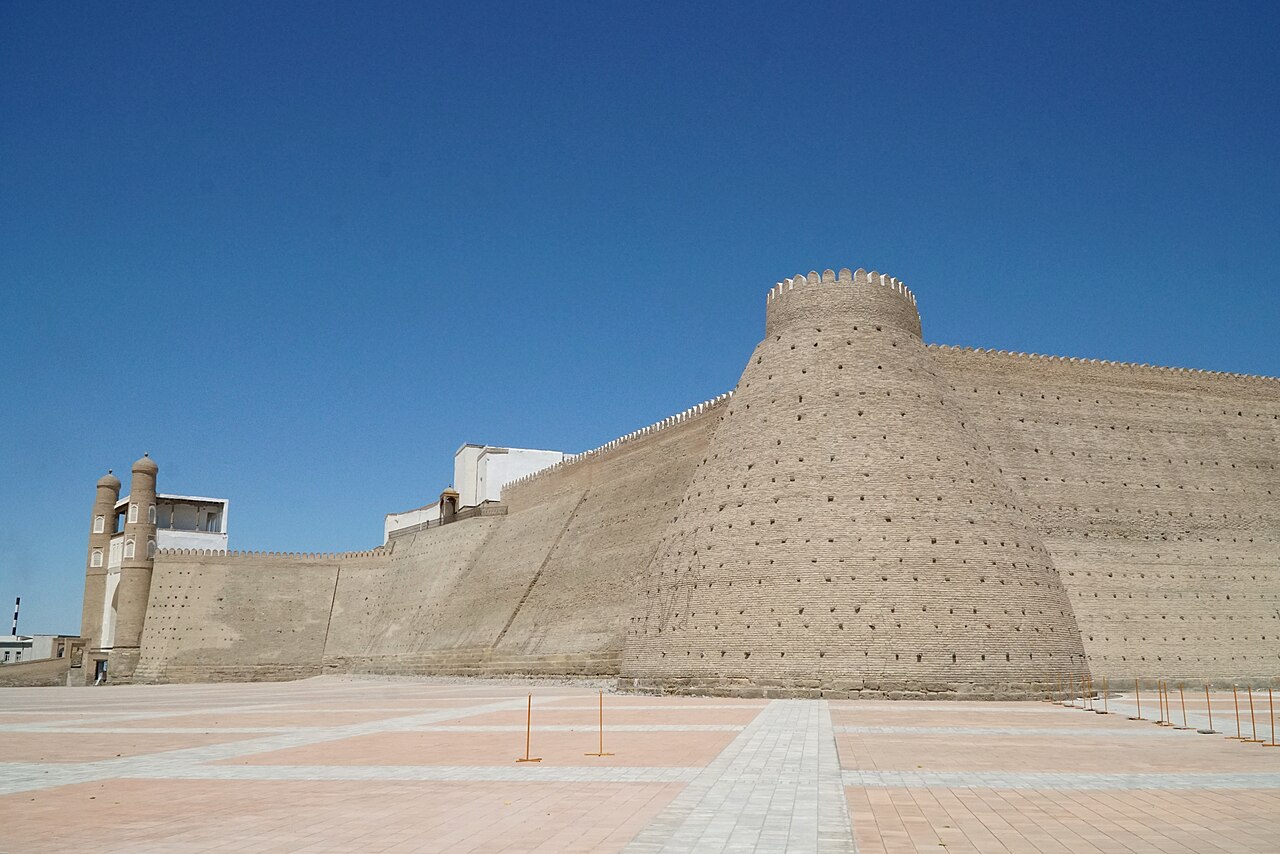

Khiva, 1740
Ilbars Khan of Khiva refused to submit and had Nader’s envoys, two of them respected sheikhs of the Juybari family of Bukhara, put to death. Nader advanced down the Oxus into Khwarazm, defeated the Khivan army near Pitnak, and besieged Ilbars in the fortress of Khanqah. The khan surrendered and was executed with about twenty of his commanders, a punishment that the chroniclers say was requested by the heirs of the murdered envoys. Nader installed a new khan, Tahir Khan, and returned to Khorasan. Khwarazm rebelled again soon afterwards and Persian troops had to return to restore control.
The eight-month campaign covered roughly 3,000 kilometres. For a brief period Nader’s empire stretched from the Tigris to the Indus and the Syr Darya region, a reach that Iranian writers compared with the empires of antiquity.
Dagestan, 1741 to 1743
Nader’s next target was Dagestan, the mountainous land on the western shore of the Caspian. He had a personal motive. In 1738 his brother Ebrahim Khan, governor of Azerbaijan, had been killed fighting Lezgi tribesmen of the Jar and Belokan districts. Dagestan’s peoples, including Lezgis, Avars, Laks, Kumyks and Tabasarans, also raided Shirvan and Georgia and refused to recognise Iranian authority.
On the march north in 1741, while passing through the forests of Mazandaran, Nader was shot at by a hidden gunman and slightly wounded. He came to suspect his son Reza Qoli Mirza of being behind the attempt, and in 1742 had him blinded. Nader later regretted the act bitterly and executed nobles who had witnessed it, but the episode marked the beginning of the suspicion and cruelty that dominated his last years.
In Dagestan his army won battles but could not hold the country. The mountain peoples fell back to their villages and gorges and attacked supply columns. Iran had no Caspian fleet, and Nader had to pay Russian ships to carry grain, a weakness that encouraged his later shipbuilding, described in Nader Shah’s navy. In September 1741, in the Avar district of Andalal, Persian columns withdrawing through the mountains suffered heavy losses, an event remembered in Dagestani tradition as a great victory. Nader stayed in the region through 1742, with illness and food shortages wearing down his army, and left early in 1743 to renew war with the Ottomans, as told in Nader Shah’s wars with the Ottomans.
- 1737 Reza Qoli Mirza takes Balkh and Andkhui
- 1738 Ebrahim Khan killed in the Caucasus
- 1740 Oxus bridged at Charjui; Bukhara submits
- Late 1740 Khiva taken; Ilbars Khan executed
- 1741 Assassination attempt in Mazandaran; Dagestan campaign begins
- Sept 1741 Losses in the Andalal mountains
- 1742 Reza Qoli Mirza blinded
- 1743 Nader leaves Dagestan for Iraq
Weighing the northern campaigns
The Central Asian campaign was a quick success that did not last. Bukhara and Khiva slipped from Iranian control within a few years of Nader’s death, when his former Uzbek officers founded their own dynasties. Dagestan was a failure that cost men, money and prestige. Historians link both to the strains that brought Nader down: an army too large to pay without crushing taxes, and a ruler increasingly convinced that he was surrounded by traitors. That story ends in 1747 at Quchan, told in the assassination of Nader Shah.
Persian words from this page
| بخارا | Bokhârâ | Bukhara |
| خیوه | Khive | Khiva |
| خوارزم | Khârazm | Khwarazm |
| جیحون | Jeyhun | the Oxus (Amu Darya) |
| داغستان | Dâghestân | Dagestan |
| رضاقلی میرزا | Rezâ Gholi Mirzâ | Reza Qoli Mirza |
Sources and further reading
- Mirza Mohammad Mahdi Khan Astarabadi, Tarikh-e Jahangosha-ye Naderi.
- Mohammad Kazem Marvi, Alamara-ye Naderi, a second contemporary Persian chronicle with much detail on the northern campaigns.
- Ernest Tucker, “Nāder Shah”, Encyclopaedia Iranica: iranicaonline.org/articles/nader-shah.
- Michael Axworthy, The Sword of Persia (London, 2006).
- Laurence Lockhart, Nadir Shah (London, 1938).
Want to learn Persian? Get the free Starter Pack
Get the 14-page printable Starter Pack (all 32 letters, a 7-day reading plan, 100 core words and 20 survival phrases) and a short 5-email course. Free.
More in The Afsharids and Zands (1736–1796)
- The Rise of Nader
- The Battle of Mihmandust (1729)
- Nader Shah Crowned at the Mughan Plain (1736)
- Nader Shah’s Wars with the Ottomans
- Battle of Karnal and the Sack of Delhi (1739)
- Nader Shah in Central Asia and Dagestan
- Nader Shah’s Navy and the Persian Gulf
- The Assassination of Nader Shah (1747)
- Nader Shah’s Religious Policy
- Shahrokh Afshar and Afsharid Khorasan
- Ahmad Shah Durrani and the Birth of Afghanistan
- Karim Khan Zand
- Shiraz under Karim Khan
- The Persian Capture of Basra (1775–1776)
- Lotf Ali Khan, the Last Zand