Under Karim Khan Zand, who made it his capital in the 1760s, Shiraz became the political centre of Iran for the only time in its long history. Karim Khan laid out a royal quarter with a citadel, a congregational mosque, a covered bazaar and a bathhouse, all named Vakil after his title, and the city grew to perhaps 40,000 to 50,000 people before the Qajars tore down its walls in the 1790s.
| Zand capital | From the 1760s to 1794 (Karim Khan resident from 1765) |
|---|---|
| Population | Perhaps 40,000 to 50,000 under Karim Khan (estimate given by John R. Perry) |
| Main buildings | Arg (citadel), Vakil Mosque, Vakil Bazaar, Vakil Bath, Bagh-e Nazar pavilion |
| Workforce | Sources speak of more than 12,000 workers on the royal projects |
| Fate | Walls and fortifications demolished by Agha Mohammad Khan Qajar after 1792 |
Why Shiraz
When Karim Khan won the civil wars after Nader Shah’s death, Isfahan had been ruined by the Afghan siege of 1722 and by decades of occupation and plunder. Shiraz was smaller but closer to Karim’s allies among the tribes of Fars and to the Persian Gulf ports through which trade with India and the East India Company passed. He first entered the city in 1754 and settled there for good on 21 July 1765. For the next fourteen years it was the seat of government for almost all of Iran.
The decision changed the city. Karim moved Zand, Lak and Lor families into new quarters, and poets, craftsmen and merchants came from Isfahan. Contemporaries describe a court with music, poetry and wine, and Karim also repaired the tombs of Shiraz’s great poets, Hafez and Saadi, and of the medieval ruler Shah Shoja. The background to the city itself, from its gardens to its poets, is on the page on Shiraz.
A planned royal quarter
Karim Khan’s builders laid out a new centre on the north side of the old town. The citadel faced an open square, the meydan, with the bazaar and mosque close by. A moat was dug around the city, the walls were rebuilt, and new channels supplied water and drained the streets. Sources speak of more than 12,000 workers employed on the royal projects.
The Arg
The heart of the quarter was the Arg, the brick citadel where Karim Khan lived and kept his treasury and guard. With its four round corner towers it is still the best-known landmark of Shiraz. Its architecture and later history are described on the Arg of Karim Khan.
The Vakil Mosque
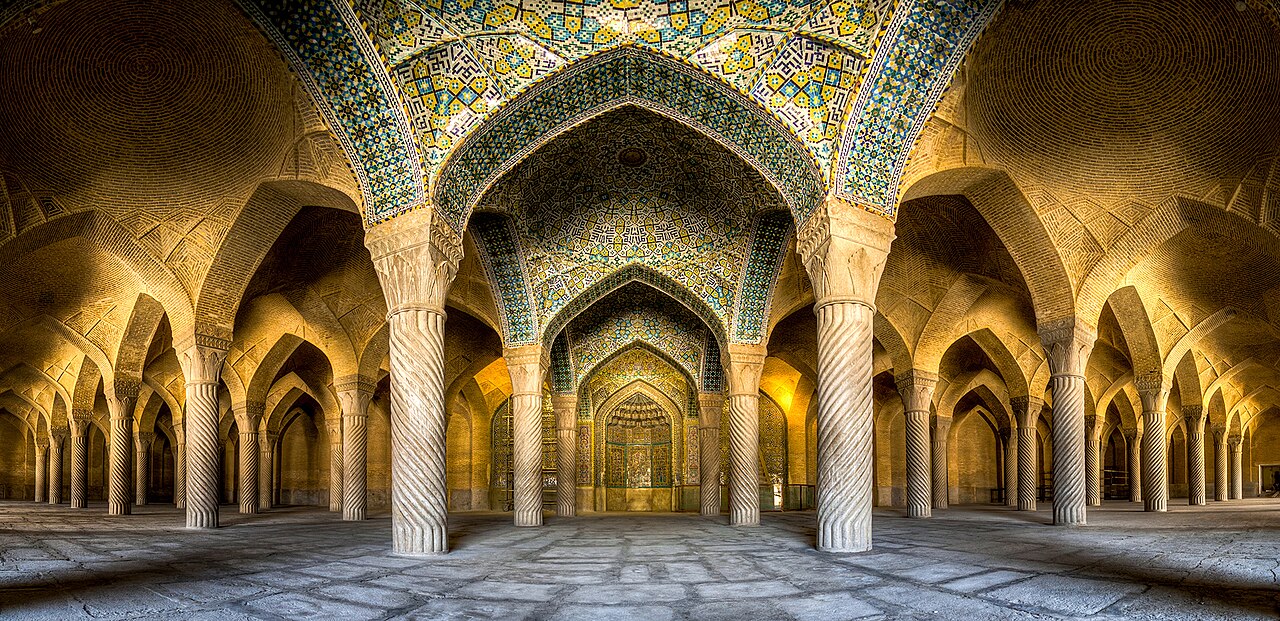
The congregational mosque was built mainly in the 1760s and 1770s and restored in the Qajar period. Unusually it has two iwans, on the north and south sides of its courtyard, rather than the four of the classic Iranian plan. Its winter prayer hall is a forest of 48 stone columns carved with spiral fluting, and its pulpit is carved from marble. Much of the tilework, with roses and other flowers in pinks and yellows, was renewed in the nineteenth century, but it keeps the light palette associated with Shiraz.

The Vakil Bazaar
Next to the mosque, Karim Khan built a long covered market roofed with high brick vaults. It was meant to bring trade back to the city and to give the vakil an income from rents. The bazaar still works as a market today, though about half of the original structure was destroyed later, partly by the Qajars and partly by twentieth-century road building.
The Vakil Bath
West of the mosque stands the Vakil Bath, a hammam with a domed octagonal changing hall and a hot room carried on columns. It was built for the people of the royal quarter and remained in use until modern times; it is now a museum.
Gardens and the Nazar pavilion
Karim Khan also laid out or restored several gardens. In the Bagh-e Nazar, next to his palace, stood an octagonal pavilion used to receive guests and hold ceremonies. Karim Khan was buried there in 1779. The pavilion now houses the Pars Museum.
Shiraz after Karim Khan
Shiraz remained the Zand capital through the civil wars of the 1780s. Its loss in 1791, when the city’s chief magistrate Hajji Ebrahim Khan closed the gates against Lotf Ali Khan, decided the fate of the dynasty; see Lotf Ali Khan, the last Zand. Agha Mohammad Khan, who had spent sixteen years in Shiraz as Karim’s hostage, took his revenge on the city. He ordered its walls and fortifications demolished, destroyed the Lak quarter where the Zand tribesmen had lived, and, according to tradition, had Karim Khan’s bones taken to Tehran. Shiraz became a provincial capital again, and Tehran took its place.
- 1754 Karim Khan first enters Shiraz
- 1760s Arg, bazaar and mosque begun
- 21 July 1765 Karim Khan settles permanently in Shiraz
- 1773 to 1774 Approximate completion of the Vakil Mosque
- 1779 Karim Khan buried in the Bagh-e Nazar
- 1791 to 1792 Shiraz passes to the Qajars
- 1790s City walls demolished on Agha Mohammad Khan’s orders
Visiting the Zand quarter
The Arg, the Vakil Mosque, the Vakil Bath and the Vakil Bazaar stand within a few minutes’ walk of each other in the centre of Shiraz, with the Pars Museum close by. Check current opening times and ticket arrangements with official sources before visiting.
Persian words from this page
| مسجد وکیل | Masjed-e Vakil | the Vakil Mosque |
| بازار وکیل | Bâzâr-e Vakil | the Vakil Bazaar |
| حمام وکیل | Hammâm-e Vakil | the Vakil Bath |
| ارگ | arg | citadel |
| باغ نظر | Bâgh-e Nazar | the Nazar Garden |
| میدان | meydân | square |
| ستون | sotun | column |
Sources and further reading
- John R. Perry, “Karim Khan Zand”, Encyclopaedia Iranica: iranicaonline.org/articles/karim-khan-zand.
- John R. Perry, Karim Khan Zand: A History of Iran, 1747-1779 (Chicago, 1979).
- Mirza Mohammad Kalantar, Ruznama, the diary of the Zand-era mayor of Shiraz.
- John W. Limbert, Shiraz in the Age of Hafez (Seattle, 2004), for the older city that Karim Khan inherited.
Want to learn Persian? Get the free Starter Pack
Get the 14-page printable Starter Pack (all 32 letters, a 7-day reading plan, 100 core words and 20 survival phrases) and a short 5-email course. Free.
More in The Afsharids and Zands (1736–1796)
- The Rise of Nader
- The Battle of Mihmandust (1729)
- Nader Shah Crowned at the Mughan Plain (1736)
- Nader Shah’s Wars with the Ottomans
- Battle of Karnal and the Sack of Delhi (1739)
- Nader Shah in Central Asia and Dagestan
- Nader Shah’s Navy and the Persian Gulf
- The Assassination of Nader Shah (1747)
- Nader Shah’s Religious Policy
- Shahrokh Afshar and Afsharid Khorasan
- Ahmad Shah Durrani and the Birth of Afghanistan
- Karim Khan Zand
- Shiraz under Karim Khan
- The Persian Capture of Basra (1775–1776)
- Lotf Ali Khan, the Last Zand