In February 1739 Nader Shah defeated the army of the Mughal emperor Muhammad Shah at Karnal, north of Delhi, and in March occupied the Mughal capital. After a riot in which Persian soldiers were killed, he ordered a massacre on 22 March in which tens of thousands of people died, and he left India in May with the Mughal treasury, including the Peacock Throne and the Koh-i-Noor diamond.
| Battle of Karnal | 24 February 1739 (13 February in the Old Style calendar used by British sources of the time) |
|---|---|
| Delhi occupied | 20 March to 16 May 1739 |
| Massacre | 22 March 1739; usually estimated at 20,000 to 30,000 dead |
| Mughal emperor | Muhammad Shah (r. 1719 to 1748), restored as Nader’s vassal |
| Booty | Estimates up to about 700 million rupees; the Peacock Throne, the Koh-i-Noor and Darya-ye Nur diamonds |
The road to India
Nader’s Indian campaign began as a war against Afghans. In 1737 he marched on Kandahar, the last Hotaki stronghold, and took it in March 1738 after a long siege. He complained that Afghan fugitives had found refuge in Mughal territory and that the emperor had ignored his envoys. Historians add other motives: Mughal India was rich and militarily weak, and Nader needed money to pay an army that had grown far larger than Iran’s war-ravaged economy could support.
He took Ghazni and Kabul in 1738, crossed the Khyber Pass that winter, and took Lahore in January 1739.
Karnal, 24 February 1739
Muhammad Shah gathered his army near Karnal, about 120 kilometres north of Delhi. With servants and camp followers the Mughal camp may have held 300,000 people, but its fighting strength was far smaller and divided among rival nobles. The Mughal historian Rustam Ali put Nader’s army at about 55,000 horsemen. The battle was short. A Mughal force under Saadat Khan, governor of Awadh, was drawn into an attack and cut down by Persian musket and swivel-gun fire; the commander-in-chief Khan Dauran was mortally wounded, and Saadat Khan was captured.
Mughal losses are uncertain. Contemporary writers gave figures up to 30,000, many agreed on about 20,000, and Michael Axworthy suggests roughly 10,000 soldiers killed. Rather than storm the camp, Nader negotiated. Muhammad Shah came to his tent, and in March the two rulers rode to Delhi together.
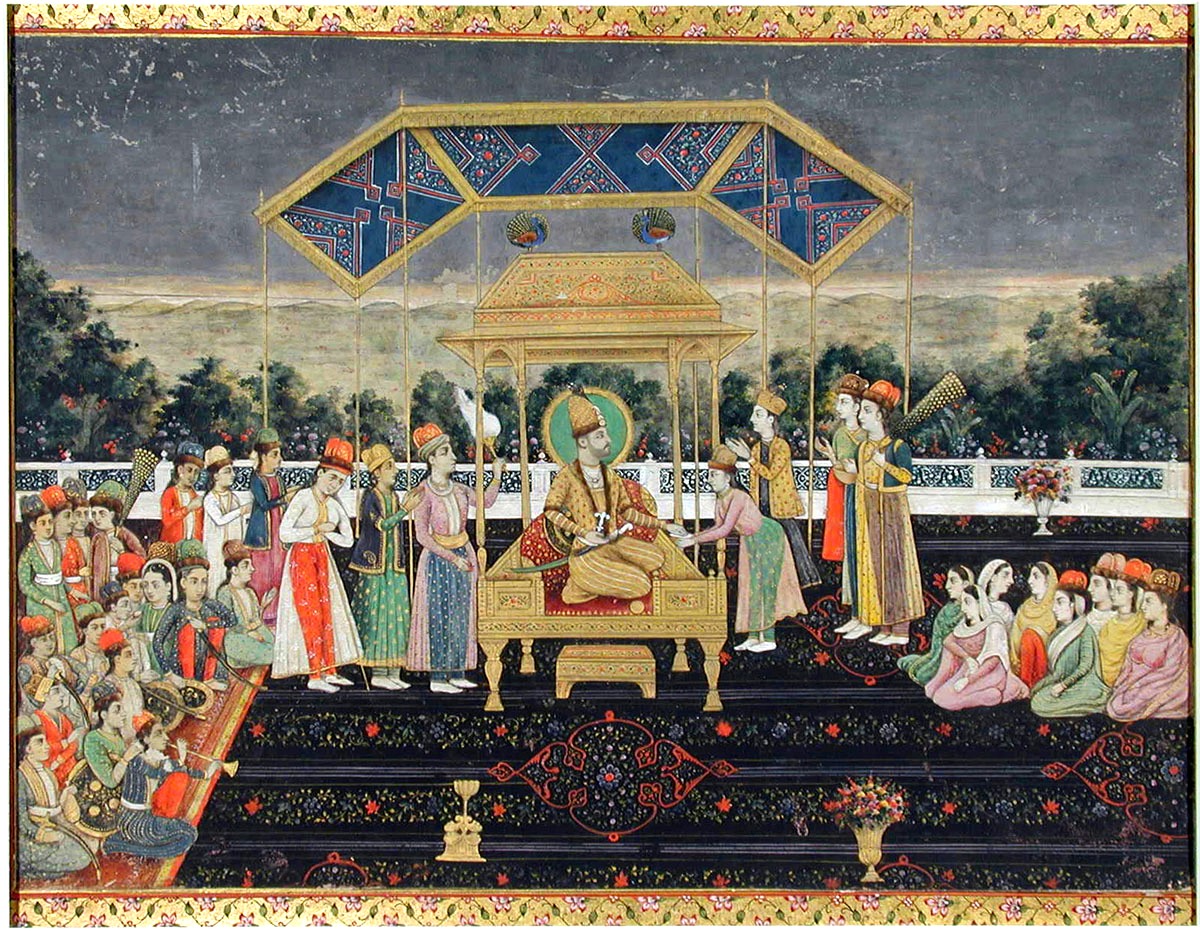

The massacre of 22 March
Nader entered Delhi on 20 March 1739 and lodged in the Red Fort. Grain prices rose with the arrival of his army, and on 21 March a quarrel over prices turned into a riot. A rumour spread that Nader had been killed, and crowds attacked Persian soldiers in the streets; the figure usually given is about 3,000 killed, though it may be inflated.
Next morning Nader went to the Sunehri Masjid of Roshan-ud-Daulah, a small mosque on Chandni Chowk, and gave the order for a general massacre, the qatl-e amm. For about six hours his troops killed, plundered and burned in Chandni Chowk, Dariba and the surrounding quarters. The Indian writer Anand Ram Mukhlis, who lived through it, described streets left strewn with corpses. Many families killed themselves rather than fall into the soldiers’ hands. The killing stopped when Nader, at the plea of Muhammad Shah and his nobles, sheathed his sword.
The number of dead is not known, because the bodies were burned or buried without any count. Most estimates fall between 20,000 and 30,000. A Dutch East India Company representative in Delhi also reported about 10,000 women and children taken as slaves. Some later writers gave far higher totals, which most historians treat as exaggerations.
The treasure
For nearly two months Nader’s officials emptied the Mughal treasury and the houses of the nobility, and a levy of about 20 million rupees was imposed on the city’s people. The total value of what was taken cannot be calculated precisely. The figure most often quoted is up to about 700 million rupees; other contemporary estimates are lower, and all of them are approximate. In Iran the loot paid for a remission of taxes for three years.
The Peacock Throne
The most famous single object was Shah Jahan’s jewelled Peacock Throne, the Takht-e Tavus. It travelled to Iran, but after Nader’s murder in 1747 it disappeared, almost certainly broken up for its gold and stones. The “Peacock Throne” later used by the Qajar and Pahlavi shahs in Tehran is a different, Iranian-made throne.
The Koh-i-Noor and the Darya-ye Nur
Nader also took the two great diamonds that Persian writers call the “Mountain of Light” (Koh-e Nur) and the “Sea of Light” (Darya-ye Nur). The Koh-i-Noor passed after 1747 to the Afghan Durrani rulers, as told on Ahmad Shah Durrani, then to the Sikh ruler Ranjit Singh in 1813 and to the British crown in 1849. The Darya-ye Nur stayed in Iran and is today part of the Iranian national jewels in Tehran.
- Mar 1738 Nader takes Kandahar
- 1738 Ghazni and Kabul taken; Khyber Pass crossed
- Jan 1739 Lahore surrenders
- 24 Feb 1739 Battle of Karnal
- 20 Mar 1739 Nader enters Delhi
- 22 Mar 1739 Massacre in Delhi
- 16 May 1739 Nader leaves Delhi, returning lands east of the Indus to Muhammad Shah
Consequences
Nader did not try to rule India. He restored Muhammad Shah as a vassal, annexed the lands west of the Indus, and married his son Nasrollah to a Mughal princess. The blow to Mughal prestige was lasting, and historians of India see 1739 as a moment that opened the way for Afghan, Maratha and later British power in the north. In Iran the victory fed Nader’s legend: it was painted on the walls of the Chehel Sotoun palace in Isfahan, discussed in Chehel Sotoun palace and its war paintings. Yet the wealth was soon spent or hoarded at Kalat, and the tax burden returned, with consequences told in the assassination of Nader Shah.
Persian words from this page
| تخت طاووس | Takht-e Tâvus | the Peacock Throne |
| کوه نور | Kuh-e Nur | Koh-i-Noor, “Mountain of Light” |
| دریای نور | Daryâ-ye Nur | “Sea of Light” diamond |
| دهلی | Dehli | Delhi |
| قتل عام | ghatl-e âm | general massacre |
| هند | Hend | India |
Sources and further reading
- Anand Ram Mukhlis, Tazkira, an eyewitness account of the occupation of Delhi (extracts translated in H. M. Elliot and J. Dowson, The History of India as Told by Its Own Historians, vol. 8).
- James Fraser, The History of Nadir Shah (London, 1742), an early English account based on Indian reports.
- Ernest Tucker, “Nāder Shah”, Encyclopaedia Iranica: iranicaonline.org/articles/nader-shah.
- Michael Axworthy, The Sword of Persia (London, 2006), chapters on the Indian campaign.
- William Dalrymple and Anita Anand, Koh-i-Noor: The History of the World’s Most Infamous Diamond (London, 2017).
Want to learn Persian? Get the free Starter Pack
Get the 14-page printable Starter Pack (all 32 letters, a 7-day reading plan, 100 core words and 20 survival phrases) and a short 5-email course. Free.
More in The Afsharids and Zands (1736–1796)
- The Rise of Nader
- The Battle of Mihmandust (1729)
- Nader Shah Crowned at the Mughan Plain (1736)
- Nader Shah’s Wars with the Ottomans
- Battle of Karnal and the Sack of Delhi (1739)
- Nader Shah in Central Asia and Dagestan
- Nader Shah’s Navy and the Persian Gulf
- The Assassination of Nader Shah (1747)
- Nader Shah’s Religious Policy
- Shahrokh Afshar and Afsharid Khorasan
- Ahmad Shah Durrani and the Birth of Afghanistan
- Karim Khan Zand
- Shiraz under Karim Khan
- The Persian Capture of Basra (1775–1776)
- Lotf Ali Khan, the Last Zand