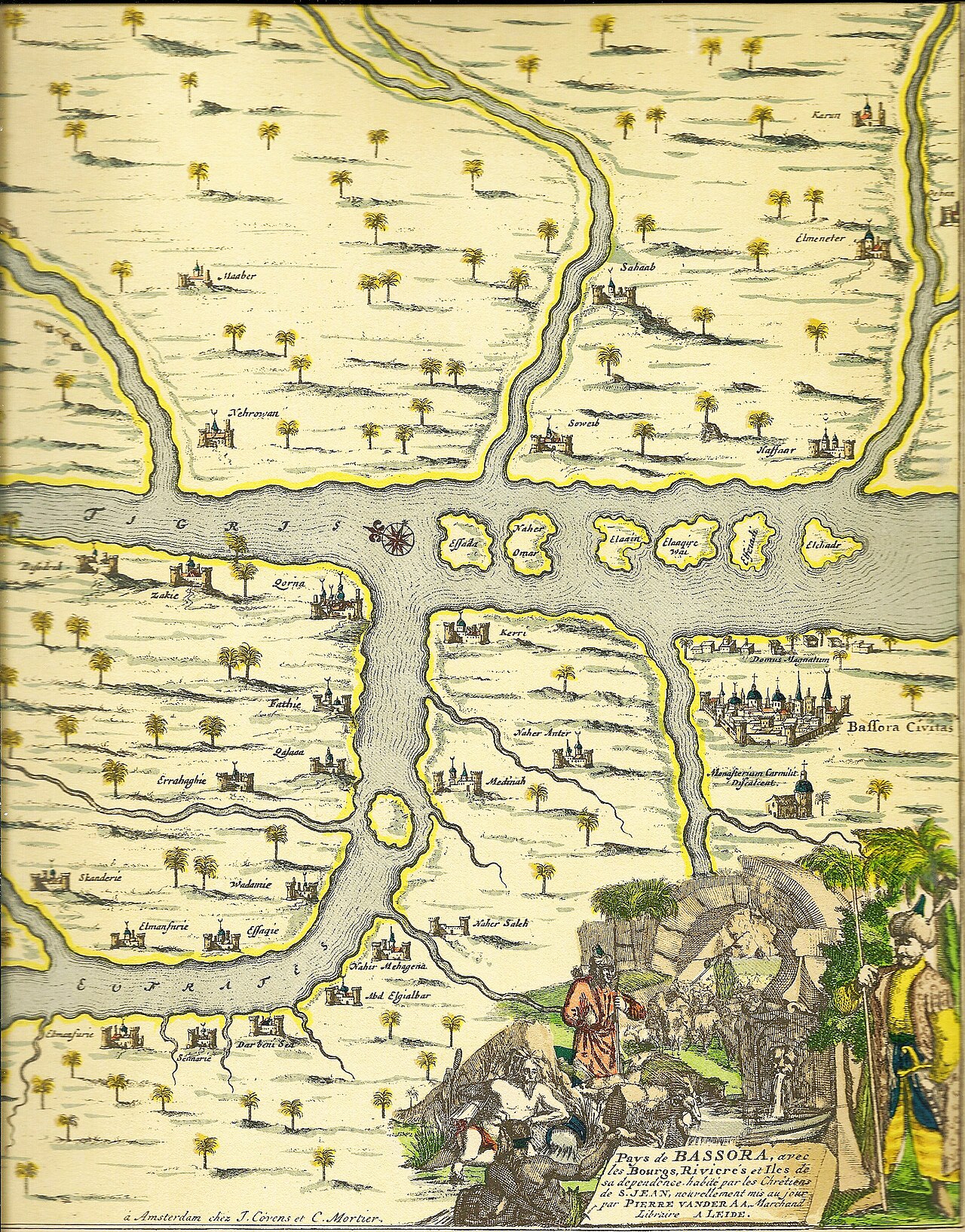
In April 1775 Karim Khan Zand sent his brother Sadeq Khan with an army of about 30,000 to besiege Basra, the Ottoman port at the head of the Persian Gulf. After a siege of a year, the garrison surrendered in April 1776, and the city stayed under Zand rule until shortly after Karim Khan’s death in 1779. No Iranian government has ruled Basra since.
| Siege | 6 April 1775 to April 1776 (garrison surrendered about 20 April 1776) |
|---|---|
| Place | Basra, on the Shatt al-Arab in southern Iraq |
| Zand commander | Sadeq Khan Zand, brother of Karim Khan |
| Defender | Soleyman Agha, deputy governor (mutasallim) for the Mamluk pasha of Baghdad |
| Allies of the Zands | The Arab Banu Ka’b of Khuzestan; Shaykh Naser of Bushehr |
| Outcome | Basra held by the Zands from 1776 to 1779 |
Why Karim Khan wanted Basra
Karim Khan did not seek foreign conquests, and Basra was the great exception. John R. Perry, the historian of the Zand period, lists several reasons. Basra was the main rival of the Iranian ports of Bushehr and Bandar Abbas, and the British East India Company’s agency there drew trade away from Iran. Relations with Omar Pasha, the Mamluk governor of Baghdad, had soured: after the plague of 1773 killed many Iranian pilgrims at the shrine cities of Najaf and Karbala, the pasha confiscated their property, and he also interfered in the politics of the Kurdish principality of Ardalan on Iran’s border. Raids and skirmishes in 1774, including an attack on Basra by the Banu Ka’b, turned a quarrel into an undeclared war.
The timing was favourable. The Ottoman Empire had just lost a long war with Russia, ended by the Treaty of Küçük Kaynarca in 1774, and Baghdad could expect little help from Istanbul.
The siege
Sadeq Khan marched through Khuzestan early in 1775 and crossed the Shatt al-Arab. On 6 April he arrived to take command, and the bombardment of the walls began. His allies supplied what the Zands lacked: Shaykh Naser of Bushehr brought ships and men, and the Banu Ka’b, who controlled the waterways of the delta, provided boats and fighters.
The defence was organised by Soleyman Agha, the deputy governor. Assaults with scaling ladders in April were beaten back. Help from outside failed one source after another. The Mamluk government in Baghdad sent almost nothing, the al-Jalili rulers of Mosul refused reinforcements, and the Arab Montafeq tribe, nominally Ottoman allies, stayed out of the fighting. A small British squadron fought the Zand and Ka’b boats in the river, but the British then withdrew, their agent leaving for Bombay in the summer. An Omani fleet reached the Shatt in the autumn and broke through the Zands’ river chain, bringing supplies into the city, but by the spring of 1776 it too had gone.

The surrender
By early 1776 Basra was starving and its people were slipping out of the city, some to be fed in the Zand camp. Soleyman Agha opened negotiations in mid-April and surrendered on about 20 April 1776; Sadeq Khan entered the city the next day. The leading officials, Soleyman Agha among them, were sent as prisoners to Shiraz. Soleyman later returned to Iraq and, as Büyük Süleyman Pasha, became one of the most powerful Mamluk governors of Baghdad.
The Zands set up their own administration. Coins were struck in Basra in the name of Karim Khan and the Twelve Imams, Shi’i forms were used in the Friday sermon, and a garrison of several thousand men stayed in the city.
Three years of Zand rule
The prize turned out to be disappointing. The plague and the siege had already ruined Basra’s trade, and the British were in no hurry to return. When Sadeq Khan was replaced by a Zand kinsman, Mohammad Ali Khan, his greed alienated the local tribes, and in June 1778 he was killed in an ambush by the Montafeq, leaving the city in disorder. Sadeq Khan was sent back in December 1778 to restore order. Barely three months later news came that Karim Khan had died, on 1 March 1779. Sadeq Khan left at once for Shiraz to claim the succession, and the Zand garrison withdrew. Basra returned to Ottoman rule.
- 1773 Plague in Iraq; dispute over the property of dead Iranian pilgrims
- 1774 Border clashes; Banu Ka’b attack on Basra
- 6 Apr 1775 Sadeq Khan begins the siege
- Summer 1775 British withdraw from the defence
- Autumn 1775 Omani fleet reaches the city
- About 20 Apr 1776 Basra surrenders
- June 1778 Zand governor killed by the Montafeq
- Mar 1779 Death of Karim Khan; Zand withdrawal
Significance
The capture of Basra was the largest military success of Karim Khan’s reign and showed that the Zand state, for all its modest resources, could defeat an Ottoman province. It was also a symptom of the Zands’ interest in the Persian Gulf trade that had made Karim encourage the East India Company at Bushehr. In the longer view it was an interlude: Basra never returned to Iranian rule, and the border along the Shatt al-Arab became a subject of treaties and disputes between Iran and the Ottomans, and later Iraq, for the next two centuries. For the ruler behind the campaign see Karim Khan Zand, and for Sadeq Khan’s brief and violent reign after 1779 see Lotf Ali Khan, the last Zand.
Persian words from this page
| بصره | Basre | Basra |
| محاصره | mohâsere | siege |
| صادقخان | Sâdegh Khân | Sadeq Khan |
| اروندرود | Arvandrud | the Shatt al-Arab (Iranian name) |
| طاعون | tâ’un | plague |
| خوزستان | Khuzestân | Khuzestan |
Sources and further reading
- John R. Perry, “Karim Khan Zand”, Encyclopaedia Iranica: iranicaonline.org/articles/karim-khan-zand.
- John R. Perry, “The Zand Dynasty”, in The Cambridge History of Iran, vol. 7 (1991).
- John R. Perry, Karim Khan Zand: A History of Iran, 1747-1779 (Chicago, 1979).
- J. G. Lorimer, Gazetteer of the Persian Gulf, Oman and Central Arabia (Calcutta, 1908 to 1915), historical section on Turkish Iraq.
- Fred M. Donner, “Basra”, Encyclopaedia Iranica: iranicaonline.org/articles/basra.
Want to learn Persian? Get the free Starter Pack
Get the 14-page printable Starter Pack (all 32 letters, a 7-day reading plan, 100 core words and 20 survival phrases) and a short 5-email course. Free.
More in The Afsharids and Zands (1736–1796)
- The Rise of Nader
- The Battle of Mihmandust (1729)
- Nader Shah Crowned at the Mughan Plain (1736)
- Nader Shah’s Wars with the Ottomans
- Battle of Karnal and the Sack of Delhi (1739)
- Nader Shah in Central Asia and Dagestan
- Nader Shah’s Navy and the Persian Gulf
- The Assassination of Nader Shah (1747)
- Nader Shah’s Religious Policy
- Shahrokh Afshar and Afsharid Khorasan
- Ahmad Shah Durrani and the Birth of Afghanistan
- Karim Khan Zand
- Shiraz under Karim Khan
- The Persian Capture of Basra (1775–1776)
- Lotf Ali Khan, the Last Zand