On 8 March 1736 the general Nader was crowned shah of Iran on the Mughan plain in the north-west of the country, after an assembly of the realm’s notables had agreed to replace the infant Safavid king Abbas III. The ceremony ended 235 years of Safavid rule and founded the Afsharid dynasty, although Nader made his acceptance depend on conditions that changed Iran’s official religious position.
| Date | Assembly from January 1736; coronation 8 March 1736 |
|---|---|
| Place | Mughan (Moghan) plain, near the meeting of the Aras and Kura rivers, today divided between Iran and the Republic of Azerbaijan |
| Deposed | Abbas III, a child of about four, the last Safavid shah in name |
| New dynasty | Afsharid, named after Nader’s tribe |
| Conditions set by Nader | Loyalty to his family; an end to the ritual cursing of the first caliphs; a new “Ja’fari” religious settlement |
From regent to king
After Nader restored Shah Tahmasp II to Isfahan in 1729, the shah’s position depended entirely on his general. When Tahmasp, campaigning on his own in 1731, lost to the Ottomans and signed a treaty early in 1732 that gave back Nader’s conquests in the Caucasus, Nader denounced the treaty and moved against him. The court historians later told how Nader got the shah drunk in Isfahan and showed him to the courtiers, asking whether such a man was fit to rule. In 1732 Tahmasp was deposed and his son, a baby of a few months, was proclaimed Shah Abbas III, with Nader as regent.
For the next four years Nader fought in the shah’s name, winning back the western provinces and the Caucasus from the Ottomans and recovering the Caspian coast from Russia, as told in Nader Shah’s wars with the Ottomans. By the end of 1735 the lands of the old Safavid state were almost all under his control, and the question of who should rule them could be asked openly.
Calling the assembly
According to the court historian Mirza Mahdi Khan Astarabadi, who drafted the summonses, Nader first raised the idea of becoming shah with a few close companions after a great hunt on the Mughan plain. One of them advised him to gather the leading men of the state and get their consent in a signed and sealed document. In November 1735 orders went out to military commanders, governors, religious scholars and tribal chiefs. They began to arrive in January 1736.
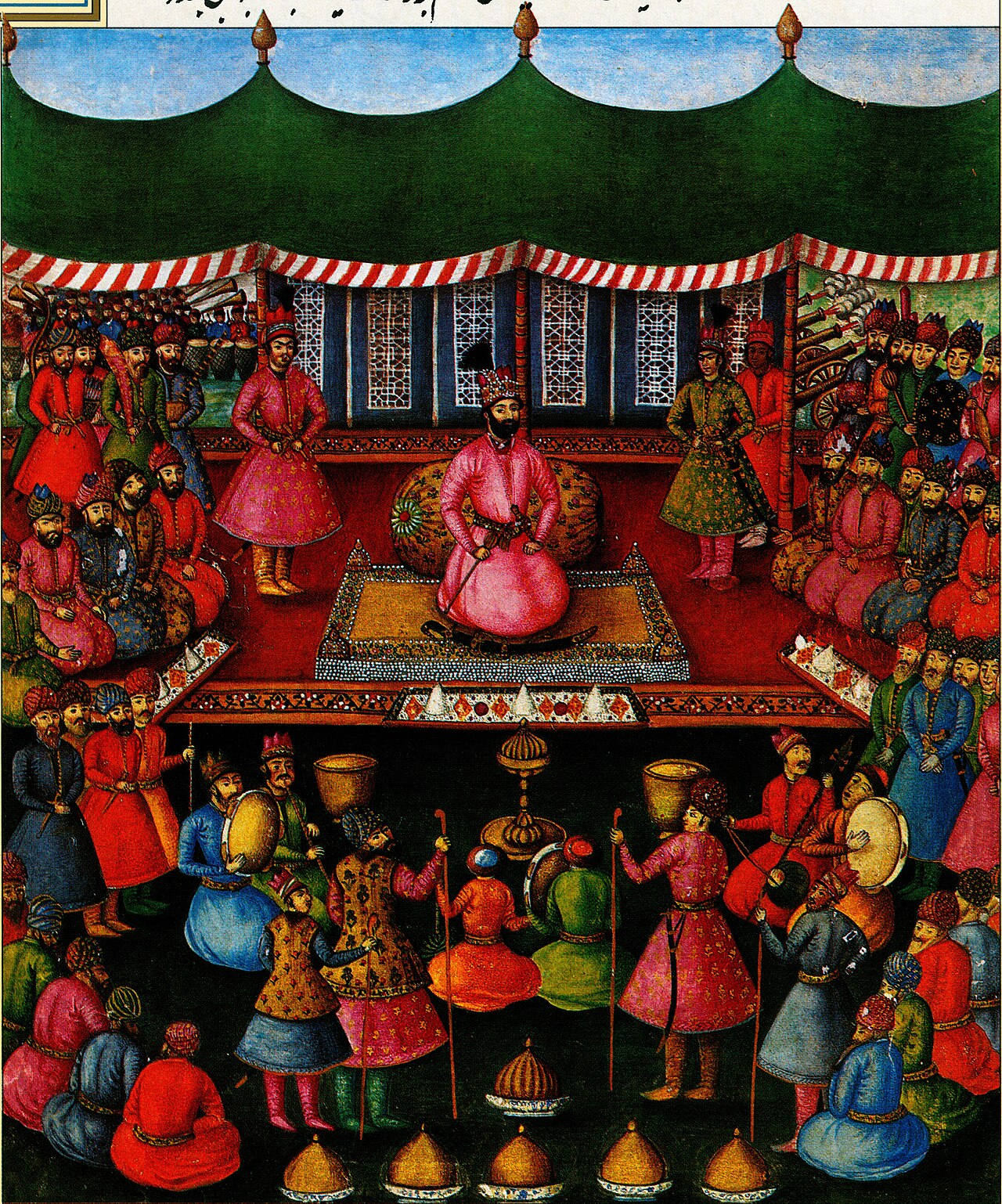
The Mughan plain was chosen partly for practical reasons: it was large, had plenty of fodder for horses, and lay close to the Caucasus front where Nader’s army was. Temporary buildings were put up to house the gathering. The assembly was also a deliberate echo of the quriltai, the great councils at which Mongol and Timurid rulers had been acclaimed, a model that suited a Turkic tribal leader better than Safavid court ritual.

Consent and its limits
Nader is said to have told the assembly that it could choose between keeping the Safavid boy king and choosing a new ruler, and that he himself wished to retire to Khorasan. Nobody took the offer at face value. Most delegates agreed to make him shah, some with enthusiasm and others out of fear. One senior cleric, the mollabashi, was reported to have spoken privately in favour of the Safavids; he was strangled. The story, whether or not every detail is true, shows how the consent was obtained.
Nader set conditions for accepting the crown. The delegates had to promise loyalty to his sons and family after him, which turned a personal seizure of power into a dynasty. They also had to give up practices that offended Sunni Muslims, above all the ritual cursing of the first three caliphs that the Safavids had encouraged, and accept a new definition of Iranian Shi’ism as a fifth legal school alongside the four Sunni schools. These religious terms, and what came of them, are discussed in Nader Shah’s religious policy.
The coronation
The coronation took place on 8 March 1736, a day chosen by Nader’s astrologers. The court history describes a very large gathering of nobles, officers and clergy, and the Ottoman ambassador was present. Nader’s name was read in the Friday sermon and struck on coins, the two traditional marks of sovereignty. His new seal carried a verse saying that the jewel of state and religion, which had vanished, had been restored in the name of Nader of Iran. He took the title Nader Shah.
The deposed Abbas III was sent to Khorasan with his father. Both were killed at Sabzevar in 1740 on the orders of Nader’s son Reza Qoli Mirza, when rumours of Nader’s death in India raised fears of a Safavid restoration.
- 1732 Tahmasp II deposed; infant Abbas III proclaimed with Nader as regent
- 1733 to 1735 War with the Ottomans; Russia returns the Caspian provinces
- Nov 1735 Summonses sent for an assembly at Mughan
- Jan 1736 Delegates arrive; assembly agrees to make Nader shah
- 8 Mar 1736 Coronation of Nader Shah
- 1740 Tahmasp II and Abbas III killed at Sabzevar
What changed, and what did not
The Mughan assembly ended the Safavid dynasty in law, though in practice its power had ended in 1722. It did not end the Safavid idea. Many Iranians continued to think of the Safavids as the rightful house, and pretenders claiming Safavid blood appeared for decades. Nader’s own grandson, Shahrokh, was half Safavid through his mother, which helped him win support after 1747. Even the Zand ruler Karim Khan kept a Safavid puppet king for years and refused the title of shah.
Nader moved the centre of his state to Khorasan, with Mashhad as his capital and the mountain fortress of Kalat as his treasury. Sixty years later the Qajar chief Agha Mohammad Khan chose the same Mughan plain for his own coronation in 1796, a reminder of how strongly the place had become linked to a change of dynasty; see Agha Mohammad Khan Qajar.
Persian words from this page
| دشت مغان | Dasht-e Moghân | the Mughan plain |
| تاجگذاری | tâjgozâri | coronation |
| نادرشاه | Nâder Shâh | Nader Shah |
| صفوی | Safavi | Safavid |
| افشاریه | Afshâriye | the Afsharid dynasty |
| سکه | sekke | coin |
Sources and further reading
- Mirza Mohammad Mahdi Khan Astarabadi, Tarikh-e Jahangosha-ye Naderi, which includes the author’s eyewitness account of the Mughan assembly.
- Ernest Tucker, “Nāder Shah”, Encyclopaedia Iranica: iranicaonline.org/articles/nader-shah.
- Ernest Tucker, Nadir Shah’s Quest for Legitimacy in Post-Safavid Iran (Gainesville, 2006).
- Michael Axworthy, The Sword of Persia (London, 2006).
- John R. Perry, “Afsharids”, Encyclopaedia Iranica: iranicaonline.org/articles/afsharids.
Want to learn Persian? Get the free Starter Pack
Get the 14-page printable Starter Pack (all 32 letters, a 7-day reading plan, 100 core words and 20 survival phrases) and a short 5-email course. Free.
More in The Afsharids and Zands (1736–1796)
- The Rise of Nader
- The Battle of Mihmandust (1729)
- Nader Shah Crowned at the Mughan Plain (1736)
- Nader Shah’s Wars with the Ottomans
- Battle of Karnal and the Sack of Delhi (1739)
- Nader Shah in Central Asia and Dagestan
- Nader Shah’s Navy and the Persian Gulf
- The Assassination of Nader Shah (1747)
- Nader Shah’s Religious Policy
- Shahrokh Afshar and Afsharid Khorasan
- Ahmad Shah Durrani and the Birth of Afghanistan
- Karim Khan Zand
- Shiraz under Karim Khan
- The Persian Capture of Basra (1775–1776)
- Lotf Ali Khan, the Last Zand