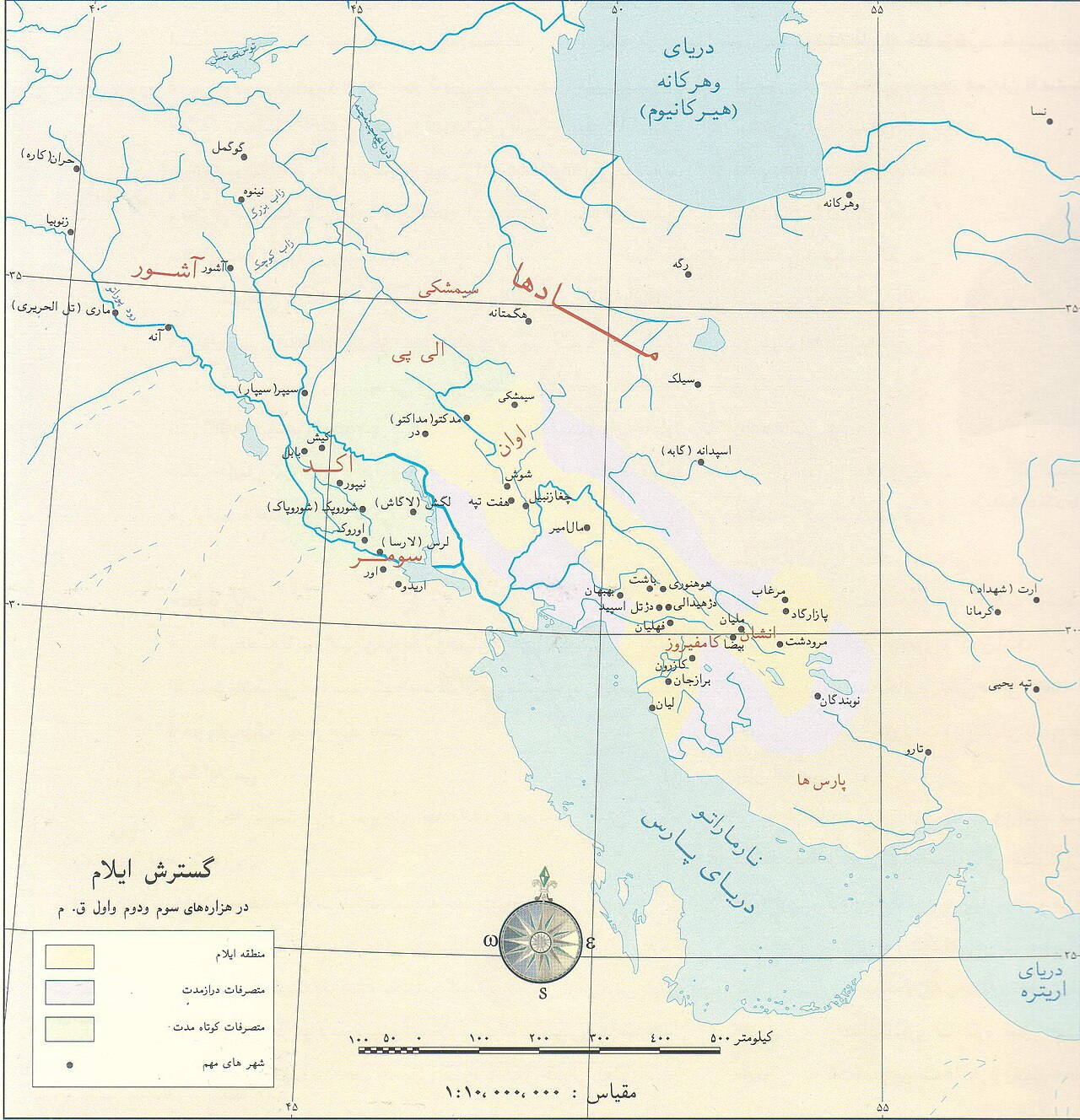
Elam was a kingdom of south-western Iran that lasted, in changing forms, from about 2700 BCE until the Persians absorbed it in the sixth century BCE. Its two heartlands were the lowland plain around Susa, in today’s Khuzestan, and the highlands of Anshan in Fars. For more than two thousand years it was Mesopotamia’s main rival in the east, and many of its traditions passed directly to the Persian Empire.

| Dates | c. 2700–539 BCE (Proto-Elamite phase before this, c. 3100–2900 BCE) |
|---|---|
| Own name | Haltamti (Akkadian Elamtu) |
| Persian name | عیلام (Eylâm) |
| Main cities | Susa, Anshan (Tal-e Malyan), Kabnak (Haft Tappeh), Al-Untash-Napirisha (Chogha Zanbil) |
| Language | Elamite, a language isolate |
| Chief gods | Inshushinak, Napirisha, Humban, Kiririsha |
Lowland and highland
Elam was never a single compact country. Its western part, Susiana, is a hot, flat plain watered by the Karkheh, the Dez and the Karun, close to the Tigris and to the cities of Sumer and Akkad. Its eastern part lay in the Zagros highlands, around Anshan near modern Shiraz, and in other mountain lands whose names appear in texts, such as Awan and Shimashki, whose exact location is still argued over.
This split shaped the whole history of Elam. The lowland was rich in grain and easily reached by Mesopotamian armies. The highland was harder to conquer and controlled the routes to the metals, timber and stone of the plateau. The kings who were strongest were those who held both, and the title many of them used, from the early second millennium onward, was “king of Anshan and Susa”.
The Old Elamite period (c. 2700–1500 BCE)
Elam enters history in Mesopotamian texts. A Sumerian king list records that Enmebaragesi of Kish “carried away the weapons of Elam”, and Elamite rulers appear as enemies and trading partners of the early Sumerian cities.
Around 2300 BCE Sargon of Akkad and his successors conquered Susa. One of the oldest documents in the Elamite language is a treaty between the Akkadian king Naram-Sin and an Elamite ruler, written in cuneiform at Susa. After Akkad declined, Puzur-Inshushinak of Awan, around 2100 BCE, made Susa the centre of a wide highland and lowland kingdom and set up inscriptions in both Akkadian and Linear Elamite.
The kings of the Third Dynasty of Ur then took Susa, but in 2004 BCE an army from Elam and Shimashki under King Kindattu sacked Ur itself and carried its last king, Ibbi-Sin, off into captivity. Sumerian poets lamented the destruction for generations.
The following centuries, the time of the sukkalmah or “grand regents”, were the high point of Elam’s influence in the old Near East. Elamite rulers were addressed as “father” by kings in Syria and Mesopotamia, and Elam intervened in the wars between Mesopotamian states, until Hammurabi of Babylon defeated an Elamite coalition around 1764 BCE.
The Middle Elamite kingdom (c. 1500–1100 BCE)
After a poorly documented gap, three dynasties ruled a revived Elam. Its kings built a new royal city at Kabnak (Haft Tappeh), the great ziggurat complex at Chogha Zanbil, and temples across the land. Under the Shutrukid kings Elam raided Babylonia and carried famous monuments, including the stele of Hammurabi’s laws, back to Susa. The full story is on the page about the Middle Elamite kingdom and Untash-Napirisha. The kingdom collapsed after Nebuchadnezzar I of Babylon invaded around 1100 BCE.
The Neo-Elamite period (c. 1000–539 BCE)
When Elam reappears in the eighth century BCE, it is caught between Babylon and an aggressive Assyria. Elamite kings fought repeatedly alongside Babylonian rebels, and Ashurbanipal of Assyria finally sacked Susa around 646 BCE. Smaller Elamite kingdoms survived until the rise of the Persians, who took over the lowlands and made Susa one of their capitals. See the Neo-Elamite period and the Assyrian sack of Susa.
How Elam was ruled
Elamite royal succession puzzled scholars for a long time. Power often passed between brothers before it passed to sons, and kings sometimes called themselves ruhu-shak, “son of a sister”, of an earlier ruler. Older books took this as evidence of brother-sister marriage or of inheritance through women. Many specialists now read it more cautiously as a way of claiming legitimate descent within the royal family, and the details remain debated.
The kingdom was also federal in character. The sukkalmah ruled over subordinate kings of Susa and of Elam and Shimashki, often members of the same family, so that lowland and highland each had their own ruler under one overlord.
Gods and temples
Elamite religion had many gods and strong local cults. Inshushinak, “lord of Susa”, was the city’s patron and was linked to the judgement of the dead. Napirisha, “the great god”, stood at the head of the highland pantheon, with the mother goddess Kiririsha, worshipped especially at Liyan near modern Bushehr. Humban, Pinikir, the sun god Nahhunte and many others had temples and priests. Kings built ziggurats, the most complete surviving one being Chogha Zanbil, and dedicated thousands of inscribed bricks, figurines and votive objects.
Sacred open-air sites mattered too. Rock reliefs at Kul-e Farah and Eshkaft-e Salman, near Izeh in the Bakhtiari mountains, show processions, musicians and sacrifices in the highland landscape.
Elam’s legacy to Iran
Elam did not vanish so much as merge into Persian Iran. Cyrus the Great called himself “king of Anshan”, using an Elamite royal title. Darius I built his palace at Susa, and the Persian administration at Persepolis kept its daily records in Elamite: tens of thousands of clay tablets list rations, travel and labour in that language. Elamite was one of the three languages of the Behistun inscription. Achaemenid court dress, crafts and some religious practices also show Elamite roots.
For the language and its scripts, see Elamite language and writing. For the city at the centre of it all, see Susa: 6,000 years of an ancient city.
- c. 3100–2900 BCE Proto-Elamite tablets at Susa and Anshan
- c. 2300 BCE Akkadian conquest of Susa
- c. 2100 BCE Puzur-Inshushinak rules from Susa
- 2004 BCE Kindattu of Shimashki sacks Ur
- c. 1764 BCE Hammurabi defeats Elam
- c. 1500–1100 BCE Middle Elamite kingdom
- c. 646 BCE Ashurbanipal sacks Susa
- 539 BCE Elam fully part of Cyrus’s Persian empire
Persian words from this page
| عیلام | Eylâm | Elam |
| شوش | Shush | Susa |
| انشان | Anshân | Anshan |
| خوزستان | Khuzestân | Khuzestan |
| کارون | Kârun | Karun river |
| هفتتپه | Haft Tappe | Haft Tappeh, “seven mounds” |
| پادشاه | pâdeshâh | king |
Sources and further reading
- Potts, D. T., The Archaeology of Elam: Formation and Transformation of an Ancient Iranian State, 2nd ed., Cambridge University Press, 2016.
- Álvarez-Mon, J., Basello, G. P. and Wicks, Y. (eds), The Elamite World, Routledge, 2018.
- Carter, E. and Stolper, M. W., Elam: Surveys of Political History and Archaeology, University of California Press, 1984.
- Encyclopaedia Iranica, “Elam” (iranicaonline.org).
- Encyclopaedia Iranica, “Susa ii. History during the Elamite period” (iranicaonline.org).
Want to learn Persian? Get the free Starter Pack
Get the 14-page printable Starter Pack (all 32 letters, a 7-day reading plan, 100 core words and 20 survival phrases) and a short 5-email course. Free.
More in Early Iran and Elam (c. 3200–700 BCE)
- Prehistoric Iran: The First Villages of the Iranian Plateau
- Proto-Elamite Civilization and the First Writing in Iran
- The Jiroft Culture and the Halil Rud Treasures
- Shahr-e Sukhteh: The Burnt City of Sistan
- Elam: Iran’s First Great Kingdom
- The Middle Elamite Kingdom and Untash-Napirisha
- The Neo-Elamite Period and the Assyrian Sack of Susa
- Susa: 6,000 Years of an Ancient City
- Chogha Zanbil Ziggurat
- Elamite Language and Writing
- The Arrival of the Iranian Peoples
- The Mannaeans, Urartu and North-West Iran
- Marlik and the Gilan Hill Cultures
- The Luristan Bronzes
- Zoroaster and the Avesta