Proto-Elamite is the name archaeologists give to the culture of south-western and central Iran around 3100–2900 BCE, when officials at Susa and Anshan began keeping records in the first writing system invented on the Iranian plateau. About 1,600 clay tablets survive. Their numbers can be read, but the signs for words still cannot, which makes Proto-Elamite one of the oldest undeciphered scripts in the world.
| Date | c. 3100–2900 BCE (some scholars extend it to c. 2700 BCE) |
|---|---|
| Main centres | Susa (Khuzestan) and Anshan, modern Tal-e Malyan (Fars) |
| Other tablet sites | Tepe Yahya, Tepe Sialk, Shahr-e Sukhteh, Godin Tepe and others |
| Writing | Proto-Elamite script, c. 1,600 known tablets, undeciphered |
| Use | Accounts of grain, animals, workers and rations |
From counting tokens to tablets
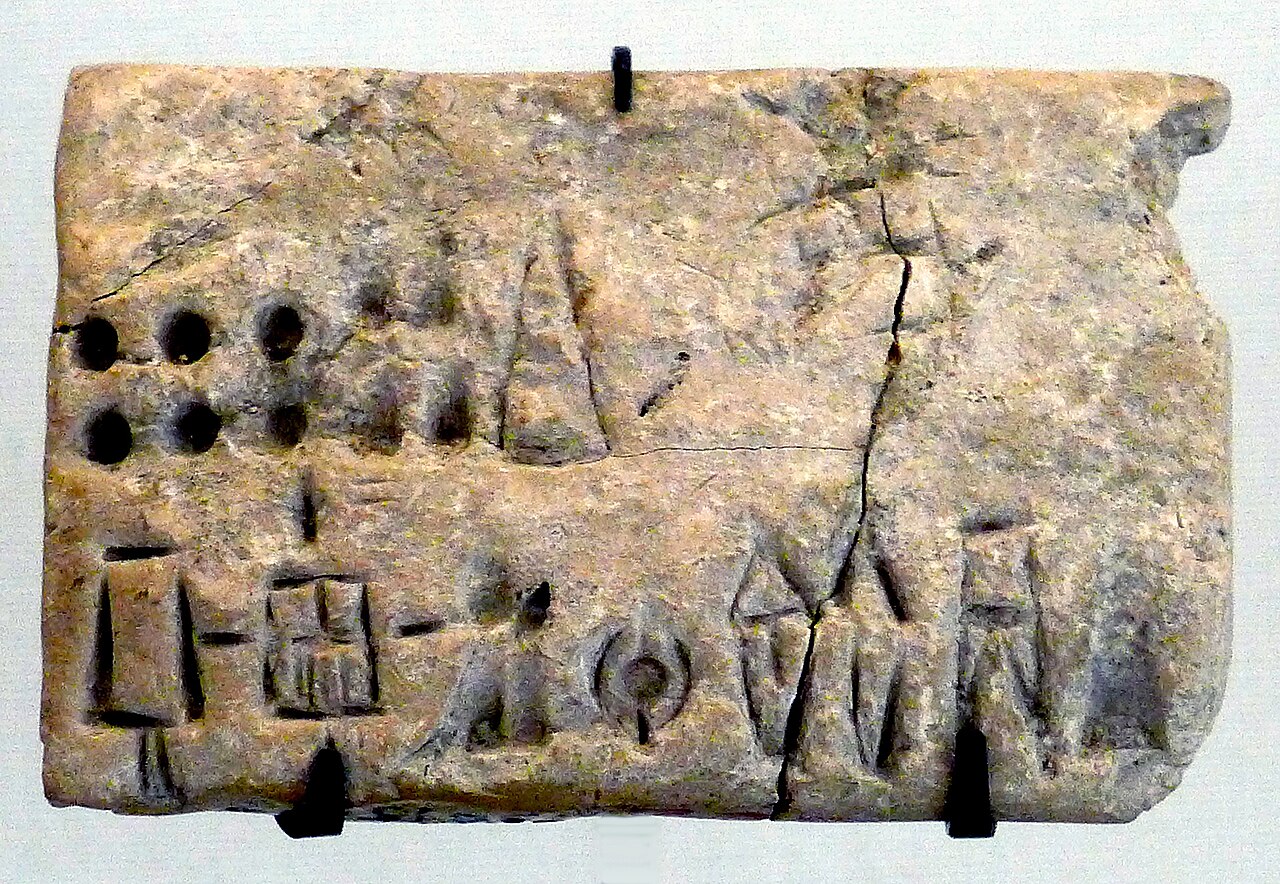
Writing in Iran did not appear out of nowhere. For centuries, people in western Iran and Mesopotamia had tracked goods with small clay tokens, sometimes sealed inside hollow clay balls called bullae. At Susa, as at Uruk in southern Iraq, administrators then began pressing number signs straight onto flat clay tablets and rolling a cylinder seal across them. These “numerical tablets” recorded quantities but not what was counted or who was involved.
Around 3100 BCE scribes in Susa took the next step. They added signs for commodities, people and institutions next to the numbers. The result was a script related in idea to early Sumerian writing but clearly not copied from it: the signs, the layout and several of the counting systems are different. This is the Proto-Elamite script.

What the tablets say, and what they do not
Most Proto-Elamite tablets are short administrative notes. A typical one opens with a sign for the person or office responsible, then lists entries, each made up of a few word-signs followed by a number, and sometimes ends with a total on the back. From the structure alone, scholars can tell that many deal with rations of grain and beer, herds of sheep and goats, and groups of workers.
The numbers are the best-understood part. Proto-Elamite scribes used several systems side by side: a sexagesimal (base 60) system for counting discrete things like animals, a bisexagesimal system for certain rations, a decimal system that seems to be an Iranian feature, and special systems for measuring grain by volume and for area. Working these out was the achievement of Peter Damerow and Robert Englund in the 1980s.
The rest is still a puzzle. Around 1,000 different signs have been catalogued, many used only once or twice. Without a bilingual text, and without knowing for sure which language lies behind the script, nobody can read the word-signs. Jacob Dahl at Oxford has led a project since the 2000s to publish high-quality images of every tablet, so that patterns can be studied across the whole corpus.
A network across the plateau
The most striking thing about Proto-Elamite is how far it reached. Tablets of the same type and seals in the same style turn up at sites hundreds of kilometres apart:
- Susa in the lowlands of Khuzestan produced the great majority of tablets, mostly from the excavations of Jacques de Morgan and Roland de Mecquenem in the early 1900s.
- Tal-e Malyan in Fars, the city later called Anshan, is a huge mound of some 200 hectares, though only part of it was occupied in the Proto-Elamite phase. William Sumner’s American team began work there in 1971, and inscribed bricks found in the early 1970s confirmed that it was Anshan.
- Tepe Yahya in Kerman province, excavated by C. C. Lamberg-Karlovsky of Harvard from 1967, had a Proto-Elamite building with tablets and seal impressions far out in the south-east.
- Tepe Sialk near Kashan, Godin Tepe in the central Zagros and Shahr-e Sukhteh in Sistan have smaller numbers of tablets or related finds.
How to explain this spread is one of the main debates. Some archaeologists see a political network run from Susa or Anshan, with colonies or trading posts placed on the routes for metals and stones. Others prefer a looser picture: local elites across the plateau adopting a prestigious way of keeping accounts, much as later peoples adopted Aramaic. The truth may lie in between, and it may have changed over the two centuries the system lasted.
Trade in stone and metal
The plateau was rich in materials Mesopotamia lacked. Copper came from central Iran and from Oman across the Persian Gulf. Lapis lazuli travelled from Badakhshan in Afghanistan, passing through Sistan, where workshops at Shahr-e Sukhteh worked the raw blue stone. Soft chlorite was carved into vessels around Tepe Yahya and in the Halil Rud valley, the region later famous for the Jiroft culture. Proto-Elamite towns sat on these routes, and the need to record goods moving along them is one plausible reason the script spread.
Proto-Elamite seals and art
Proto-Elamite cylinder seals have a distinct character. Lions, bulls and goats often stand upright and behave like people: they sit on thrones, carry vessels, or work as potters and builders. Stone and silver figurines of kneeling bulls holding vessels come from the same period. These images have no direct Mesopotamian equivalent and are among the first signs of an artistic tradition rooted in Iran itself.
Why it ended, and what came next
Around 2900 BCE, or a little later at some sites, the Proto-Elamite tablets stop. The towns of the plateau shrank and the eastern network broke up. At Susa, Mesopotamian influence grew strong again during the following centuries.
Whether the language of the Proto-Elamite tablets was an early form of Elamite is not known, although many scholars think it likely, given that later Elamite kings ruled the same two centres, Susa and Anshan. A second, much later script, Linear Elamite, has sometimes been seen as a descendant, but the link is not proven. Both are explained on the page about Elamite language and writing, and the political history that followed is told in Elam: Iran’s first great kingdom.
Persian words from this page
| خط | khatt | script, writing |
| لوح | lowh | tablet |
| شوش | Shush | Susa |
| انشان | Anshân | Anshan |
| مهر | mohr | seal |
| عدد | adad | number |
Sources and further reading
- Potts, D. T., The Archaeology of Elam: Formation and Transformation of an Ancient Iranian State, 2nd ed., Cambridge University Press, 2016.
- Damerow, P. and Englund, R. K., The Proto-Elamite Texts from Tepe Yahya, Harvard, 1989.
- Dahl, J. L., “Early Writing in Iran”, in D. T. Potts (ed.), The Oxford Handbook of Ancient Iran, Oxford University Press, 2013.
- Sumner, W. M., “Excavations at Tall-i Malyan (Anshan)”, reports in the journal Iran, 1970s.
- Encyclopaedia Iranica, “Susa ii. History during the Elamite period” (iranicaonline.org).
Want to learn Persian? Get the free Starter Pack
Get the 14-page printable Starter Pack (all 32 letters, a 7-day reading plan, 100 core words and 20 survival phrases) and a short 5-email course. Free.
More in Early Iran and Elam (c. 3200–700 BCE)
- Prehistoric Iran: The First Villages of the Iranian Plateau
- Proto-Elamite Civilization and the First Writing in Iran
- The Jiroft Culture and the Halil Rud Treasures
- Shahr-e Sukhteh: The Burnt City of Sistan
- Elam: Iran’s First Great Kingdom
- The Middle Elamite Kingdom and Untash-Napirisha
- The Neo-Elamite Period and the Assyrian Sack of Susa
- Susa: 6,000 Years of an Ancient City
- Chogha Zanbil Ziggurat
- Elamite Language and Writing
- The Arrival of the Iranian Peoples
- The Mannaeans, Urartu and North-West Iran
- Marlik and the Gilan Hill Cultures
- The Luristan Bronzes
- Zoroaster and the Avesta