The Neo-Elamite period (c. 1000–539 BCE) was the last chapter of independent Elam. For a century Elamite kings backed Babylon against the Assyrian empire, until Ashurbanipal of Assyria destroyed Susa around 646 BCE. Elam survived as smaller kingdoms and then merged into the rising Persian state, which inherited its capital, its scribes and much of its court culture.
| Date | c. 1000–539 BCE |
|---|---|
| Main enemy | Assyria |
| Main ally | Babylonian rulers and rebels |
| Key battles | Der (720 BCE), Halule (691 BCE), Til-Tuba on the Ulai (653 BCE) |
| Sack of Susa | By Ashurbanipal, c. 646 BCE |
| End | Absorbed by the Persians under Cyrus II, by 539 BCE |
The silent centuries
After the fall of the Middle Elamite kingdom around 1100 BCE, almost no texts survive from Elam for three hundred years. Archaeology shows that Susa was still occupied, and a few later royal inscriptions look back to this time, but historians call these centuries Neo-Elamite I mainly for lack of anything better. During them, Iranian-speaking peoples, among them the ancestors of the Persians, were settling in the highlands around Anshan, a change described on the page about the arrival of the Iranian peoples.
Elam and Babylon against Assyria
Elam reappears in the Babylonian chronicles in 743 BCE with King Humban-nikash I. By then Assyria was the great power of the Near East, and Babylonia was its unwilling subject. Elam’s kings saw a strong Assyria on their border as a threat, and for nearly a century they supplied troops, money and refuge to Babylonian leaders who resisted it.
- 720 BCE: at Der, east of the Tigris, Humban-nikash fought the army of Sargon II. The Babylonian chronicle claims an Elamite victory; Sargon claims one too.
- 694 BCE: after Sennacherib of Assyria sent a fleet down the Persian Gulf to attack Elamite coastal towns, the Elamite king Hallushu-Inshushinak struck back, seized Sennacherib’s son, who was governing Babylon, and carried him off. The prince was never seen again.
- 691 BCE: a combined Elamite and Babylonian army met Sennacherib at Halule on the Tigris. Sennacherib’s annals describe a crushing victory, while the Babylonian chronicle describes an Assyrian retreat. Most historians read it as a bloody draw.
Elam itself was unstable. Kings were often overthrown by brothers or nephews, and defeated princes fled to Assyria, which used them as puppets.
Teumman and the Battle of Til-Tuba
In the 650s BCE the Elamite throne was seized by Teumman, who tried to kill his rival nephews. They escaped to the court of Ashurbanipal at Nineveh. Ashurbanipal invaded, and around 653 BCE the two armies met at Til-Tuba on the Ulai river near Susa. The Elamites were routed and Teumman was killed.
Ashurbanipal had the battle carved on the walls of his palace in remarkable detail. The reliefs, now in the British Museum, show the Elamite king’s chariot overturned, Teumman and his son cut down, and the king’s head carried away as a trophy. In another famous relief Ashurbanipal reclines in a garden with his queen while Teumman’s head hangs from a tree nearby.
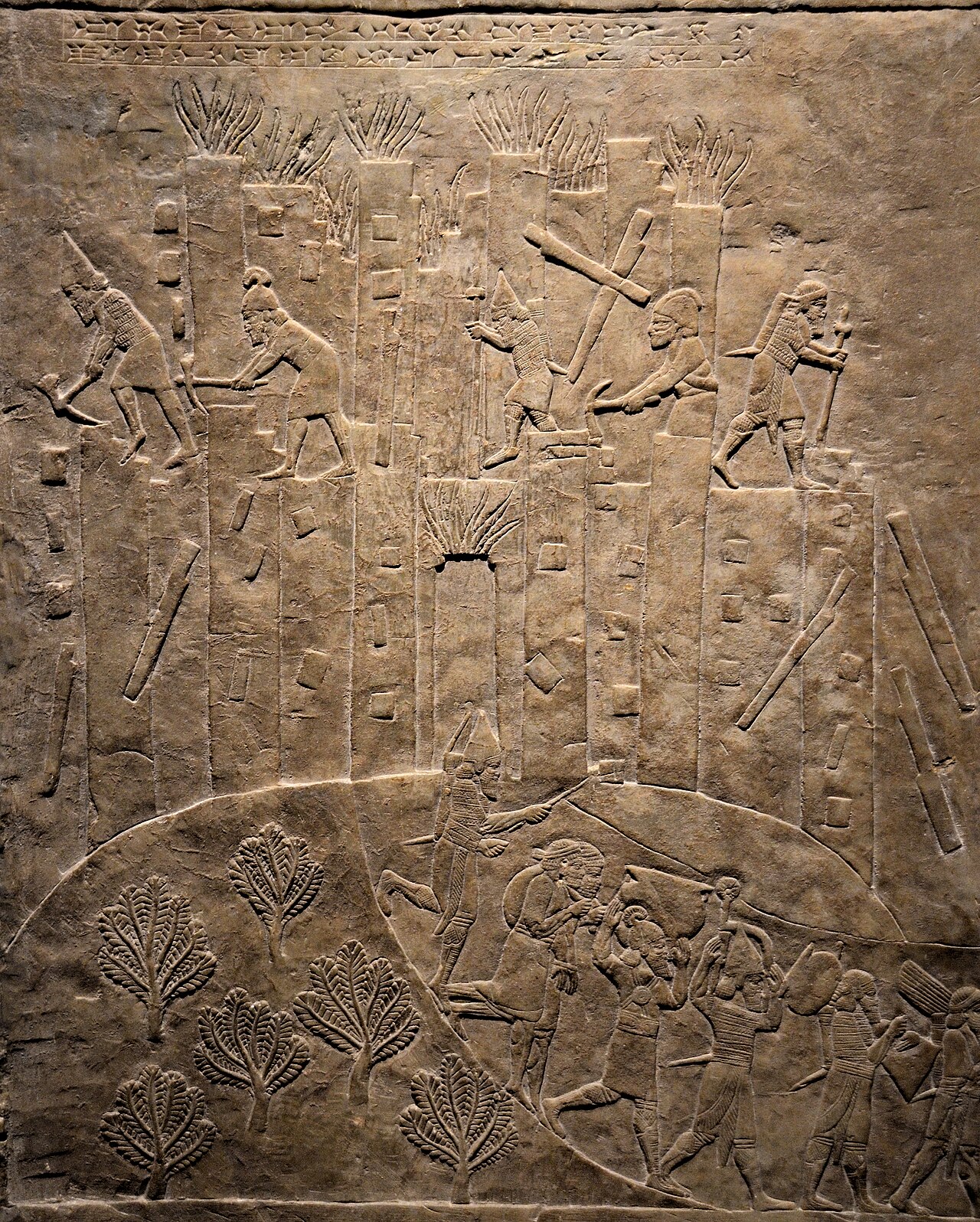

The sack of Susa (c. 646 BCE)
Peace did not follow. When Ashurbanipal’s own brother, Shamash-shum-ukin, king of Babylon, rebelled in 652 BCE, Elam supported him. After crushing Babylon in 648 BCE, Ashurbanipal turned on Elam in a series of campaigns that ended in the capture of Susa, around 646 BCE.
His inscriptions describe the destruction in the language of total victory. He says he smashed the ziggurat, looted the temples and carried off the statues of the gods, opened the tombs of Elam’s kings and took their bones to Assyria so their spirits would find no rest, and spread salt over the fields. Among the treasures he took home was the statue of a goddess that, he claimed, Elam had carried off from Mesopotamia 1,635 years earlier. Assyrian royal inscriptions exaggerate, and archaeology shows that Susa was soon reoccupied, but as a political power Elam was broken.
The last Elamite kingdoms
Assyria itself collapsed only a few decades later, when the Medes and Babylonians destroyed Nineveh in 612 BCE. In the gap, Elamite rulers re-emerged in the lowlands and in the hills between Khuzestan and Fars. A rich tomb found by chance in 1982 at Arjan, near Behbahan, belonged to one of these late princes, Kidin-Hutran son of Kurlush. It contained a gold ring, textiles and a famous bronze bowl decorated with scenes of court life, all dating to around 600 BCE.
These late Elamite courts were increasingly mixed with the Persians, who had settled in the old Elamite highland around Anshan. Elamite and Persian elites intermarried, served each other, and shared crafts and styles.
Legacy to the Persians
The Persian kings did not present themselves as conquerors of Elam but as its heirs. The Cyrus Cylinder calls Cyrus, his father, his grandfather and his ancestor Teispes “king of Anshan”, an Elamite royal title. A seal used later at Persepolis belongs to “Kurash of Anshan, son of Teispes”, generally taken to be Cyrus I. When Cyrus the Great conquered Babylon in 539 BCE, Susa and the Elamite lowlands were already part of his realm.
Elam left deep marks on the empire that followed:
- Darius I made Susa one of his capitals and built a great palace there.
- Elamite was the main language of the Persian administration in Fars: the Persepolis Fortification and Treasury tablets are written mostly in it.
- Elamite was one of the three languages of Darius’s inscriptions, including Behistun.
- Achaemenid court robes, some royal ceremonies and craft traditions show Elamite origins.
Elam also revolted against Darius in 522–521 BCE, under leaders named Assina and Martiya, a sign that its identity was still alive. Its later story belongs to the Achaemenid Empire, and the city itself is followed on the page about Susa.
Persian words from this page
| آشور | Âshur | Assyria, Ashur |
| آشوربانیپال | Âshurbânipâl | Ashurbanipal |
| نینوا | Neynavâ | Nineveh |
| بهبهان | Behbahân | Behbahan |
| کوروش | Kurosh | Cyrus |
| جنگ | jang | war, battle |
Sources and further reading
- Waters, M. W., A Survey of Neo-Elamite History, State Archives of Assyria Studies 12, Helsinki, 2000.
- Potts, D. T., The Archaeology of Elam, 2nd ed., Cambridge University Press, 2016.
- Álvarez-Mon, J., The Arjan Tomb: At the Crossroads of the Elamite and the Persian Empires, Peeters, 2010.
- Grayson, A. K., Assyrian and Babylonian Chronicles, 1975 (the Babylonian chronicle entries for Der and Halule).
- Kuhrt, A., The Persian Empire: A Corpus of Sources from the Achaemenid Period, Routledge, 2007.
Want to learn Persian? Get the free Starter Pack
Get the 14-page printable Starter Pack (all 32 letters, a 7-day reading plan, 100 core words and 20 survival phrases) and a short 5-email course. Free.
More in Early Iran and Elam (c. 3200–700 BCE)
- Prehistoric Iran: The First Villages of the Iranian Plateau
- Proto-Elamite Civilization and the First Writing in Iran
- The Jiroft Culture and the Halil Rud Treasures
- Shahr-e Sukhteh: The Burnt City of Sistan
- Elam: Iran’s First Great Kingdom
- The Middle Elamite Kingdom and Untash-Napirisha
- The Neo-Elamite Period and the Assyrian Sack of Susa
- Susa: 6,000 Years of an Ancient City
- Chogha Zanbil Ziggurat
- Elamite Language and Writing
- The Arrival of the Iranian Peoples
- The Mannaeans, Urartu and North-West Iran
- Marlik and the Gilan Hill Cultures
- The Luristan Bronzes
- Zoroaster and the Avesta