Susa (Persian Shush) in Khuzestan is one of the oldest continuously important cities in the world. Founded around 4200 BCE, it was the lowland capital of Elam for over two thousand years and then one of the capitals of the Persian kings. French excavations from 1897 onward turned it into one of the richest sites of the ancient Near East, which is why many of its finest objects are now in the Louvre.

| Persian name | شوش (Shush) |
|---|---|
| Other names | Elamite Shushen, Akkadian Shushan, Greek Sousa |
| Founded | c. 4200–4000 BCE |
| Location | Khuzestan province, between the Karkheh and Dez rivers |
| Main mounds | Acropolis, Apadana, Royal City, Artisans’ Town |
| UNESCO | Susa, inscribed 2015 |
The first Susa (c. 4200–3500 BCE)
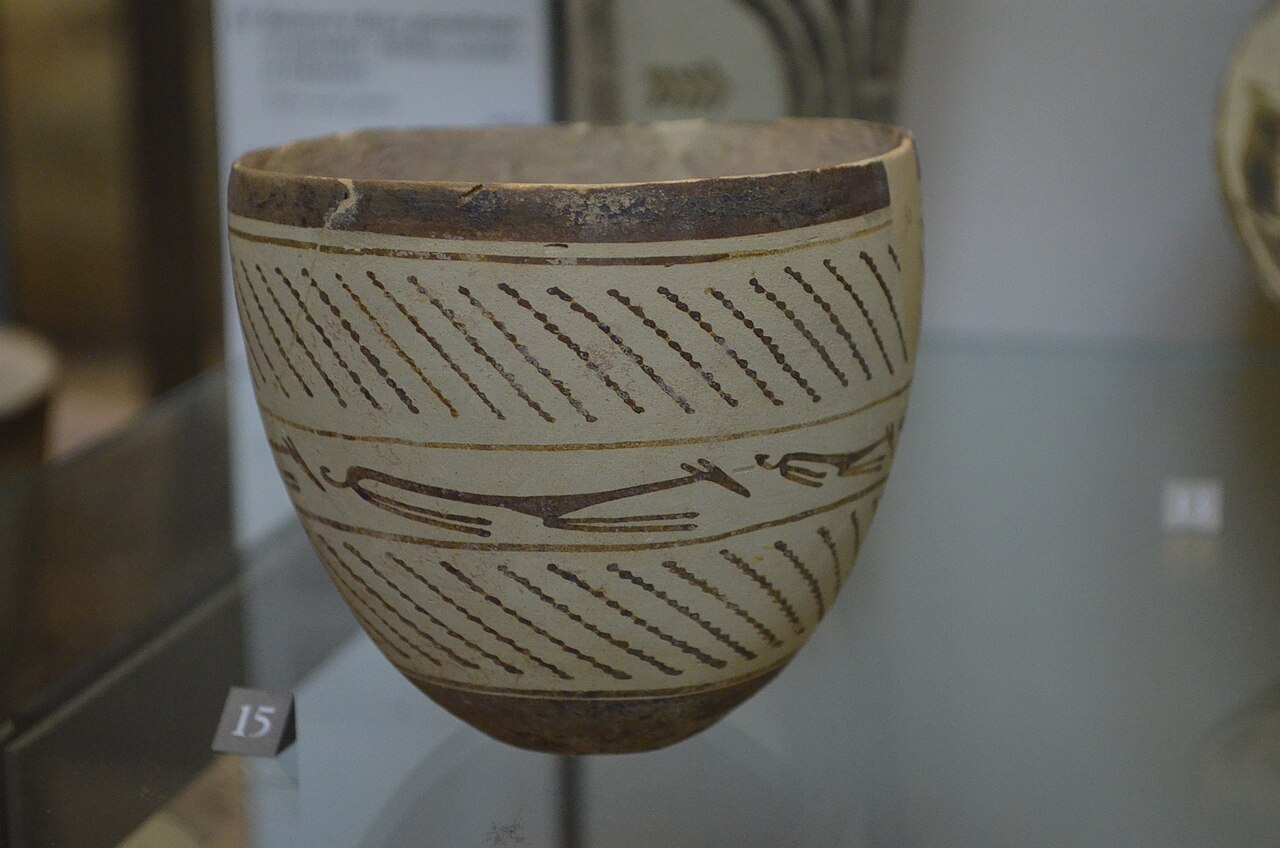
The settlers who founded Susa built, almost at once, something no village needed: a massive platform of mud brick, raised on the spot that later became the Acropolis mound. Next to it lay a cemetery with well over a thousand burials. Many graves held a copper axe, a mirror, and a tall, thin-walled beaker painted in black on buff clay.
These “Susa I” beakers are among the most elegant pottery of the ancient world. Their painters reduced animals to a few strokes: ibexes whose horns sweep round into huge circles, rows of long-necked wading birds, running dogs stretched into lines. The sheer effort of the platform and the quality of the grave goods suggest that early Susa was already a religious or political centre for the surrounding plain, rather than just a large village.
Elamite Susa (c. 3100–539 BCE)
Susa became the first place in Iran where writing was used, in the Proto-Elamite period, and remained the lowland capital through every phase of Elamite history. Its city god Inshushinak, “lord of Susa”, had his temple on the Acropolis, rebuilt by king after king. Mesopotamian powers repeatedly fought over the city: Akkad, Ur and Babylon each held it for a time, and Elamite kings each took it back.
The city’s long ties with Mesopotamia explain one of its oddities. In the twelfth century BCE King Shutruk-Nahhunte brought home trophies from his raids on Babylonia, including the law stele of Hammurabi, so Susa ended up holding some of the most famous Mesopotamian monuments ever found. The story is told on the page about the Middle Elamite kingdom. Around 646 BCE the Assyrian king Ashurbanipal sacked the city, but it recovered within a few generations (see the Neo-Elamite period).
Persian Susa
Under Darius I, from about 520 BCE, Susa was rebuilt as a royal capital. Darius levelled a new terrace, put up a palace with courtyards decorated in coloured glazed bricks, and next to it a huge columned audience hall, the Apadana. A foundation text from the palace lists where the materials and workers came from: cedar from Lebanon, gold from Sardis and Bactria, lapis lazuli and carnelian from Sogdiana, and craftsmen from Ionia, Egypt, Babylon and beyond. It is an inventory of the empire.
The Greeks knew Susa as the end of the Royal Road from Sardis and as the place where Greek envoys came to the Great King. The Bible remembers it as “Shushan the palace”, the setting of the Book of Esther. Alexander the Great took the city in 331 BCE and held the mass weddings of his officers to Persian women there in 324 BCE. The Achaemenid buildings are covered in detail on the page about the Palace of Darius at Susa.
After the empires
Susa remained a city under the Seleucids, who called it Seleucia on the Eulaeus, and under the Parthians and Sasanians. According to later sources, Shapur II destroyed it in the fourth century CE after a revolt and rebuilt it nearby. In the early Islamic period it was a busy town known for its textiles and pottery. It declined in the later Middle Ages, and by the time European travellers arrived, the small town of Shush had grown up around the shrine traditionally identified as the tomb of the prophet Daniel.
Digging Susa: from Loftus to Perrot
The excavation of Susa is itself a chapter in the history of archaeology and of Iran’s relations with Europe.
- 1851–1853: the British geologist William Kennett Loftus identified the site and found inscribed column bases of Artaxerxes II.
- 1884–1886: Marcel and Jane Dieulafoy, a French engineer and his wife, uncovered the glazed brick friezes of archers and lions, which went to the Louvre.
- 1897–1912: Jacques de Morgan led a large French mission. France had obtained a monopoly on excavation in Iran from Naser al-Din Shah in 1895, and a 1900 agreement with Mozaffar al-Din Shah gave France the finds from Susa. De Morgan built a fortified base on the site, the “castle” (château) that still stands, from ancient bricks.
- 1901–1902: his team found the stele of Hammurabi’s laws in three pieces; the victory stele of Naram-Sin and the bronze statue of Queen Napir-Asu also came from these years.
- 1946–1967: Roman Ghirshman excavated the Royal City and later worked at nearby Chogha Zanbil.
- 1968–1979: Jean Perrot led a new, more scientific French programme. In 1972 it found a statue of Darius I, made in Egypt and inscribed in hieroglyphs with the peoples of the empire. Unlike earlier finds, it stayed in Iran and is now in the National Museum in Tehran.
France’s general monopoly on excavation in Iran ended in 1927, though it kept its rights at Susa for decades afterwards. Since 1979 the site has been studied mainly by Iranian archaeologists. Old excavations removed a great deal of the stratigraphy, and much of what was found was recorded poorly by modern standards, so scholars still argue about the dates of many levels.
The Louvre’s Susa treasures
The Louvre’s Near Eastern galleries are in large part a Susa museum. Highlights include the Code of Hammurabi, the stele of Naram-Sin, the statue of Napir-Asu, the Frieze of Archers, a giant double-bull column capital from the Apadana, and dozens of Susa I beakers. Their presence in Paris is a reminder of the unequal terms under which the excavations were carried out.
For the modern town and how to visit, see Shush (Susa) today and the Susa archaeological site.
Persian words from this page
| شوش | Shush | Susa |
| قلعه | ghal’e | castle, fort |
| آپادانا | Âpâdânâ | Apadana, audience hall |
| کاخ | kâkh | palace |
| دانیال | Dâniyâl | Daniel |
| کاوش | kâvosh | excavation |
| موزه | muze | museum |
Sources and further reading
- Harper, P. O., Aruz, J. and Tallon, F. (eds), The Royal City of Susa: Ancient Near Eastern Treasures in the Louvre, Metropolitan Museum of Art, 1992.
- Perrot, J. (ed.), The Palace of Darius at Susa, I.B. Tauris, 2013.
- Potts, D. T., The Archaeology of Elam, 2nd ed., Cambridge University Press, 2016.
- Encyclopaedia Iranica, “Susa ii. History during the Elamite period” (iranicaonline.org).
- UNESCO World Heritage Centre, “Susa” (whc.unesco.org/en/list/1455).
Want to learn Persian? Get the free Starter Pack
Get the 14-page printable Starter Pack (all 32 letters, a 7-day reading plan, 100 core words and 20 survival phrases) and a short 5-email course. Free.
More in Early Iran and Elam (c. 3200–700 BCE)
- Prehistoric Iran: The First Villages of the Iranian Plateau
- Proto-Elamite Civilization and the First Writing in Iran
- The Jiroft Culture and the Halil Rud Treasures
- Shahr-e Sukhteh: The Burnt City of Sistan
- Elam: Iran’s First Great Kingdom
- The Middle Elamite Kingdom and Untash-Napirisha
- The Neo-Elamite Period and the Assyrian Sack of Susa
- Susa: 6,000 Years of an Ancient City
- Chogha Zanbil Ziggurat
- Elamite Language and Writing
- The Arrival of the Iranian Peoples
- The Mannaeans, Urartu and North-West Iran
- Marlik and the Gilan Hill Cultures
- The Luristan Bronzes
- Zoroaster and the Avesta