Marlik is a hilltop cemetery in the Gohar Rud valley near Rudbar in Gilan, northern Iran, where Ezatollah Negahban excavated 53 tombs in 1961–1962 and recovered over 25,000 objects, including some of the finest gold vessels of the ancient world. Most scholars date it to the late second millennium BCE, roughly the fourteenth to tenth centuries BCE. “Amlash” is the name of the market town under which looted finds from the same hill country were sold from the 1930s onward.

| Persian name | مارلیک (Mârlik), also Cherâgh-Ali Tappe |
|---|---|
| Place | Gohar Rud valley, a tributary of the Sefid Rud, near Rudbar, Gilan province |
| Date | c. 14th–10th century BCE (Negahban’s dating; some argue later) |
| Excavated | October 1961 to November 1962, by Ezatollah Negahban for the Archaeological Service of Iran |
| Finds | 53 tombs, over 25,000 objects: gold and silver vessels, bronze weapons, figurines, seals, horse gear |
From looted “Amlash” objects to a real excavation
In the hills south of the Caspian, between Rudbar, Deylaman and the small town of Amlash, villagers had been digging into ancient graves for decades. From the 1930s, and especially in the 1950s, pottery, bronzes and figurines from these digs reached the antiquities markets of Tehran and Europe. Dealers labelled them “Amlash”, after the town where much of the trade took place, although few if any came from Amlash itself.
Some of these objects were forgeries, but many were plainly genuine, and the Archaeological Service of Iran decided to find out where they came from. In autumn 1961 a survey team led by Ezatollah Negahban, a young archaeologist who had trained at the University of Chicago, recorded a natural mound called Cherâgh-Ali Tappe in the Gohar Rud valley. Local people also called it Marlik. Fourteen months of excavation followed.
The tombs of Marlik
Marlik turned out not to be a settlement but a cemetery reserved for important people. Its 53 tombs ranged from small pits lined with stones to large chambers built of stone slabs. Tomb 52, the largest, Negahban interpreted as the grave of a “warrior-king”. Some tombs held men buried with weapons, others women with jewellery, and horse harness was placed in several graves.
Negahban saw Marlik as a royal cemetery, and most scholars agree that it reflects a society with a clear elite. Who the people were is less certain. Negahban linked them with the Mardi, or Amardi, a people placed in this region by later Greek writers; others have suggested the kingdom of Andia mentioned in Assyrian texts. Neither can be proven, because Marlik has no inscriptions.
Gold, silver and bronze
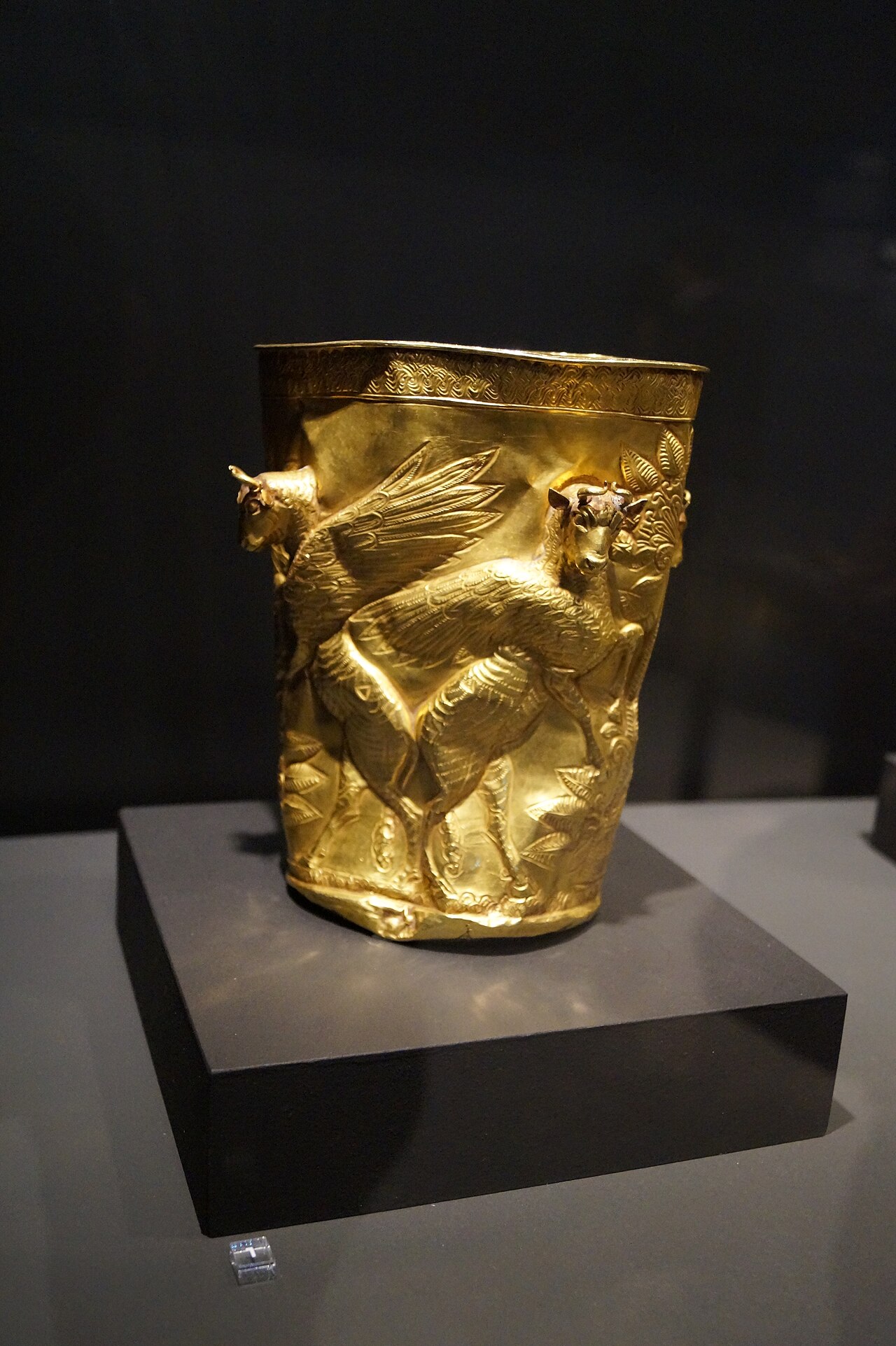
The gold vessels made Marlik famous. They are beakers and bowls hammered from sheet gold and decorated in high relief. On the best known, pairs of winged bulls stand on either side of a stylised tree, their heads turned outward to face the viewer in three dimensions. Other vessels show gazelles, rams, eagles or rows of animals walking round the cup. The workmanship is outstanding, and the style combines local ideas with influences from Mesopotamia, Elam and the wider Near East.
Alongside the gold came silver cups, vessels of mosaic glass and frit, bronze daggers, swords, spearheads and maces, cylinder seals, and gold and carnelian jewellery. The finest pieces are in the National Museum of Iran.
Humped bulls and mother goddesses
Marlik also produced pottery figures of a type already familiar from the “Amlash” market. The best known are vessels in the shape of humped zebu bulls, made of burnished red clay, with the spout formed by the animal’s muzzle. There are also stags, bears and other animals, and a few human figures.
The “Amlash” figurines on the market include clay women with tiny heads, huge hips and thighs and stumpy arms. They are often called mother goddesses or fertility figures, though their meaning is unknown. Because they were dug up illegally, they can rarely be dated precisely. Examples from controlled excavations show that the Gilan hill cultures produced such figures over a long period, during the Iron Age and possibly later.
Other Gilan hill cemeteries
Marlik was not alone. Excavations in the 1960s at Kaluraz, also near Rudbar, by the Iranian archaeologist Ali Hakemi, and by a Japanese mission from Tokyo in the Deylaman area at sites such as Ghalekuti and Noruzmahale, uncovered further cemeteries with weapons, pottery and figurines. Together they show a group of related mountain cultures in Gilan from the late second millennium into the first millennium BCE, with links to the Iron Age cultures of north-west Iran such as Hasanlu.
Dating and debate
Negahban dated Marlik to roughly the fourteenth to tenth centuries BCE, and most specialists accept a date in that range. A minority have argued for a lower date, and one proposal placed it as late as the seventh century BCE, but this has found little support. The question matters because it bears on who lived in northern Iran when Iranian-speaking groups were arriving, a topic covered on the page about the arrival of the Iranian peoples.
Marlik is also an example of the damage looting does. The “Amlash” objects on the market, however beautiful, have lost the information that would let us date them and understand them. The same problem affects the Luristan bronzes of western Iran. For the region today, see Rasht.
Persian words from this page
| مارلیک | Mârlik | Marlik |
| گیلان | Gilân | Gilan |
| رودبار | Rudbâr | Rudbar |
| املش | Amlash | Amlash |
| سفیدرود | Sefid Rud | the Sefid Rud (“white river”) |
| طلا | talâ | gold |
| گاو | gâv | cow, bull |
Sources and further reading
- Negahban, E. O., Marlik: The Complete Excavation Report, University of Pennsylvania Museum, 1996.
- Abdi, K., “Mārlik”, Encyclopaedia Iranica (iranicaonline.org).
- Negahban, E. O., “The Wonderful Gold Treasures of Marlik”, Illustrated London News, 1962.
- Potts, D. T. (ed.), The Oxford Handbook of Ancient Iran, Oxford University Press, 2013.
Want to learn Persian? Get the free Starter Pack
Get the 14-page printable Starter Pack (all 32 letters, a 7-day reading plan, 100 core words and 20 survival phrases) and a short 5-email course. Free.
More in Early Iran and Elam (c. 3200–700 BCE)
- Prehistoric Iran: The First Villages of the Iranian Plateau
- Proto-Elamite Civilization and the First Writing in Iran
- The Jiroft Culture and the Halil Rud Treasures
- Shahr-e Sukhteh: The Burnt City of Sistan
- Elam: Iran’s First Great Kingdom
- The Middle Elamite Kingdom and Untash-Napirisha
- The Neo-Elamite Period and the Assyrian Sack of Susa
- Susa: 6,000 Years of an Ancient City
- Chogha Zanbil Ziggurat
- Elamite Language and Writing
- The Arrival of the Iranian Peoples
- The Mannaeans, Urartu and North-West Iran
- Marlik and the Gilan Hill Cultures
- The Luristan Bronzes
- Zoroaster and the Avesta