The Jiroft culture is a Bronze Age civilisation of the Halil Rud valley in Kerman province, south-east Iran, which flourished in the third millennium BCE, at its height around 2500–2200 BCE. It became world news in 2001, when looted cemeteries released thousands of carved chlorite vessels onto the market, and excavations at the twin mounds of Konar Sandal then revealed a major urban centre that had been almost unknown.

| Date | Third millennium BCE, peak c. 2500–2200 BCE (excavators’ dating) |
|---|---|
| Place | Halil Rud valley near Jiroft, Kerman province |
| Main site | Konar Sandal, two mounds known as A and B |
| Excavated by | Iranian team led by Yousef Madjidzadeh, from the early 2000s |
| Known for | Carved chlorite vessels, a large citadel, a possible early script |
A discovery made by looters
Around 2000, floods along the Halil Rud river exposed ancient graves near the town of Jiroft. Local villagers began digging, and within months the cemeteries were riddled with pits. Carved stone vessels, many of them beautiful, flowed out to dealers in the Persian Gulf states and Europe. Iranian police and the cultural heritage authorities stepped in, seized large numbers of objects and stopped the worst digging.
The archaeologist Yousef Madjidzadeh, who had earlier worked on Mesopotamia and Elam, then led a series of excavations in the valley. His team concentrated on Konar Sandal, south of Jiroft, where two large mounds rise from the plain.
Konar Sandal: a city on the Halil Rud
The southern mound (B) is the taller and holds a massive fortified building, often called the citadel, built of mud brick on a high platform with thick walls. The northern mound (A) has a huge stepped platform that the excavators compared with a ziggurat, though its exact purpose is unclear. Around and between the mounds, survey and trenches found the remains of a lower town covering a wide area, with houses, workshops and cemeteries.
The Halil Rud valley is fertile by the standards of south-east Iran, and the river gave year-round water. That made it a natural base for farmers and for craftsmen working local stone. Settlements of the same culture extend along the valley, and related sites lie at Tepe Yahya to the west and Shahdad on the edge of the Lut desert to the north.
The chlorite vessels
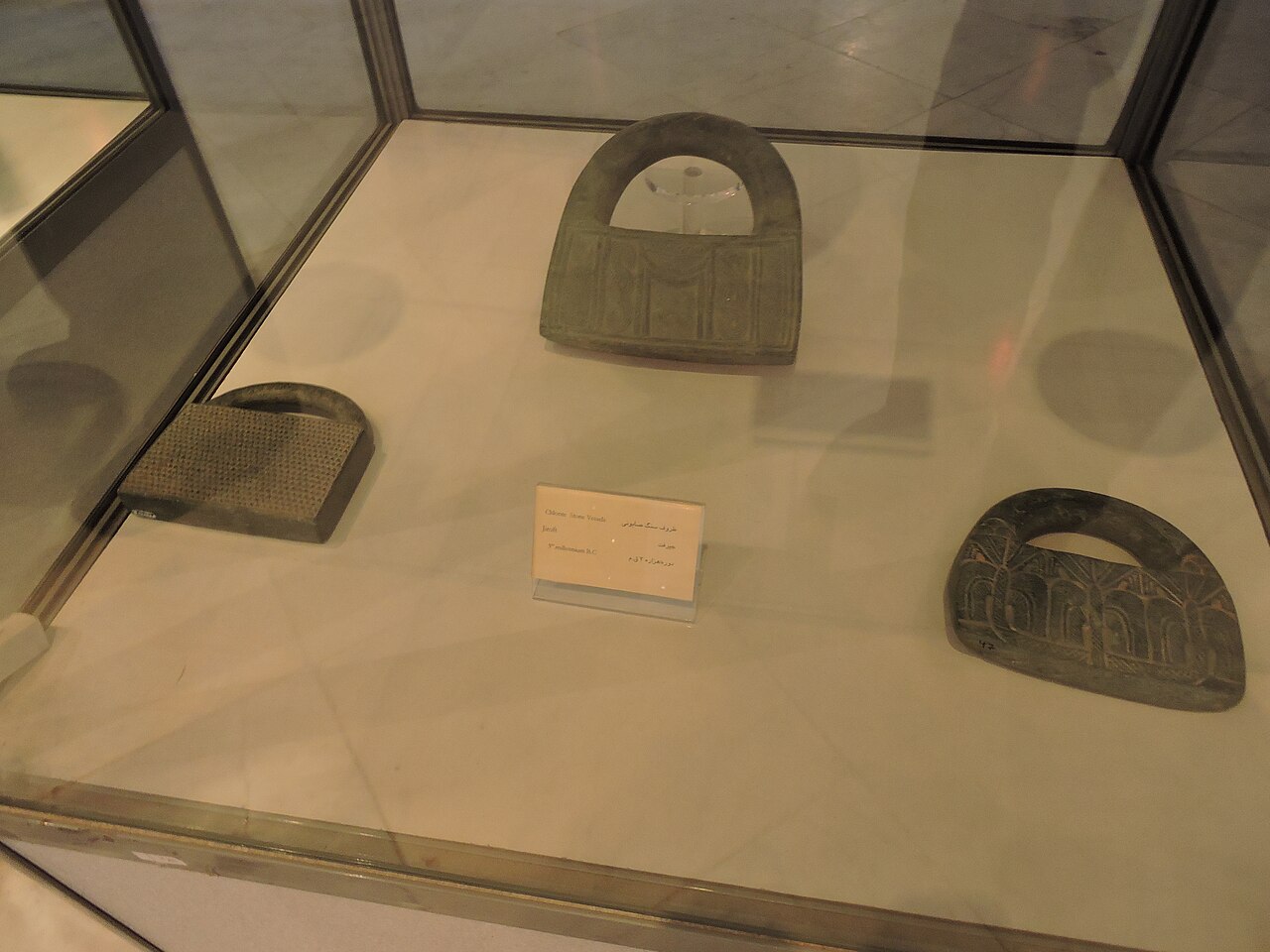
Jiroft’s fame rests on its carved vessels of chlorite, a soft grey-green stone. They include cylindrical jars, bowls, tall beakers and objects shaped like handbags, which may have been weights. The surfaces are covered in relief carving, sometimes inlaid with coloured stones and shell. Recurring motifs include:
- men with the bodies of scorpions, and men with the horns or bodies of bulls,
- eagles with outspread wings and large snakes, sometimes fighting,
- a “master of animals” holding back leopards, lions or serpents,
- rows of zebu cattle, date palms and scenes from the countryside,
- façades of buildings with doorways, a pattern often called the “hut” motif.
Vessels in this “intercultural style” had been known long before 2001 from sites far away: Susa, the temples of Mari in Syria, Nippur and other Mesopotamian cities, and the islands of the Persian Gulf. Archaeologists had already found a production centre at Tepe Yahya. The Jiroft finds showed that the Halil Rud valley was a heartland of the style, and that these were luxury goods traded over very long distances.
Aratta or Marhashi?
Sumerian literary texts tell of Aratta, a rich land beyond seven mountain ranges east of Sumer, whose lord exchanged precious stones and metals with Enmerkar, king of Uruk. Madjidzadeh proposed that Jiroft was Aratta. The idea caught the public imagination in Iran, but most specialists are cautious. The Aratta stories are literature written down centuries later, and their geography is vague.
A second proposal links Konar Sandal with Marhashi, a powerful kingdom east of Elam mentioned in real historical documents from Akkad and Ur. Piotr Steinkeller and Daniel Potts have argued for this identification. It fits the records better, but it also remains unproven until a text from the site names the place.
An early script?
A few inscribed objects found at Konar Sandal carry signs in a geometric style. Madjidzadeh suggested they were an early form of Elamite writing, and some enthusiasts went further and claimed Jiroft as the birthplace of writing itself. That claim has no support among specialists. The inscriptions are few and short, and their relationship to Linear Elamite, the script of Elam in the late third millennium, is still being studied. They are discussed on the page about Elamite language and writing.
Fakes, gaps and the scholarly debate
The looting came at a cost. Objects ripped from graves have no context, so we cannot tell which vessel lay with which burial or date them precisely. The success of the style on the market also encouraged forgeries, and some pieces in collections abroad are suspect. The archaeologist Oscar White Muscarella criticised early announcements as too sensational and too slow to be published in full. Supporters reply that the excavations have recovered real stratified material and that the site has transformed the map of Bronze Age Iran.
What is not in doubt is the main point. In the third millennium BCE, south-east Iran was home to wealthy, organised societies that traded with Mesopotamia, the Persian Gulf and the Indus valley. Jiroft and Shahr-e Sukhteh in Sistan are its two best-known centres. The seized vessels are now displayed in the museum at Jiroft and at the National Museum of Iran in Tehran.
Persian words from this page
| جیرفت | Jiroft | Jiroft |
| کرمان | Kermân | Kerman |
| هلیلرود | Halil Rud | Halil river |
| رود | rud | river |
| سنگ | sang | stone |
| عقاب | oqâb | eagle |
| مار | mâr | snake |
Sources and further reading
- Madjidzadeh, Y., Jiroft: The Earliest Oriental Civilization, Tehran, 2003.
- Potts, D. T., The Archaeology of Elam, 2nd ed., Cambridge University Press, 2016.
- Lawler, A., “Ancient Writing or Modern Fakery?”, Science 317 (2007).
- Muscarella, O. W., “Jiroft and ‘Jiroft-Aratta'”, Bulletin of the Asia Institute 15 (2001, published 2005).
Want to learn Persian? Get the free Starter Pack
Get the 14-page printable Starter Pack (all 32 letters, a 7-day reading plan, 100 core words and 20 survival phrases) and a short 5-email course. Free.
More in Early Iran and Elam (c. 3200–700 BCE)
- Prehistoric Iran: The First Villages of the Iranian Plateau
- Proto-Elamite Civilization and the First Writing in Iran
- The Jiroft Culture and the Halil Rud Treasures
- Shahr-e Sukhteh: The Burnt City of Sistan
- Elam: Iran’s First Great Kingdom
- The Middle Elamite Kingdom and Untash-Napirisha
- The Neo-Elamite Period and the Assyrian Sack of Susa
- Susa: 6,000 Years of an Ancient City
- Chogha Zanbil Ziggurat
- Elamite Language and Writing
- The Arrival of the Iranian Peoples
- The Mannaeans, Urartu and North-West Iran
- Marlik and the Gilan Hill Cultures
- The Luristan Bronzes
- Zoroaster and the Avesta