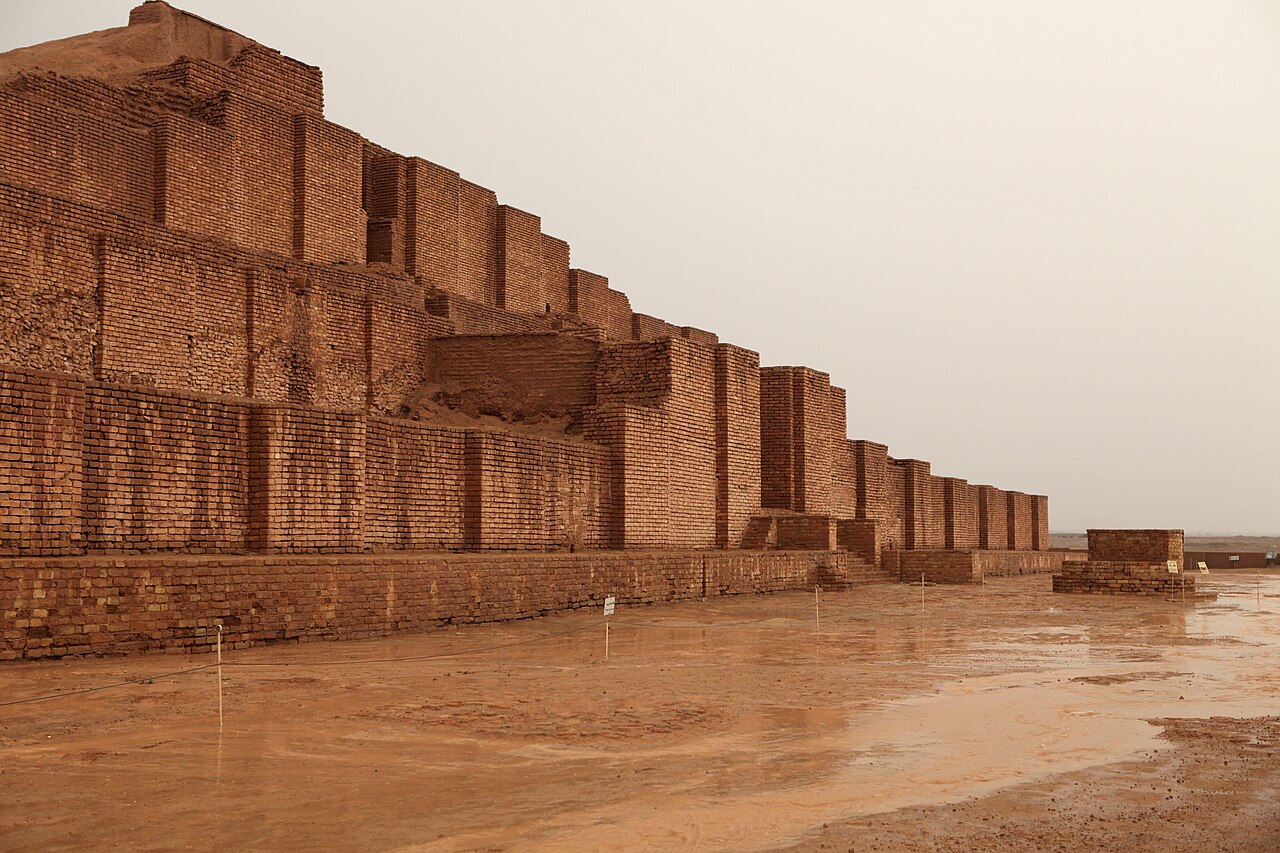
Chogha Zanbil is the ruined religious city of Al-Untash-Napirisha in Khuzestan, built by the Elamite king Untash-Napirisha in the fourteenth or thirteenth century BCE, conventionally around 1250 BCE. Its ziggurat is the best-preserved anywhere, and in 1979 it became the first site in Iran inscribed on UNESCO’s World Heritage List.

| Persian name | چغازنبیل (Choghâ Zanbil, “basket mound”) |
|---|---|
| Ancient name | Al-Untash-Napirisha, “city of Untash-Napirisha” |
| Built | 14th or 13th century BCE, conventionally c. 1250 BCE |
| Location | About 30 km south-east of Susa, near the Dez river, Khuzestan |
| Ziggurat | Base about 105 m square; estimated original height about 53 m; today about 25 m |
| Gods | Inshushinak and Napirisha, with temples for many others |
| UNESCO | Tchogha Zanbil, inscribed 1979 |
A king’s new holy city
Untash-Napirisha ruled Elam at a time of peace and prosperity, during the Middle Elamite kingdom. Rather than simply enlarge the temples of Susa, he chose open ground on a plateau above the Dez river and laid out an entirely new city. Its name, Al-Untash-Napirisha, tied it to himself and to Napirisha, the great god of the highlands.
The city was planned as three nested enclosures. The outer wall, roughly a kilometre across on its long side, enclosed a large area with royal buildings, including a palace complex and underground tombs near the east gate. A middle wall surrounded a ring of temples to other gods. The inner wall enclosed the ziggurat itself, set on a paved court. Brick inscriptions mention twenty-two temples, and about half of them have been found.
How the ziggurat was built
Mesopotamian ziggurats were usually built like stacked cakes, each stage resting on the one below. Roman Ghirshman, who excavated the site, concluded that Chogha Zanbil was built differently. It seems to have begun as a square courtyard temple dedicated to Inshushinak. Later, the king’s builders filled the courtyard and raised a series of nested towers, with each level rising from ground level inside the one around it. The result looked like a ziggurat from outside, five storeys high, with a small temple on top.
The core was mud brick, and the outer faces were baked brick, much more durable. At intervals the builders set bricks stamped or inscribed in Elamite cuneiform with the king’s dedication, so that the walls themselves carried his message. More than 5,000 inscribed bricks have been counted, most in Elamite and a few dozen in Akkadian. A typical text says the king built the temple in baked brick and gave it to the god.
The decoration included glazed bricks and glazed terracotta knobs in the walls, and glazed figures of bulls and winged creatures guarded the stairways. Excavators also found pieces of glass, among the oldest in Iran.
Water for a new city
A city on a dry plateau needed water. Excavators identified a canal that brought water from the Karkheh river some distance away, and a brick reservoir near the outer wall. How the system worked in detail is debated, but it shows how much engineering went into the project.
Abandonment and destruction
The city never grew into a real town. After Untash-Napirisha’s death, building seems to have slowed, though some construction continued. Some archaeologists believe the site was largely abandoned by the end of the Middle Elamite period, around 1100 BCE. The city was then wrecked, or at least looted, during the Assyrian campaigns that culminated in Ashurbanipal’s sack of Susa around 646 BCE (see the Neo-Elamite period).
Sand and erosion then buried the lower levels of the ziggurat, which is one reason they are so well preserved. Local people knew the mound as Chogha Zanbil, “basket mound”, from its shape, said to look like an upturned basket.
Rediscovery
In 1935 a geologist surveying the area for the Anglo-Persian Oil Company noticed inscribed bricks on the mound and passed some to the French archaeologists working at Susa. The inscriptions named Untash-Napirisha (then read Untash-Gal). Roland de Mecquenem dug trial trenches in the late 1930s. The main excavation was led by Roman Ghirshman, who worked there in six seasons between 1951 and 1962 and uncovered the ziggurat, the temples, the walls and the royal tombs. Iranian and German teams have studied the site again since 1999.
Protection and conservation
UNESCO listed Chogha Zanbil in 1979, the same year as Persepolis and Naqsh-e Jahan Square in Isfahan. Its baked bricks have stood up remarkably well for over 3,000 years, but rain, heat and salts in the soil erode the faces, and occasional floods are a threat. Iranian and international teams have run conservation programmes since the late 1990s, replacing damaged bricks and improving drainage.
Why it matters
Chogha Zanbil is the most impressive surviving building of Elam and one of the very few ziggurats whose upper storeys still stand. It shows the ambition of a Middle Elamite king, his attempt to bring the gods of lowland and highland together in one sacred place, and the skill of Elamite builders. Its inscribed bricks are also an important source for the Elamite language, discussed on the page about Elamite language and writing.
For travel information, see the visitor page Chogha Zanbil and the guide to Shushtar’s historical hydraulic system, another UNESCO site in Khuzestan.
Persian words from this page
| چغا | choghâ | mound, hill (in local dialect) |
| زنبیل | zanbil | basket |
| زیگورات | zigurât | ziggurat |
| آجر | âjor | baked brick |
| خشت | khesht | mud brick |
| معبد | ma’bad | temple |
| دیوار | divâr | wall |
Sources and further reading
- Ghirshman, R., Tchoga Zanbil (Dur-Untash), vol. 1: La Ziggurat, Mémoires de la Délégation archéologique en Iran 39, Paris, 1966.
- UNESCO World Heritage Centre, “Tchogha Zanbil” (whc.unesco.org/en/list/113).
- Potts, D. T., The Archaeology of Elam, 2nd ed., Cambridge University Press, 2016.
- Mofidi-Nasrabadi, B., Archäologische Ausgrabungen und Untersuchungen in Čoġā Zanbil, Münster, 2007.
Want to learn Persian? Get the free Starter Pack
Get the 14-page printable Starter Pack (all 32 letters, a 7-day reading plan, 100 core words and 20 survival phrases) and a short 5-email course. Free.
More in Early Iran and Elam (c. 3200–700 BCE)
- Prehistoric Iran: The First Villages of the Iranian Plateau
- Proto-Elamite Civilization and the First Writing in Iran
- The Jiroft Culture and the Halil Rud Treasures
- Shahr-e Sukhteh: The Burnt City of Sistan
- Elam: Iran’s First Great Kingdom
- The Middle Elamite Kingdom and Untash-Napirisha
- The Neo-Elamite Period and the Assyrian Sack of Susa
- Susa: 6,000 Years of an Ancient City
- Chogha Zanbil Ziggurat
- Elamite Language and Writing
- The Arrival of the Iranian Peoples
- The Mannaeans, Urartu and North-West Iran
- Marlik and the Gilan Hill Cultures
- The Luristan Bronzes
- Zoroaster and the Avesta