Elamite was the language of ancient Elam in south-western Iran, written for about 2,000 years, from the late third millennium BCE to the Persian Empire. It is a language isolate with no proven relatives. It was written in three scripts: the still undeciphered Proto-Elamite, Linear Elamite, whose decipherment was published in 2022, and a version of Mesopotamian cuneiform, which scholars have been able to read since the nineteenth century.
| Attested | c. 2250 BCE to c. 330 BCE (in cuneiform) |
|---|---|
| Region | Khuzestan and Fars, and the Persian administration across the empire |
| Family | Language isolate |
| Scripts | Proto-Elamite (c. 3100–2900 BCE), Linear Elamite (c. 2300–1880 BCE), Elamite cuneiform |
| Key texts | Treaty of Naram-Sin, Chogha Zanbil bricks, Behistun inscription, Persepolis tablets |
A language without relatives
Elamite is not Indo-European like Persian, nor Semitic like Akkadian and Arabic, nor related to Sumerian. Linguists call it an isolate. The best-known attempt to link it to another family is the Elamo-Dravidian hypothesis, proposed by David McAlpin in the 1970s, which compares Elamite with the Dravidian languages of southern India such as Tamil and Brahui. It has attracted interest but has not convinced most specialists.
What we know of its structure comes mainly from royal inscriptions and administrative tablets. Elamite added suffixes to word stems to build meaning, and it marked nouns and verbs for person. For example, a noun referring to a third person singular often carried the ending -r, one referring to several people -p, while a different set of endings, such as -me, was used for things and abstract ideas. These endings also linked words together in a phrase. The Elamite word for king is usually read sunki, and the people called their land Haltamti.
Much remains uncertain, because the surviving texts are limited in type and the language changed over two thousand years. Scholars divide it into Old, Middle, Neo- and Achaemenid Elamite.
Proto-Elamite: the first script
The oldest writing found in Iran, used around 3100–2900 BCE at Susa, Anshan and other sites, is called Proto-Elamite. It records accounts and has not been deciphered; it is not even certain that its language was Elamite. It is covered on the page about Proto-Elamite civilization.
Linear Elamite and its decipherment
Linear Elamite is a separate script, made of geometric signs, used in southern Iran between about 2300 and 1880 BCE. A little over forty inscriptions are known. Some were set up at Susa by King Puzur-Inshushinak in the twenty-second century BCE, including a stone “table” carved with a lion that carries the same dedication in Akkadian cuneiform and in Linear Elamite. Others are on silver beakers said to come from Fars, near Anshan.
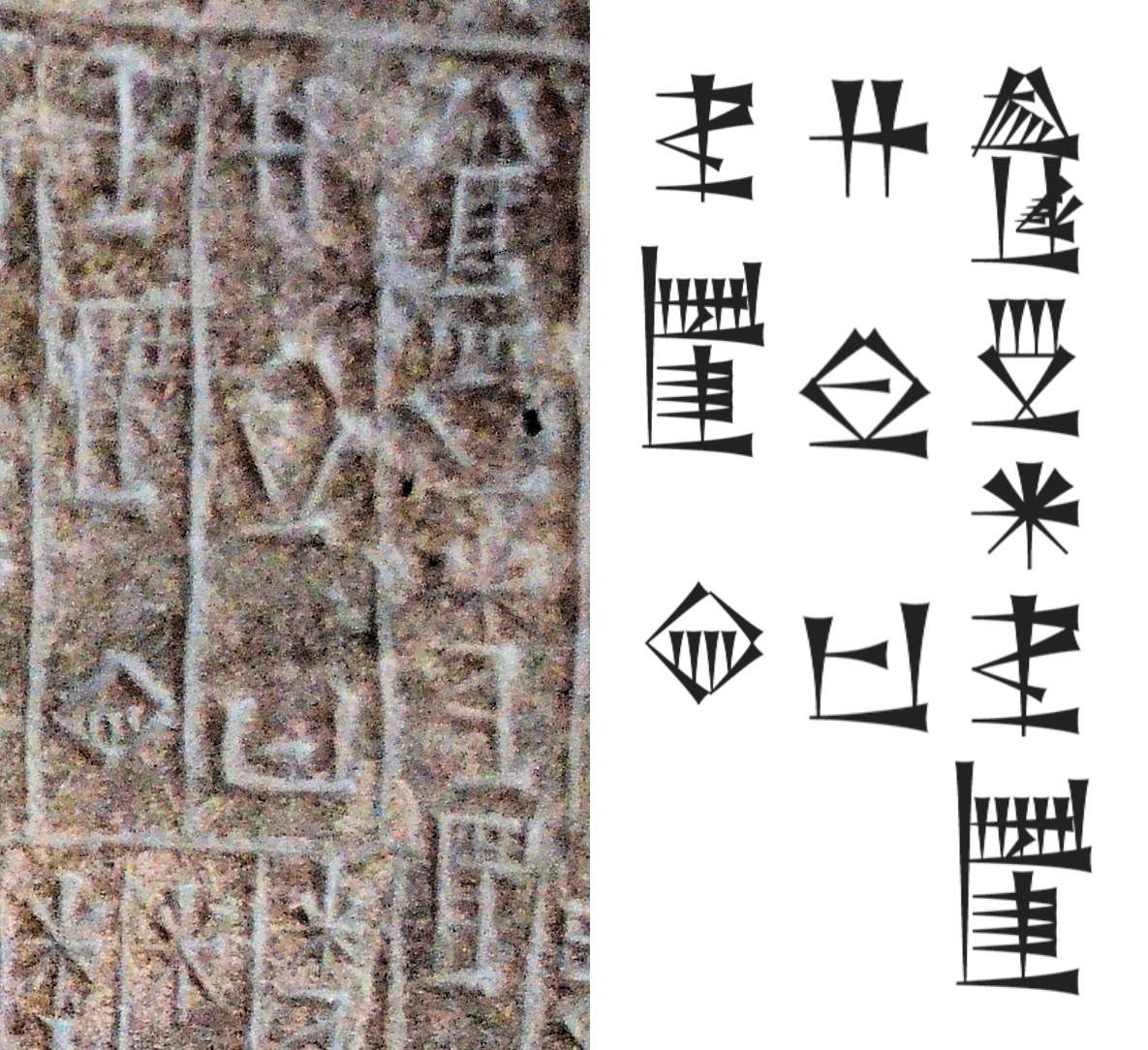

For a century, scholars such as Ferdinand Bork, Carl Frank, Walther Hinz and Piero Meriggi tried to read it, with limited success. The breakthrough came from François Desset, who from 2017 identified royal names such as Shilhaha and Eparti on the silver beakers and so fixed more sign values. In 2022 Desset, Kambiz Tabibzadeh, Matthieu Kervran, Gian Pietro Basello and Gianni Marchesi published “The Decipherment of Linear Elamite Writing” in the Zeitschrift für Assyriologie. They showed that Linear Elamite is mostly phonetic, with signs for syllables and vowels, and that it writes the Elamite language.
The decipherment has been widely welcomed, though parts of it are still debated. Some scholars have questioned relying on silver vessels that came through the antiquities market without a recorded findspot. And since Elamite grammar and vocabulary are imperfectly known, reading the signs does not always mean understanding the text.
A few inscriptions in a related geometric style from Konar Sandal near Jiroft are also being studied in this light (see the Jiroft culture).
Elamite cuneiform
From the time of the Akkadian empire, Elamite scribes also borrowed Mesopotamian cuneiform to write their language. One of the earliest examples is a treaty between Naram-Sin of Akkad and an Elamite ruler, around 2250 BCE, which lists Elamite gods as witnesses. For several centuries after that, most texts at Susa were in Akkadian, the international language.
In the Middle Elamite period, kings switched more and more to Elamite for their royal inscriptions. The thousands of inscribed bricks of Chogha Zanbil are a classic example. Over time Elamite scribes simplified the script, using fewer signs than in Babylonia.
Elamite in the Persian Empire
The Persians, who took over Elam’s highland around Anshan, kept Elamite as a working language. Darius I’s great inscription at Behistun has versions in Old Persian, Babylonian and Elamite, and the same three languages appear on many royal inscriptions at Persepolis and Susa.
More striking still is everyday use. The Persepolis Fortification tablets, dated about 509 to 493 BCE, and the later Treasury tablets record rations for workers, travel permits, herds and grain stores. The great majority are in Elamite, and they are among the richest sources for daily life in the empire. Read more about them on the page about the Persepolis Fortification and Treasury tablets.
After the fall of the Achaemenids, written Elamite disappears. Medieval Arab geographers mention a language called Khuzi spoken in Khuzestan, and some historians have wondered whether it descended from Elamite, but there is no evidence to decide.
How Elamite cuneiform was deciphered
The key was the Achaemenid trilingual inscriptions. Once Old Persian had been worked out, scholars could compare the parallel Elamite column, then often called “Susian” or “Median”. The Danish scholar Niels Ludvig Westergaard made the first systematic study in 1844, and the British scholar Edwin Norris published the Elamite version of Behistun in 1855, based on copies made by Henry Rawlinson. The Behistun inscription was to Elamite what the Rosetta Stone was to Egyptian.
Persian words from this page
| زبان | zabân | language |
| خط میخی | khatt-e mikhi | cuneiform (“nail script”) |
| کتیبه | katibe | inscription |
| رمزگشایی | ramzgoshâyi | decipherment |
| بیستون | Bisotun | Behistun |
| عیلامی | eylâmi | Elamite |
Sources and further reading
- Desset, F., Tabibzadeh, K., Kervran, M., Basello, G. P. and Marchesi, G., “The Decipherment of Linear Elamite Writing”, Zeitschrift für Assyriologie und Vorderasiatische Archäologie 112 (2022), pp. 11–60.
- Stolper, M. W., “Elamite”, in R. D. Woodard (ed.), The Cambridge Encyclopedia of the World’s Ancient Languages, Cambridge University Press, 2004.
- Khačikjan, M., The Elamite Language, Rome, 1998.
- Potts, D. T., The Archaeology of Elam, 2nd ed., Cambridge University Press, 2016.
- Darius I, Behistun inscription (Elamite version), translated in A. Kuhrt, The Persian Empire: A Corpus of Sources, Routledge, 2007.
Want to learn Persian? Get the free Starter Pack
Get the 14-page printable Starter Pack (all 32 letters, a 7-day reading plan, 100 core words and 20 survival phrases) and a short 5-email course. Free.
More in Early Iran and Elam (c. 3200–700 BCE)
- Prehistoric Iran: The First Villages of the Iranian Plateau
- Proto-Elamite Civilization and the First Writing in Iran
- The Jiroft Culture and the Halil Rud Treasures
- Shahr-e Sukhteh: The Burnt City of Sistan
- Elam: Iran’s First Great Kingdom
- The Middle Elamite Kingdom and Untash-Napirisha
- The Neo-Elamite Period and the Assyrian Sack of Susa
- Susa: 6,000 Years of an Ancient City
- Chogha Zanbil Ziggurat
- Elamite Language and Writing
- The Arrival of the Iranian Peoples
- The Mannaeans, Urartu and North-West Iran
- Marlik and the Gilan Hill Cultures
- The Luristan Bronzes
- Zoroaster and the Avesta