The Middle Elamite kingdom (c. 1500–1100 BCE) was the classic age of Elam, when kings ruling from Susa and Anshan built the ziggurat of Chogha Zanbil, wrote their inscriptions in their own language, and at the end of the period raided Babylon and carried its greatest monuments home. Its best-known kings are Untash-Napirisha, the builder, and Shutruk-Nahhunte, the conqueror.
| Date | c. 1500–1100 BCE |
|---|---|
| Dynasties | Kidinuids, Igihalkids, Shutrukids |
| Capitals and royal cities | Susa, Anshan, Kabnak (Haft Tappeh), Al-Untash-Napirisha (Chogha Zanbil) |
| Famous kings | Tepti-ahar, Untash-Napirisha, Shutruk-Nahhunte, Shilhak-Inshushinak |
| Ended | Invasion by Nebuchadnezzar I of Babylon, c. 1100 BCE |
A new beginning at Haft Tappeh
After the age of the sukkalmah regents faded in the sixteenth century BCE, Elam drops almost out of the record. When it returns, a new line of kings, the Kidinuids, holds the lowlands. One of them, Tepti-ahar, built a royal centre at Kabnak, the modern mounds of Haft Tappeh (“seven mounds”) about 15 kilometres south-east of Susa. Iranian excavations led by Ezatollah Negahban from 1965 uncovered a large temple and funerary complex there, with vaulted brick tombs holding many skeletons, and an archive of tablets. Links with the Kassite kings of Babylon help date him to around 1400 BCE.
The Kidinuids still used Akkadian, the international language of the time, for most of their writing. That would change under the next dynasty.
The Igihalkids and Untash-Napirisha
From about 1400 BCE the family of Igi-halki ruled Elam. They married into the Kassite royal house of Babylon, and a later Babylonian letter lists several such marriages. This was a time of peace and building.
The most famous Igihalkid king is Untash-Napirisha, whose reign is placed by different scholars in the mid-fourteenth or the thirteenth century BCE. He founded an entirely new religious city about 30 kilometres south-east of Susa, which he named Al-Untash-Napirisha, “city of Untash-Napirisha”. At its centre he raised a ziggurat for Inshushinak and Napirisha, today called Chogha Zanbil, together with temples for many other gods of lowland and highland. Bringing so many cults together in one place may have been a way of binding the two halves of the kingdom to the crown.
Untash-Napirisha’s inscriptions, stamped on thousands of bricks, are written in Elamite cuneiform. Middle Elamite kings increasingly used their own language for royal texts, a sign of confidence and of a distinct Elamite identity.
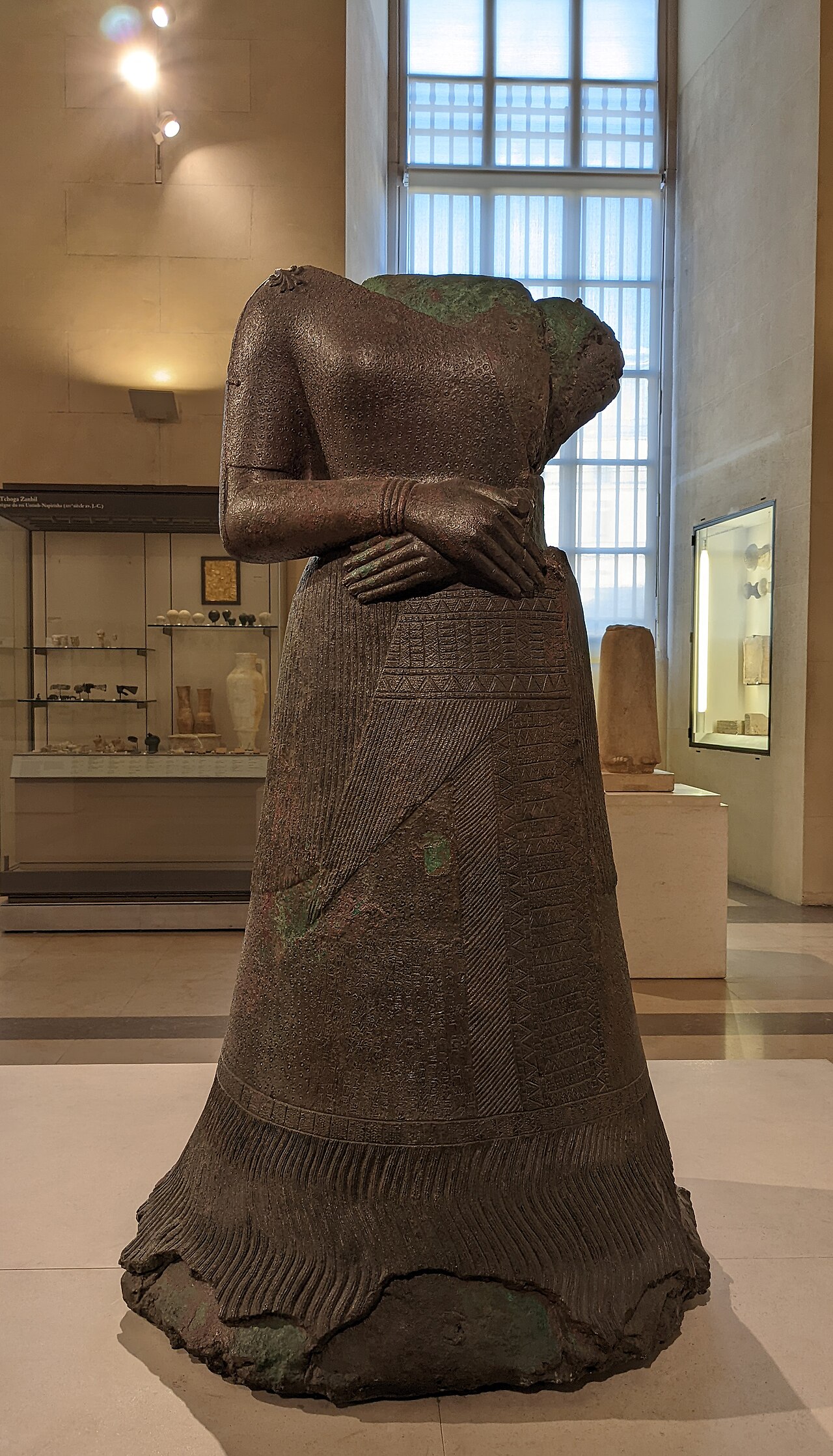

Queen Napir-Asu
One of the masterpieces of ancient metalwork comes from this reign: a life-size bronze statue of Untash-Napirisha’s wife, Napir-Asu, found at Susa in 1903 and now in the Louvre. It weighs about 1,750 kilograms because its core was filled with solid metal. The head is lost, but the robe is covered in fine engraved detail. The inscription on the skirt asks the gods to punish anyone who damages or removes the statue.
Raids into Mesopotamia
Peace with Babylon did not last. In the late thirteenth century King Kidin-Hutran attacked Babylonian cities, including Nippur and Der, at a time when the Assyrian king Tukulti-Ninurta I was also campaigning there. Elam’s eastern neighbour had become a western threat.
The new Shutrukid dynasty went much further. Around 1158 BCE Shutruk-Nahhunte invaded Babylonia with a large army, took Sippar, Kish and other cities, and installed his son Kutir-Nahhunte as ruler. Within a few years the Kassite dynasty, which had ruled Babylon for over four centuries, came to an end, and Kutir-Nahhunte carried the statue of Marduk, Babylon’s chief god, off to Elam.
The plunder of Susa’s museum
Shutruk-Nahhunte also brought back monuments already a thousand years old and set them up at Susa as trophies, among them:
- the victory stele of Naram-Sin of Akkad, on which he carved his own inscription claiming it,
- the great basalt stele of Hammurabi’s laws, from which a few columns of text were erased, perhaps to make room for an Elamite text that was never added,
- statues and an obelisk of the Akkadian king Manishtushu.
That is why French excavators found these Mesopotamian treasures at Susa around 1900, and why they are in the Louvre today. The story of their discovery is on the page about Susa.
Shilhak-Inshushinak, the builder king
Shutruk-Nahhunte’s second son, Shilhak-Inshushinak, ruled for perhaps 30 years in the mid-twelfth century BCE. He campaigned up the Diyala valley and into the lands east of the Tigris, and he left more building inscriptions than any other Elamite king, recording temples restored all over the kingdom. A façade of moulded baked bricks from his temple to Inshushinak at Susa, showing a bull-man and a goddess beside a palm tree, can be seen in the Louvre.
Nebuchadnezzar I and the end of the kingdom
Babylon recovered under a new dynasty. Around 1110 BCE its king Nebuchadnezzar I marched into Elam in the heat of summer, defeated the Elamite king Hutelutush-Inshushinak near the Ulai river, and brought the statue of Marduk home in triumph. Babylonian texts celebrated the event for centuries. Hutelutush-Inshushinak seems to have withdrawn to Anshan, where a building with his inscriptions was excavated at Tal-e Malyan, and after him the Middle Elamite kingdom fades from view.
The next three centuries are almost silent. Elam’s story picks up again in the Neo-Elamite period. For the kingdom as a whole, see Elam: Iran’s first great kingdom.
- c. 1400 BCE Tepti-ahar builds at Kabnak (Haft Tappeh)
- 14th or 13th century BCE Untash-Napirisha founds Al-Untash-Napirisha (Chogha Zanbil)
- Late 13th century BCE Kidin-Hutran raids Babylonia
- c. 1158 BCE Shutruk-Nahhunte invades Babylonia
- c. 1155 BCE End of the Kassite dynasty; Marduk statue taken to Elam
- c. 1110 BCE Nebuchadnezzar I defeats Elam and recovers Marduk
Persian words from this page
| هفتتپه | Haft Tappe | Haft Tappeh |
| چغازنبیل | Choghâ Zanbil | Chogha Zanbil |
| زیگورات | zigurât | ziggurat |
| ملکه | malake | queen |
| مجسمه | mojassame | statue |
| بابل | Bâbel | Babylon |
Sources and further reading
- Potts, D. T., The Archaeology of Elam, 2nd ed., Cambridge University Press, 2016, chapters on the Middle Elamite period.
- Carter, E. and Stolper, M. W., Elam: Surveys of Political History and Archaeology, University of California Press, 1984.
- Harper, P. O., Aruz, J. and Tallon, F. (eds), The Royal City of Susa: Ancient Near Eastern Treasures in the Louvre, Metropolitan Museum of Art, 1992.
- Negahban, E. O., Excavations at Haft Tepe, Iran, University Museum, Philadelphia, 1991.
- Encyclopaedia Iranica, “Susa ii. History during the Elamite period” (iranicaonline.org).
Want to learn Persian? Get the free Starter Pack
Get the 14-page printable Starter Pack (all 32 letters, a 7-day reading plan, 100 core words and 20 survival phrases) and a short 5-email course. Free.
More in Early Iran and Elam (c. 3200–700 BCE)
- Prehistoric Iran: The First Villages of the Iranian Plateau
- Proto-Elamite Civilization and the First Writing in Iran
- The Jiroft Culture and the Halil Rud Treasures
- Shahr-e Sukhteh: The Burnt City of Sistan
- Elam: Iran’s First Great Kingdom
- The Middle Elamite Kingdom and Untash-Napirisha
- The Neo-Elamite Period and the Assyrian Sack of Susa
- Susa: 6,000 Years of an Ancient City
- Chogha Zanbil Ziggurat
- Elamite Language and Writing
- The Arrival of the Iranian Peoples
- The Mannaeans, Urartu and North-West Iran
- Marlik and the Gilan Hill Cultures
- The Luristan Bronzes
- Zoroaster and the Avesta