Prehistoric Iran covers the long stretch from the first stone tools on the Iranian plateau to the eve of writing at Susa around 3200 BCE. The Zagros mountains in the west were one of the places where people first cultivated plants and managed herds, from about 11,700 years ago, and the villages that grew up afterwards laid the ground for Elam and every later Iranian state.
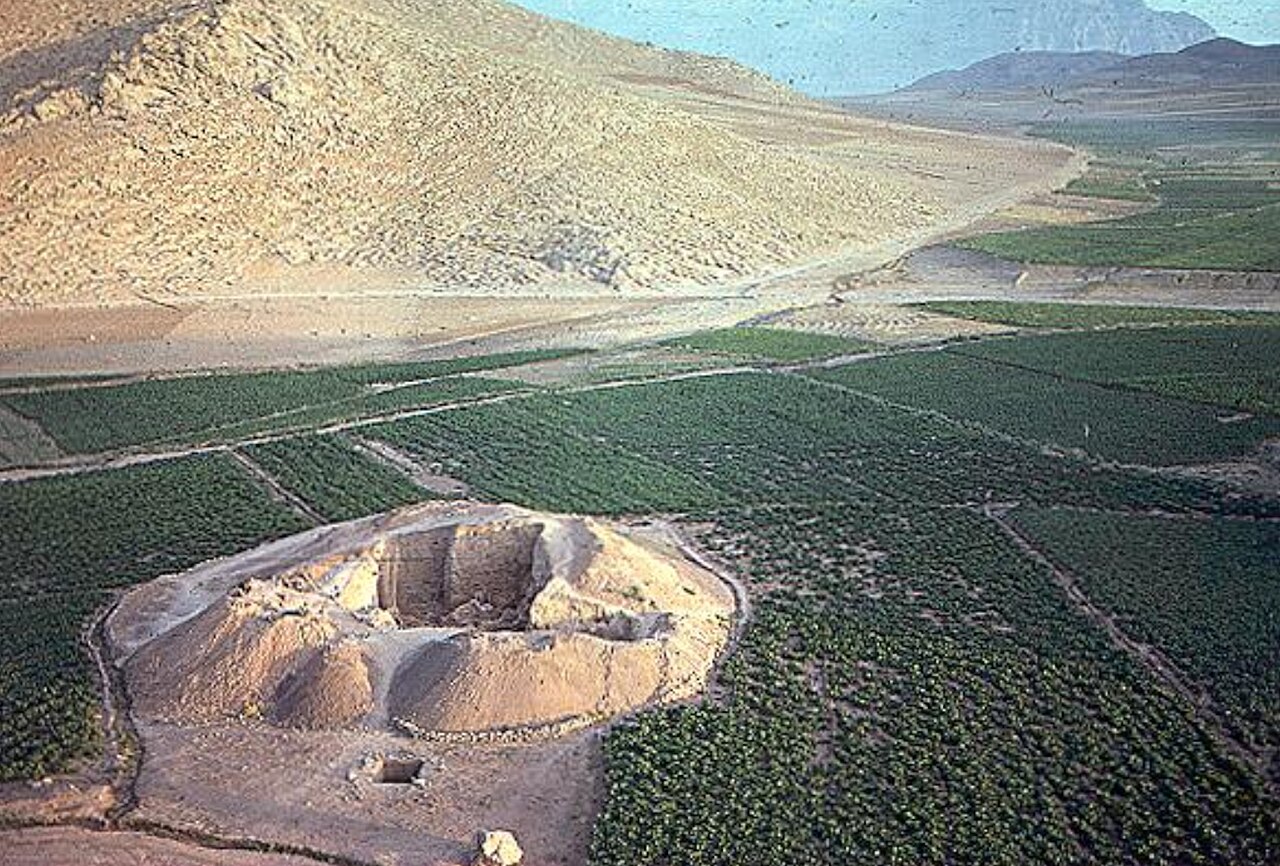

| Period | Palaeolithic to Chalcolithic, before c. 3200 BCE |
|---|---|
| Key regions | Zagros mountains, Khuzestan plain, central plateau, Caspian and Khorasan foothills |
| Key sites | Yafteh and Wezmeh caves, Chogha Golan, Ganj Dareh, Ali Kosh, Hajji Firuz, Tepe Sialk, Chogha Mish |
| Big change | From hunting and gathering to farming villages, c. 10,000–6000 BCE |
Why the Iranian plateau mattered
Iran is a high plateau ringed by mountains: the Zagros run from the north-west down to the Persian Gulf, the Alborz guard the Caspian, and two great salt deserts, the Dasht-e Kavir and the Dasht-e Lut, fill much of the centre. Water decides where people could live. Settlements cluster where streams leave the mountains and spread out over alluvial fans, along the Zagros valleys, and in the lowland plain of Khuzestan, which is really an extension of Mesopotamia.
The western mountains had the wild ancestors of several founding crops and animals: wild barley, wild wheat, lentils, wild goats and sheep. That is the main reason the Zagros sits at the centre of the story of early farming. For an overview of the landscape, see the geography of Iran.
Hunters in the Zagros caves
The oldest traces of people in Iran are stone tools. Finds along the Kashafrud river near Mashhad have been proposed as Lower Palaeolithic, though their age is still argued over. The record is much firmer for the Middle Palaeolithic, when Neanderthals used caves and rock shelters in the central Zagros. A Neanderthal arm bone came from Bisotun cave near Kermanshah, excavated by Carleton Coon in 1949, and a Neanderthal tooth was later identified among the animal bones from Wezmeh cave in the same region.
Modern humans arrived in the Upper Palaeolithic. Yafteh cave near Khorramabad in Lorestan has thick layers of a stone-tool tradition called the Baradostian, with dates reaching back roughly 40,000 years, and shell and bone ornaments that show people decorating themselves. These were mobile groups who followed game such as wild goat, red deer and onager between the valleys and the high pastures.
Chogha Golan and the first cultivation
After the last Ice Age the climate grew warmer and wetter, and in the foothills people began to stay longer in one place. Chogha Golan, a small mound in Ilam province, has given the clearest picture. German and Iranian archaeologists excavated it in 2009 and 2010, and in 2013 Simone Riehl and her colleagues published more than 30,000 charred plant remains from its layers. The deposits span about 11,700 to 9,800 years ago. Wild barley, goat-grass and lentil were gathered and probably sown from the lowest levels, and domesticated emmer wheat appears near the top.
The result mattered because it showed that the eastern edge of the Fertile Crescent was not simply copying farmers in the Levant or Anatolia. Cultivation developed here as well, in parallel.
Ganj Dareh and the first herders
Ganj Dareh, a mound near Harsin in Kermanshah province, was excavated by Philip Smith between 1965 and 1974. Around 10,000 years ago its people lived in small rectilinear buildings of mud and clay, and some of the oldest clay figurines and pots in the region come from the site. Its goat bones are the famous part. In 2000 Melinda Zeder and Brian Hesse showed that the herd structure, with young males culled and females kept to old age, points to managed goats about 9,900 years ago, even though the animals still looked physically wild. Goat herding in the Zagros is among the earliest known anywhere.
Ancient DNA has added a twist. Genomes from Ganj Dareh, published in 2016, showed that these early Zagros farmers were genetically quite distinct from the first farmers of Anatolia. Two separate farming populations grew up at either end of the Fertile Crescent, and the Zagros group contributed ancestry to later peoples across Iran and South Asia.
Villages spread across Iran
Between about 7500 and 5000 BCE farming villages spread from the mountains into every region that could support them.
- Ali Kosh in the Deh Luran plain of Khuzestan, excavated by Frank Hole and Kent Flannery in the 1960s, shows a lowland village moving from gathered wild plants to cultivated cereals and herded goats and sheep.
- Sang-e Chakhmaq near Shahrud carried farming to the north-eastern edge of the plateau.
- Hajji Firuz Tepe south of Lake Urmia produced pottery jars with chemical residues of wine and tree resin, dated to about 5400–5000 BCE, one of the earliest known traces of wine.
- Tepe Sialk outside Kashan, dug by Roman Ghirshman in the 1930s, has a long sequence of painted pottery and early copper working from about the sixth millennium BCE onwards.
- Chogha Mish in Khuzestan and Tall-e Bakun in Fars became large villages with fine painted wares in the fifth millennium.
Painted pottery is the archaeologist’s main clock for this time. Each region had its own styles, with ibexes, birds and geometric bands, and their spread shows contacts between valleys long before any written record.
Copper, towns and the road to writing
In the Chalcolithic, roughly 5000 to 3200 BCE, people learned to smelt copper, and some settlements began to grow into centres that controlled their neighbours. The most important was Susa in Khuzestan, founded around 4200 BCE with a huge mud-brick platform and a cemetery full of thin, elegantly painted beakers. You can follow its story on our page about Susa, the ancient city.
By the late fourth millennium, accounting with clay tokens, seals and numerical tablets had developed at Susa as in Mesopotamia. That led straight to the first writing on the plateau, described on the page about Proto-Elamite civilization.
What we still do not know
Large parts of Iran have barely been surveyed, especially the south-east and the deserts’ edges, and many dates rest on a handful of radiocarbon samples. Older excavations, dug before modern methods, often recorded pottery but not plant or animal remains. New projects since the 2000s, many of them joint Iranian and foreign teams, keep revising the picture, so treat any single “first” with some caution.
Persian words from this page
| غار | ghâr | cave |
| زاگرس | Zâgros | Zagros mountains |
| گنج دره | Ganj Darre | Ganj Dareh |
| کشاورزی | keshâvarzi | farming, agriculture |
| جو | jow | barley |
| گندم | gandom | wheat |
| بز | boz | goat |
Read next: the Bronze Age cities of the east at Shahr-e Sukhteh and Jiroft.
Sources and further reading
- Riehl, S., Zeidi, M. and Conard, N. J., “Emergence of Agriculture in the Foothills of the Zagros Mountains of Iran”, Science 341 (2013).
- Zeder, M. A. and Hesse, B., “The Initial Domestication of Goats (Capra hircus) in the Zagros Mountains 10,000 Years Ago”, Science 287 (2000).
- Broushaki, F. et al., “Early Neolithic genomes from the eastern Fertile Crescent”, Science 353 (2016).
- Potts, D. T., The Archaeology of Elam, 2nd ed., Cambridge University Press, 2016.
- Smith, P. E. L., “An Interim Report on Ganj Dareh Tepe, Iran”, American Journal of Archaeology.
Want to learn Persian? Get the free Starter Pack
Get the 14-page printable Starter Pack (all 32 letters, a 7-day reading plan, 100 core words and 20 survival phrases) and a short 5-email course. Free.
More in Early Iran and Elam (c. 3200–700 BCE)
- Prehistoric Iran: The First Villages of the Iranian Plateau
- Proto-Elamite Civilization and the First Writing in Iran
- The Jiroft Culture and the Halil Rud Treasures
- Shahr-e Sukhteh: The Burnt City of Sistan
- Elam: Iran’s First Great Kingdom
- The Middle Elamite Kingdom and Untash-Napirisha
- The Neo-Elamite Period and the Assyrian Sack of Susa
- Susa: 6,000 Years of an Ancient City
- Chogha Zanbil Ziggurat
- Elamite Language and Writing
- The Arrival of the Iranian Peoples
- The Mannaeans, Urartu and North-West Iran
- Marlik and the Gilan Hill Cultures
- The Luristan Bronzes
- Zoroaster and the Avesta