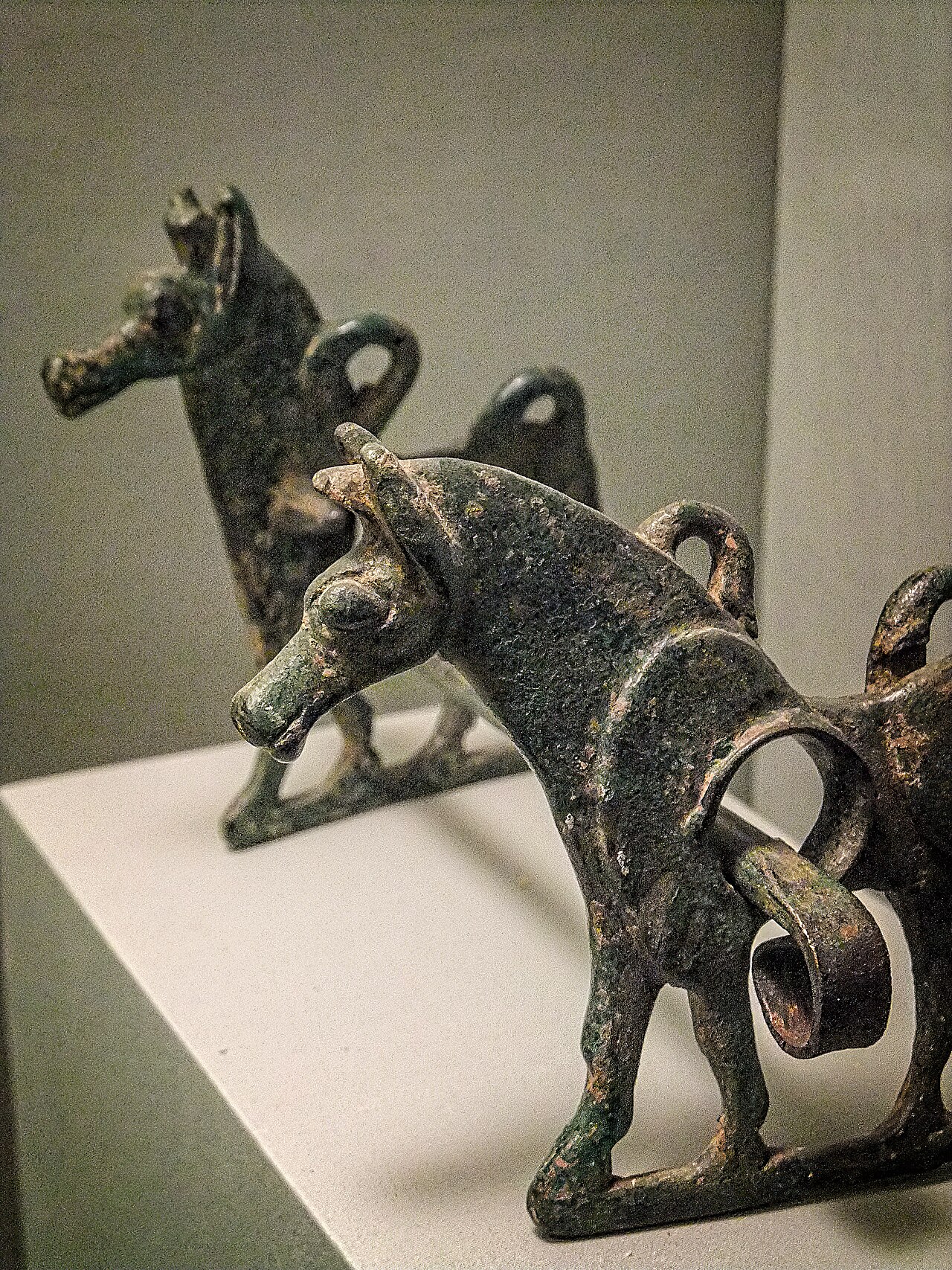
The Luristan bronzes are cast bronze objects from the Zagros mountains of Lorestan in western Iran, mostly horse harness, weapons, pins and ornamental “standards” decorated with stylised animals and fantastic creatures. Most were made in the Early Iron Age, roughly 1300 to 650 BCE. Almost all of the thousands in museums were dug up by looters from the late 1920s onward, which is why their makers and meaning are still uncertain.
| Persian name | مفرغهای لرستان (mefragh-hâ-ye Lorestân) |
|---|---|
| Date | Mainly c. 1300/1250–700/650 BCE, most in the Early Iron Age |
| Region | Lorestan province, including Pish-e Kuh and Posht-e Kuh |
| Typical objects | Horse bits and cheekpieces, finials and standards, axes, daggers, whetstone handles, pins |
| Excavations | Erich Schmidt (1930s), Belgian mission under Louis Vanden Berghe (1965–1979), Clare Goff at Baba Jan (from 1968) |

A flood of bronzes on the market
In the late 1920s, farmers and tribesmen in Lorestan began opening ancient graves on a large scale. Bronzes poured into the bazaars of Kermanshah, Hamadan and Tehran and on to dealers in Paris, London and New York. By the 1930s “Luristan bronzes” were collectors’ items, and nearly every major museum of the Near East bought some. The market demand encouraged still more digging, and forgers soon joined in, casting new pieces in the old style or assembling pastiches from genuine fragments.
The result is a large body of objects with a recognisable style but almost no information about where each was found, what was buried with it, or how old it is.
What the bronzes are
The most characteristic pieces fall into a few groups:
- Horse gear. Bits with large cast cheekpieces in the form of horses, ibexes, winged bulls, or composite monsters, along with rein rings and harness ornaments. They show how important horses and chariots were to the people who made them.
- Finials and standards. Tube-shaped figures, often of a “master of animals” grasping two rearing beasts with long necks, mounted on bottle-shaped stands. Their use is unclear: they may have been cult objects, set up in shrines or graves.
- Weapons. Axes, some with blades emerging from the jaws of a lion or dragon; daggers, swords, maces and arrowheads; decorated quiver plaques.
- Personal objects. Large pins with disc heads decorated in repoussé, bracelets, and handles for whetstones in animal form.
The style is lively and inventive. Animals stretch, curve and merge into one another; heads appear at the ends of handles and blades; human figures have wide eyes and prominent noses. Some motifs echo Mesopotamian and Elamite art, while others seem to be local.
Finding a context: the excavations
Archaeologists tried to recover what the looters had destroyed. Aurel Stein surveyed the region in 1936 without finding the richest graves. Erich Schmidt, working for an American expedition, surveyed valleys of Lorestan from the air and on the ground in the 1930s, and in 1938 spent 17 days at Surkh Dum, where he uncovered a sanctuary full of offerings, including many decorated pins.
The most important programme was the Belgian Archaeological Mission in Iran, directed by Louis Vanden Berghe, which excavated graveyards in Posht-e Kuh every year from 1965 to 1979. Its excavations of Chalcolithic, Bronze Age and Iron Age cemeteries, such as War Kabud, established a chronology for the region and showed which bronze types belonged to which period. Clare Goff of the London Institute of Archaeology excavated the settlement of Baba Jan from 1968; its main levels date to the ninth to seventh centuries BCE.
These excavations showed that metalworking in Lorestan had a long history. Bronze weapons from the third millennium BCE also come from the region, so not every bronze sold as “Luristan” belongs to the classic Iron Age group.
How old are they?
Dates have shifted as evidence improved. Early scholars placed them anywhere from the third millennium BCE to the Achaemenid period. Excavated examples now place the classic bronzes mainly between about 1300/1250 and 700/650 BCE, in the Early Iron Age, with fewer pieces from the later Iron Age. A few objects carry inscriptions of Babylonian or Elamite kings of the late second and early first millennia BCE, probably booty or gifts, which helps anchor the chronology.
Who made them?
This is the hardest question. Over the years the bronzes have been attributed to the Kassites, who ruled Babylon and came from the Zagros; to the Cimmerians, Scythians or Medes; and to Iranian-speaking newcomers in general. None of these theories can be proven. Most of the classic bronzes date before the period of the Scythians and before the Medes are well attested in this region. Assyrian sources mention peoples such as the kingdom of Ellipi in the area in the eighth and seventh centuries BCE, but we know little about the Early Iron Age population when most bronzes were made. The safest view is that they were made by local peoples of the central Zagros, probably semi-nomadic herders and horse-breeders, whose language and name we do not know.
The cost of looting
The Luristan bronzes are one of the classic cases of how the antiquities trade destroys knowledge. Thousands of graves were emptied without record, and the objects became decorative art with no story. Forgeries, some made in the 1930s, are still found in collections. The same problem affects other “named” groups of Iranian antiquities, such as the Amlash finds from Gilan, discussed with Marlik, and the Jiroft vessels.
Lorestan’s main museum is in the Falak-ol-Aflak castle in Khorramabad; see Falak-ol-Aflak Castle and Khorramabad. For north-west Iran in the same period, see the Mannaeans, Urartu and north-west Iran.
Persian words from this page
| لرستان | Lorestân | Lorestan |
| مفرغ | mefragh | bronze |
| اسب | asb | horse |
| تبر | tabar | axe |
| خنجر | khanjar | dagger |
| خرمآباد | Khorramâbâd | Khorramabad |
Sources and further reading
- Encyclopaedia Iranica, “Luristan Bronzes” (iranicaonline.org), including “i. The field research”.
- Muscarella, O. W., Bronze and Iron: Ancient Near Eastern Artifacts in the Metropolitan Museum of Art, Metropolitan Museum of Art, 1988.
- Moorey, P. R. S., Catalogue of the Ancient Persian Bronzes in the Ashmolean Museum, Oxford, 1971.
- Schmidt, E. F., van Loon, M. N. and Curvers, H. H., The Holmes Expeditions to Luristan, Oriental Institute Publications 108, Chicago, 1989.
Want to learn Persian? Get the free Starter Pack
Get the 14-page printable Starter Pack (all 32 letters, a 7-day reading plan, 100 core words and 20 survival phrases) and a short 5-email course. Free.
More in Early Iran and Elam (c. 3200–700 BCE)
- Prehistoric Iran: The First Villages of the Iranian Plateau
- Proto-Elamite Civilization and the First Writing in Iran
- The Jiroft Culture and the Halil Rud Treasures
- Shahr-e Sukhteh: The Burnt City of Sistan
- Elam: Iran’s First Great Kingdom
- The Middle Elamite Kingdom and Untash-Napirisha
- The Neo-Elamite Period and the Assyrian Sack of Susa
- Susa: 6,000 Years of an Ancient City
- Chogha Zanbil Ziggurat
- Elamite Language and Writing
- The Arrival of the Iranian Peoples
- The Mannaeans, Urartu and North-West Iran
- Marlik and the Gilan Hill Cultures
- The Luristan Bronzes
- Zoroaster and the Avesta