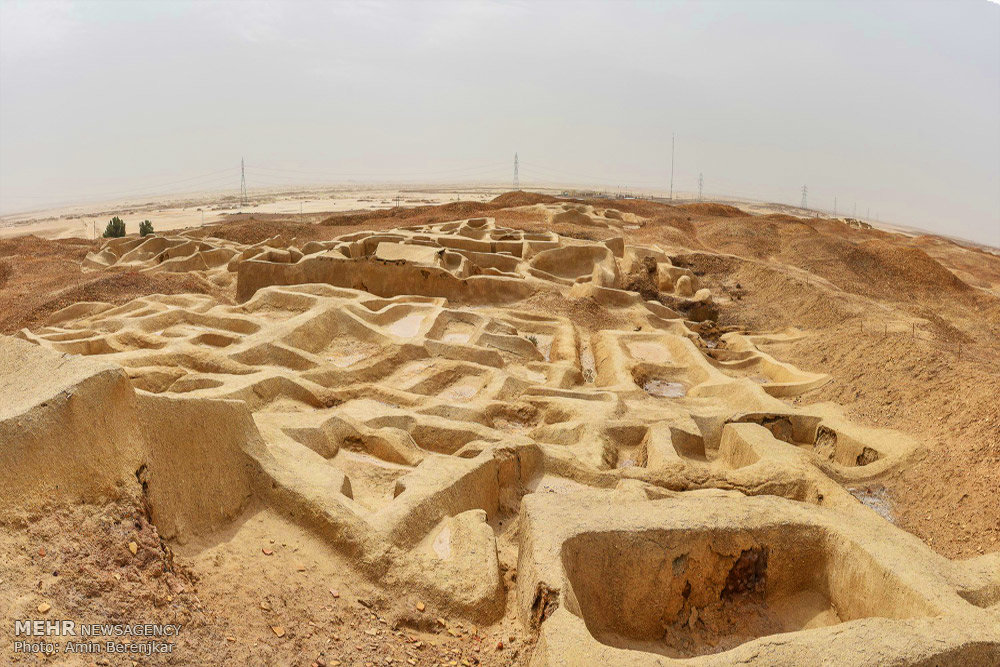
Shahr-e Sukhteh, “the Burnt City”, is a Bronze Age town in Sistan, south-east Iran, inhabited from about 3200 BCE until roughly 1800 BCE. It takes its name from fires that destroyed parts of it, and its dry desert soil has preserved an unusual record of everyday life: textiles, baskets, food, hair and the skeletons of thousands of its people. UNESCO listed it as a World Heritage Site in 2014.
| Persian name | شهر سوخته (Shahr-e Sukhte) |
|---|---|
| Date | c. 3200–1800 BCE, in four main periods |
| Place | Sistan and Baluchestan province, south of Zabol on the Zahedan road |
| Size | About 150 hectares at its largest, including a cemetery of some 25 hectares |
| Excavations | Italian mission under Maurizio Tosi 1967–1978; Iranian teams under Seyyed Mansur Sajjadi from 1997 |
| UNESCO | Shahr-i Sokhta, inscribed 2014 |
A town on the Helmand delta
Sistan today is one of the hottest and windiest parts of Iran, famous for the “wind of 120 days” that blows each summer. Five thousand years ago it was greener. The Helmand river, flowing down from the mountains of Afghanistan, ended in a delta and a chain of lakes and marshes, the Hamun. Reeds, fish, birds and fertile silt made it possible to farm wheat and barley and to keep cattle, sheep and goats.
Shahr-e Sukhteh grew up on a terrace above this delta. In its first period, from about 3200 BCE, it was a settlement of perhaps 10 to 20 hectares. By the middle of the third millennium it had expanded to its largest size, with separate quarters for houses, craft workshops, large public buildings and a vast cemetery. After about 2300 BCE it began to shrink, probably as the river shifted its course and the climate dried, and it was abandoned early in the second millennium BCE.

Who excavated it
The explorer Aurel Stein visited the mound in the early twentieth century. Proper excavation began in 1967 with an Italian team from IsMEO in Rome, led by Maurizio Tosi, which worked there until 1978. After a long pause, an Iranian team directed by Seyyed Mansur Sajjadi resumed work in 1997 and has dug at the site most seasons since, with Italian and other foreign colleagues.
Crafts and trade
The town lived partly by making things. Workshops processed lapis lazuli brought from Badakhshan in north-east Afghanistan, as well as turquoise from Khorasan and carnelian. Craftsmen also worked flint, alabaster, shell from the Persian Gulf, copper and bronze. Pottery was made in large quantities, much of it painted.
Shahr-e Sukhteh sat between several worlds. Its pottery and seals show contacts with southern Turkmenistan and Afghanistan to the north and east, with Baluchistan and the Indus valley to the south-east, and with Proto-Elamite Iran to the west: a Proto-Elamite tablet and seal impressions have been found there. It belonged to the same eastern Iranian Bronze Age world as the Jiroft culture of Kerman.
The most talked-about finds
The artificial eye
In December 2006 excavators found the grave of a woman, unusually tall for her time at about 1.8 metres, who died in her late twenties around 2900–2800 BCE. In her left eye socket lay a small hemisphere about 2.5 centimetres across, made of a light paste, probably bitumen, covered with a thin layer of gold. Lines radiating from a central circle imitate an iris. Tiny holes carried a fine thread, and marks inside the socket suggest she wore it for a long time. The excavators interpret it as the oldest known artificial eye. Some scholars prefer to call it a decorated eye cover, but either way it is a remarkable object.
The “animated” goblet
A painted earthenware cup shows a wild goat and a tree in five scenes around its side. In each scene the goat is in a slightly different position, jumping up to eat the leaves. Turn the cup and the goat seems to move. It is often described as the world’s earliest animation. That is a modern label, but the sequence of poses is clearly deliberate.
A board game
One grave held a rectangular wooden board with 60 small playing pieces. It belongs to the family of race games known from the Royal Cemetery at Ur and from the Indus valley. Iranian media often call it the oldest backgammon, but its rules are unknown and its connection with modern backgammon (تختهنرد) is not proven.
Medicine
The skull of a girl of about 13 shows signs of trepanation, a piece of bone cut out and partly healed over, possibly to treat hydrocephalus. Other skeletons show healed fractures and worn teeth with grooves, which researchers link to people using their teeth to hold fibres while weaving.
Daily life in the Burnt City
Because of the dry soil, archaeologists have recovered things that rot away on most sites. There are fragments of woven wool and goat-hair textiles, baskets and mats of reed, wooden combs and bowls, and seeds of wheat, barley, grapes and melons. Some graves contained food offerings for the dead.
The cemetery is enormous: estimates of the number of graves range from about 25,000 to 40,000, and only a small fraction has been dug. Studies of the skeletons point to a population in which many children died young and adults rarely lived beyond their forties, a normal pattern for the ancient world. Women’s graves are often as rich as men’s, and some of the most elaborate seals and objects came from women’s burials, which suggests women had a role in managing goods.
Why the town burned, and why it ended
The fires that gave the city its name came at different times and may not have been caused by war. In crowded quarters of mud brick and reed roofs, accidental fires spread easily. The end of the town is better explained by changes in the Helmand delta. As the river moved its channels and the lakes shifted, the terrace around Shahr-e Sukhteh lost its water and farmland, and its people moved elsewhere.
Visitors today see low mud-brick walls on a bare terrace, with a small site museum. For the rest of the region, see the page on Zahedan and Sistan and Baluchestan, and for the period as a whole, prehistoric Iran.
Persian words from this page
| شهر سوخته | Shahr-e Sukhte | the Burnt City |
| سیستان | Sistân | Sistan |
| زابل | Zâbol | Zabol |
| هامون | Hâmun | the Hamun lakes |
| چشم | cheshm | eye |
| تختهنرد | takhte-nard | backgammon |
| بز | boz | goat |
Sources and further reading
- UNESCO World Heritage Centre, “Shahr-i Sokhta” (whc.unesco.org/en/list/1456).
- Tosi, M. (ed.), Prehistoric Sistan, IsMEO, Rome, 1983.
- Potts, D. T., The Archaeology of Elam, 2nd ed., Cambridge University Press, 2016 (on eastern contacts).
- Archaeology magazine (Archaeological Institute of America), feature on the burials of Shahr-e Sukhteh, November/December 2011 issue.
Want to learn Persian? Get the free Starter Pack
Get the 14-page printable Starter Pack (all 32 letters, a 7-day reading plan, 100 core words and 20 survival phrases) and a short 5-email course. Free.
More in Early Iran and Elam (c. 3200–700 BCE)
- Prehistoric Iran: The First Villages of the Iranian Plateau
- Proto-Elamite Civilization and the First Writing in Iran
- The Jiroft Culture and the Halil Rud Treasures
- Shahr-e Sukhteh: The Burnt City of Sistan
- Elam: Iran’s First Great Kingdom
- The Middle Elamite Kingdom and Untash-Napirisha
- The Neo-Elamite Period and the Assyrian Sack of Susa
- Susa: 6,000 Years of an Ancient City
- Chogha Zanbil Ziggurat
- Elamite Language and Writing
- The Arrival of the Iranian Peoples
- The Mannaeans, Urartu and North-West Iran
- Marlik and the Gilan Hill Cultures
- The Luristan Bronzes
- Zoroaster and the Avesta