Agha Mohammad Khan Qajar (1742–1797) was the chieftain of the Qajar tribe who reunited Iran after the collapse of Zand rule and founded the Qajar dynasty, which governed the country until 1925. He made Tehran his capital in 1786, defeated the last Zand prince in 1794, and was crowned shah in 1796, only to be murdered by his own servants a year later.
| Born | 1742, Astarabad (today Gorgan) |
|---|---|
| Ruled | c. 1779–1797 as a contender; crowned 1796 |
| Capital | Tehran, from 1786 |
| Died | 17 June 1797, assassinated at Shusha in Karabakh |
| Successor | His nephew Baba Khan, who ruled as Fath-Ali Shah |
| Persian name | آقا محمدخان قاجار |
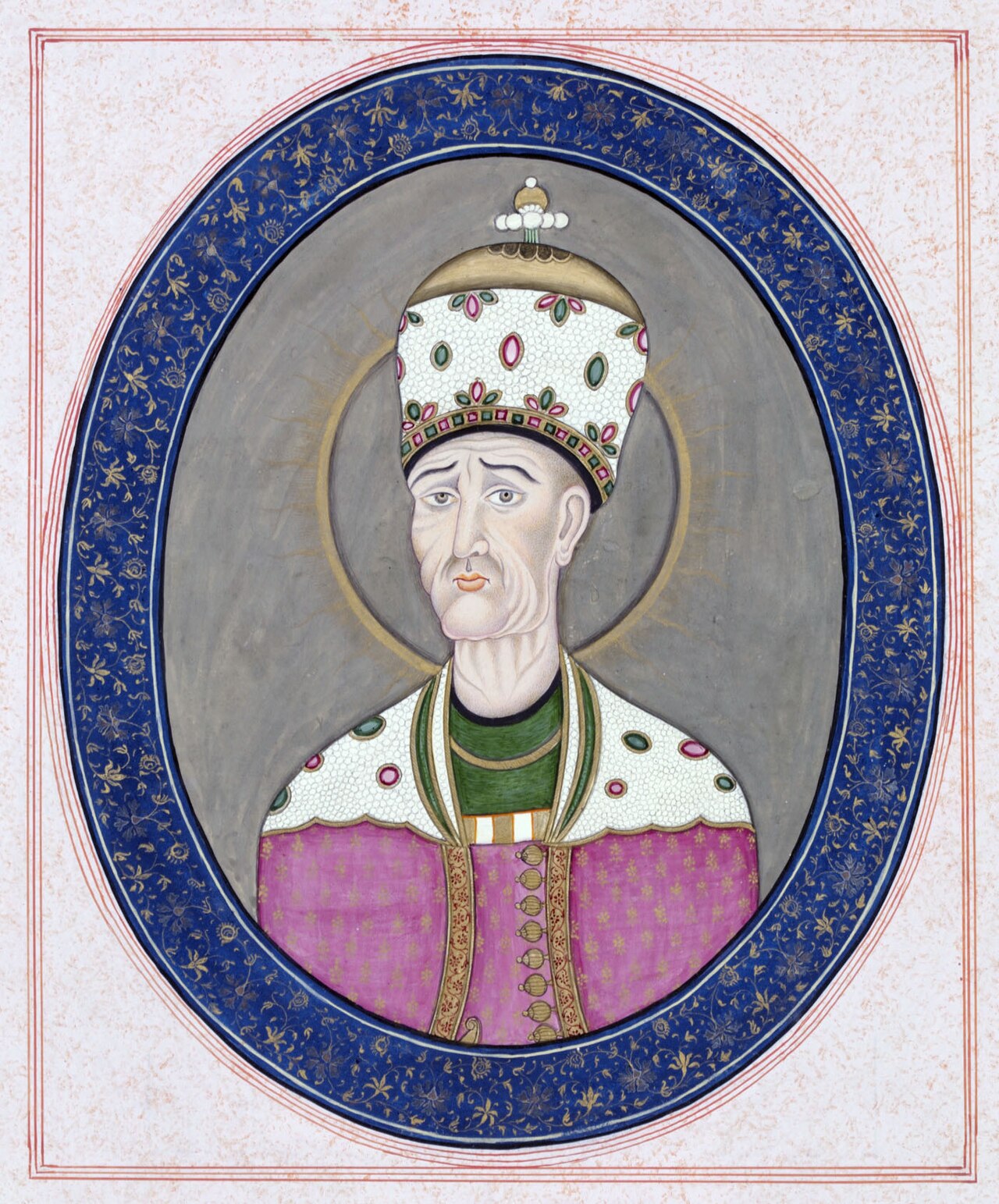

A Qajar boy in the wreck of Nader Shah’s empire
The Qajars were a Turkic-speaking tribe settled since Safavid times around Astarabad, on the south-eastern corner of the Caspian Sea. Agha Mohammad’s father, Mohammad Hasan Khan, led the Qoyunlu branch of the tribe and spent the 1750s fighting the Zands and the Afghan commander Azad Khan for control of northern Iran. He was killed in 1759, and the family’s fortunes collapsed with him.
The defining event of Agha Mohammad’s life had come earlier. As a child of about six he fell into the hands of Adel Shah, Nader Shah’s nephew and short-lived successor, who had him castrated so that he could never found a royal line. The title “Agha”, used for eunuchs of rank, stayed with him for the rest of his life. Contemporaries and later historians, from the Qajar chroniclers to John Malcolm, linked his famous suspicion, avarice and cruelty to this mutilation, though such psychological explanations are guesses.
Sixteen years as a hostage in Shiraz
In 1763 Agha Mohammad was taken to Shiraz as a hostage of Karim Khan Zand, who held the sons of rival chiefs at court to keep their tribes quiet. He lived there for about sixteen years, in honourable but watched captivity. Karim Khan treated him with some respect and is said to have consulted him on affairs of state. Later Qajar tradition adds that the young prince quietly cut the Zand carpets with a knife while sitting in council, a story that may be true or may simply express how he was remembered.
When news of Karim Khan’s death arrived in March 1779, Agha Mohammad slipped out of Shiraz, by most accounts on the pretext of a hunting trip, and rode north to Mazandaran and his tribe.
Winning the north and choosing Tehran
The next fifteen years were spent in a war on several fronts. Agha Mohammad first had to master his own family: his brothers, and the rival Davalu branch of the Qajars, did not accept his leadership easily. He then took Gilan, Mazandaran and the central plateau from Zand governors and local khans.
On 12 March 1786, just before Nowruz, he made Tehran his capital. It was then a modest walled town below the Alborz, but it lay close to the Qajar homelands in the north and to the routes into Azerbaijan and Khorasan, and far from the Zand base at Shiraz. The citadel he used grew, under his successors, into the palace complex known today as the Golestan Palace. Many historians date the dynasty itself to 1789, after the death of Jafar Khan Zand, when Agha Mohammad was the strongest power in Iran but had not yet taken the crown.
Kerman, 1794: the end of the Zands
His most capable opponent was the young Zand prince Lotf Ali Khan, a brave and popular commander who held Shiraz until the defection of its chief magistrate, Hajji Ebrahim Khan Kalantar, in 1791. Lotf Ali Khan fell back on Kerman, and in 1794 Agha Mohammad besieged the city for about four months. When it fell in October, the town was sacked with a cruelty remembered in Kerman to this day.
The figures differ by source. Persian and European accounts speak of thousands of inhabitants blinded on the conqueror’s orders; the number most often repeated is 20,000 eyes, while other sources give 7,000 people. Whatever the exact total, the sack of Kerman became the emblem of his reign. Lotf Ali Khan escaped to Bam, was betrayed, captured, blinded and later killed in Tehran.
Georgia, the crown and Mashhad
With the interior secured, Agha Mohammad turned to the Caucasus, where King Erekle II of Kartli-Kakheti had placed himself under Russian protection by the Treaty of Georgievsk in 1783. In September 1795 his army defeated the Georgians at Krtsanisi and sacked Tiflis, a campaign told on its own page, the Battle of Krtsanisi and the Sack of Tiflis.
In March 1796 he was crowned on the Mughan plain, the same place where Nader Shah had taken the crown sixty years earlier. He is said to have accepted it only after he had reunited the lands of the Safavid state. Shortly afterwards he entered Mashhad, ending the rule of the blind Afsharid Shahrokh, Nader Shah’s grandson. Shahrokh was tortured to reveal the hiding places of Nader’s jewels and died of his injuries at Damghan on the way to Mazandaran.
Murder in a tent at Shusha
A second Caucasus campaign began in 1797, after Russian troops had briefly advanced along the Caspian coast. Agha Mohammad took the fortress of Shusha in Karabakh in June. Three days later, on the night of 17 June 1797, two servants he had condemned to death for a minor offence, but left at liberty until morning, entered his tent and killed him. Accounts name them as Sadegh Gorji and Khodadad Esfahani, with a third accomplice in some versions.
He had prepared the succession with care. His nephew Baba Khan, governor of Fars, reached Tehran first and took the throne as Fath-Ali Shah. The founder was buried at Najaf.
How historians judge him
The Qajar court chronicles present Agha Mohammad as the restorer of order after half a century of civil war. European writers of the nineteenth century, drawing on the same stories, described a ruthless and miserly tyrant. Modern historians such as Gavin Hambly and Abbas Amanat accept both pictures. He was frugal, lived simply in the field and paid his troops reliably, and he left his heir a full treasury and a unified kingdom. He also ruled by fear, and the blindings at Kerman and the massacre at Tiflis were deliberate policy, meant to make resistance unthinkable.
His practical legacy was large: the choice of Tehran as capital, a dynasty that lasted until 1925, and borders in the Caucasus that his successors could not hold against Russia.
- 1742 Born at Astarabad
- c. 1748 Castrated on the orders of Adel Shah
- 1763–1779 Hostage at Karim Khan’s court in Shiraz
- 1786 Makes Tehran his capital
- 1794 Takes Kerman; end of Zand rule
- 1795 Battle of Krtsanisi and sack of Tiflis
- 1796 Crowned on the Mughan plain; takes Mashhad
- 1797 Assassinated at Shusha
Persian words from this page
| قاجار | Qâjâr | Qajar, the tribe and dynasty |
| تهران | Tehrân | Tehran |
| استرآباد | Astarâbâd | Astarabad, old name of Gorgan |
| کرمان | Kermân | Kerman |
| خواجه | khâje | eunuch |
| تاج | tâj | crown |
Sources and further reading
- Gavin R. G. Hambly, “Āghā Muhammad Khān and the establishment of the Qājār dynasty”, in The Cambridge History of Iran, vol. 7 (1991).
- Encyclopaedia Iranica, “Āqā Moḥammad Khan Qājār”.
- Abbas Amanat, Iran: A Modern History (Yale, 2017), chapter 4.
- Hasan-e Fasa’i, Farsnama-ye Naseri, translated by Heribert Busse as History of Persia under Qajar Rule (1972).
- John Malcolm, The History of Persia, vol. 2 (1815).
Want to learn Persian? Get the free Starter Pack
Get the 14-page printable Starter Pack (all 32 letters, a 7-day reading plan, 100 core words and 20 survival phrases) and a short 5-email course. Free.
More in The Qajar Dynasty (1789–1925)
- Agha Mohammad Khan Qajar
- The Battle of Krtsanisi and Sack of Tiflis (1795)
- Fath-Ali Shah Qajar
- The Qajar Court and Harem
- The Russo-Persian War of 1804–1813
- The Battle of Aslanduz (1812)
- The Treaty of Golestan (1813)
- Abbas Mirza and the First Reforms
- The Russo-Persian War of 1826–1828
- The Treaty of Turkmenchay (1828)
- The Death of Griboyedov (1829)
- Mohammad Shah and the Siege of Herat
- The Bab and the Babi Movement
- Tahirih (Qurrat al-Ayn)
- Naser al-Din Shah Qajar
- Amir Kabir
- Dar al-Funun: Iran’s First Modern School
- The Anglo-Persian War (1856–1857)
- How Iran Lost Herat
- The Great Persian Famine of 1870–1872
- The Reuter Concession (1872)
- Naser al-Din Shah’s Journeys to Europe
- The Tobacco Protest (1891–1892)
- Mirza Malkam Khan and Early Reformers
- The Assassination of Naser al-Din Shah (1896)
- Photography in Qajar Iran
- Mozaffar ad-Din Shah
- Taj al-Saltaneh
- The D’Arcy Concession and the Discovery of Oil (1908)
- The Persian Constitutional Revolution (1905–1911)
- The First Majlis and the Constitution of 1906
- The Anglo-Russian Convention of 1907
- Mohammad Ali Shah and the Bombardment of the Majlis
- The Siege of Tabriz and Sattar Khan
- The Constitutionalists Take Tehran (1909)
- The Bakhtiari and the Revolution
- Morgan Shuster and the Russian Ultimatum (1911)
- Women in the Constitutional Revolution
- Iran in the First World War
- The Persian Famine of 1917–1919
- Mirza Kuchik Khan and the Jangali Movement
- The Anglo-Persian Agreement of 1919
- The 1921 Coup: Reza Khan and Seyyed Zia
- The End of the Qajar Dynasty (1925)
- Qajar Art, Photography and Society